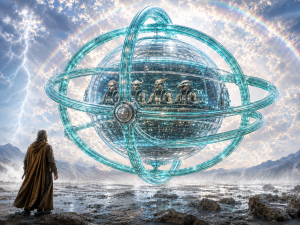
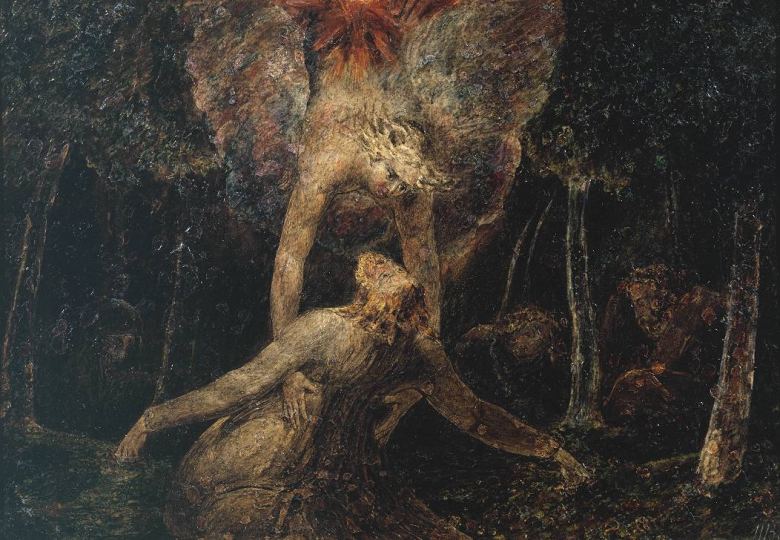
For now we see through a glass, darkly; but then face to face. — 1 Corinthians 13:12
I do not claim to know. When I say I “believe,” I mean I hold a working hypothesis — a map that seems to fit the terrain as I see it now, but which I am prepared to redraw if better evidence or insight comes along.
What follows is my current map. It is the product of years of reflection on religion, history, and personal experience. It may be completely wrong, but it will do for now.
1. The Damage of Imposed Religion
Many in my generation grew up under the shadow of compulsory religion. Faith was not offered; it was imposed. We were told what to believe, often with the warning that doubt itself was dangerous — not just morally, but eternally.
I do not think I am alone in saying that this left its mark. Some accepted the doctrines without question. Others rejected them outright. Many, like me, carried questions that would not go away: Who was Jesus? and Who am I?
I parted company with religion in my late teens, largely revolted by the idea that I was to worship a God who considered me “not worthy so much as to gather the crumbs under his table” (Matthew 15:27). That was an intolerable act of submission — one I could not accept. For years after, religion was of little concern to me.
Over time, however, life’s experiences began to nudge me toward a more reflective and spiritual outlook, even if I would not have called it that at the time. Such shifts are rarely sudden. Looking back, I see that ideas almost never arrive fully formed. There is often a surface logic — the reasons we can explain — and a deeper logic that works silently over years, perhaps decades. By the time a conviction reaches expression, it is already the product of countless influences and unconscious processes. In that sense, our thinking is led less by deliberate choice — the machinations of the mind — than by what Pascal called “the heart’s reasons, of which reason knows nothing”, and what scripture calls “the desires of our own heart” (Psalm 37:4). Our actions are ultimately shaped by a deeper logic — a kind of logos — of which we are only dimly aware.
Such processes often work unnoticed until something brings them into focus — and even then, we can never be fully aware of them. Not even AI can lay them bare. What AI does is allow us to examine issues more deeply and more accurately, bringing to light information and perspectives we might otherwise have missed. But it is still the unconscious mind that quietly does the synthesising, gradually reshaping our outlook and causing a shift in perspective.
2. Christianity as a Power Construction
The more I read, the more I became convinced that “orthodox Christianity” was not the inevitable outcome of Jesus’ teaching, but the result of deliberate choices made by the early Church.
From small, scattered communities, Christianity grew into a centralised institution: the Roman Catholic Church. It claimed the authority to define truth, to set doctrine, and to declare which beliefs were heretical.
This was not merely a religious development. It shaped European civilisation — its laws, its politics, its social hierarchies — often to preserve the Church’s own power. Councils like Nicaea (AD 325) and Chalcedon (AD 451) fixed creeds that drew boundaries around acceptable thought. Those who disagreed were silenced, exiled, or worse.
The Gospel of Thomas, one of the Nag Hammadi texts, offers a very different emphasis: “The kingdom is inside you and it is outside you. When you know yourselves, then you will be known, and you will understand that you are children of the living Father” (Saying 3).
In another saying, Jesus tells his followers: “Split a piece of wood, and I am there. Lift up the stone, and you will find me there” (Saying 77). That, to me, speaks of a consciousness that is not about attachment to one historical figure, but about a felt connection to the whole of creation.
3. Paul and the Doctrines
A great deal of what people now think of as “the Christian faith” comes not from Jesus but from Paul. His letters — 13 of them in the New Testament, though some are disputed in authorship — introduced ideas that are central to later orthodoxy: original sin, salvation through faith in Christ’s death, Jesus as the atoning sacrifice for human guilt, the claim that he was the Son of God, and — reinforced by the Gospel of John — that he existed with God before the beginning of creation.
Paul’s theology was personal and passionate, but it was also shaped by the religious environment of his time. Elements of gnosticism, mystery cults, and Hellenistic philosophy can be traced in his language. The dramatic “Damascus road” conversion was clearly a profound psychological event — one that gave him a powerful personal narrative and marked a decisive turning point in his life. Whatever its precise nature, it was from this moment that the phoenix of orthodox Christianity emerged, placing Paul — who had never met Jesus in person (Galatians 1:11–12; 1 Corinthians 15:8) — in a position to reinterpret Jesus’ life and death according to his own understanding, an understanding that would, in time, come to define the whole of Western civilisation.
4. Who I Think Jesus Was
I think Jesus was a moral teacher and a radical, but also a man of his time. He carried an urgency rooted in the belief that God would soon intervene to end Roman rule and establish a just order. Like many in first-century Judea, he expected the apocalypse in his own lifetime. That it never came suggests that Jesus, like all of us, was subject to the expectations and influences of his time — a human being shaped by the currents of indoctrination and suggestion.
He could be irreverent, even mocking, toward the God of Israel as commonly understood. His so-called “triumphal entry” into Jerusalem (Mark 11:1–11) drew on the image in Zechariah 9:9 of a king arriving on a donkey, but it stood in contrast to the popular expectation of a militant, kingly messiah who would overthrow Rome. Whether intended as fulfilment or parody, it subverted the hopes of those looking for a leader in the mould of David or the Maccabees.
In his teaching, he openly contradicted traditional ideas attributed to Yahweh, as in “Love your enemies” (Matthew 5:43–45), which rejects the old ethic of divine-sanctioned vengeance, and “The Sabbath was made for man, not man for the Sabbath” (Mark 2:27–28), which places human need above a law given in God’s own name. When he quoted Hosea — “I desire mercy, not sacrifice” (Matthew 9:13) — he was dismissing the very temple rituals that Yahweh had commanded in the Torah.
His so-called “cleansing of the temple” (Mark 11:15–17) was more than a protest against corruption; it was a symbolic disruption of the system of worship itself, casting doubt on the legitimacy of the whole enterprise.
His “triumphal entry” may also have been a way of saying: I am not the kind of messiah you think you’re getting. That irony may help explain why the crowd chose to release Barabbas, a criminal, instead of him when Pilate offered the choice.
Yet, despite his failings, Jesus passed down perhaps the most important message humanity has ever received: that the “kingdom of heaven” is not the property of rulers or priests, but a reality within each person — accessible through self-knowledge, compassion, and integrity of life.
5. Jesus’ Message as Inner Transformation
If we set aside Paul for a moment and look at the three Synoptic Gospels — Matthew, Mark, and Luke — a different picture emerges. Here, the “kingdom of heaven” is not primarily about the afterlife. It is a reality to be found now, within: “The kingdom of God is within you” (Luke 17:21).
In modern terms, this could be understood as self-trust, self-confidence, or what Carl Jung called individuation: the process of becoming whole, integrating all parts of oneself into a balanced and authentic self. As Jung put it, “Individuation means becoming one’s own self… becoming an ‘in-dividual,’ and, in so far as individuality embraces our innermost, last, and incomparable uniqueness, it also implies becoming one’s own selfhood or self-realization.”
In this sense, the kind of awareness Jesus pointed to was not merely intellectual assent to certain doctrines, but a felt, lived connection to life itself. It is more like a felt awareness — a deep, lived connection to life itself. If Descartes could say, “I think, therefore I am,” this understanding might add: “I feel, therefore I am.”
This inner work is gradual, incomplete, and often clouded: “For now we see through a glass, darkly; but then face to face: now I know in part; but then shall I know even as also I am known” (1 Corinthians 13:12).
6. Why This Matters Now
In a world facing political division, environmental crisis, and rising inequality, talk of an “inner kingdom” may sound like an escape. I think it is the opposite. Without inner clarity, we are easily swayed by fear, anger, and manipulation. Without self-understanding, we reproduce the same destructive patterns we inherited.
The Gospel of Thomas has a saying that captures the urgency: “If you bring forth what is within you, what you have will save you. If you do not have that within you, what you do not have within you will kill you” (Saying 70).
If more people lived by this understanding — that the kingdom of heaven is here, now, within — we might build a society less bound by fear and greed. Whether or not this view is “right” in an ultimate sense is less important than whether it helps us live better lives together.
A Provisional Creed
I do not claim to know. I hold a working hypothesis:
- Jesus’ truest message was about the kingdom within — an inner transformation available to all.
- Orthodox Christianity was shaped by the early Church to preserve its own authority.
- Paul’s theology shifted the focus from transformation to dogma.
- Our understanding of the kingdom will always be partial — for now we see through a glass, darkly.
If this way of seeing things spreads, we may yet have a future worth sharing.
As Jesus said: “My yoke is easy, and my burden is light” (Matthew 11:30).