From the Arab Spring to Today
Introduction
Europe’s difficulties with immigration are deeply rooted in a legal framework created more than seventy years ago. The 1951 Geneva Convention on Refugees, drafted in the aftermath of the Second World War, guaranteed protection to anyone fleeing persecution. Crucially, the system was designed so that an asylum seeker was “illegal” only for a matter of minutes: the moment they declared persecution, they gained the legal right to stay while their claim was assessed.
The 1967 Protocol widened these protections, removing the original limits so that the right of asylum applied everywhere and indefinitely. Later agreements, such as the Schengen Treaty (1985/1990) and the Dublin Convention (1990), reinforced this framework, all built on the assumption that refugee numbers would remain relatively modest.
That assumption no longer holds. Wars, instability, and poverty in the Middle East, North Africa, and Sub-Saharan Africa have produced mass flows of people on a scale never envisaged in the 1950s. The result is that Europe’s problem today is not primarily illegal immigration. It is the overwhelming number of asylum-seekers, most of whom acquire legal status almost instantly on arrival under international law.
This legal inheritance—progressive in its day but shaped by very different circumstances—now constrains Europe’s ability to respond. The public perception is of a tacit agreement among leaders to do nothing, leaving the system to drift. One example of this hidden dynamic is the 2024 Pact on Migration and Asylum, a major EU reform package agreed in principle but given little public attention. The Pact set out new rules for screening, asylum procedures, and burden-sharing between member states. Yet because support for it was uneven, and its details highly technical, it passed with muted publicity. Leaders avoided championing it loudly, perhaps fearing criticism from both left and right, while much of the media preferred to focus on the drama of small boats and border flashpoints. The result is that few citizens are even aware that such reforms exist, reinforcing the perception of political inertia.
At the same time, it is important to remember that the Geneva Convention and its successors remain a cornerstone of humanitarian law. They have saved countless lives and continue to provide vital protection to those with genuine claims of persecution. The challenge today is not whether asylum should exist, but how Europe can uphold that principle while adapting its laws to present realities. Reforming the framework would not mean abandoning humanitarian obligations, but rather updating the rules so that asylum remains credible, workable, and fair in an age of mass migration. But here lies the danger: the law moves so slowly that it risks being outpaced by public opinion. If there is no visible sign of change soon, citizens may conclude that governments are incapable of action, with unpredictable consequences for democratic stability.
1. A Turning Point: The Arab Spring
The Arab Spring of 2010–2011 was hailed at the time as a wave of democratic uprisings. In practice, it left behind instability, civil war, and state collapse — in Syria, Libya, Yemen, and beyond. The consequences for Europe were immediate and lasting. Millions were displaced, and the continent faced the largest mass movement of people since the Second World War.
Western powers, far from being passive observers, played a role in creating the crisis.
Libya
NATO’s intervention in Libya, supported by the US, Britain, and France, hastened the fall of Muammar Gaddafi. His regime was brutal — most starkly shown by the 1996 Abu Salim prison massacre, where more than 1,000 inmates were killed, and by decades of repression, torture, and disappearances documented by Amnesty International and Human Rights Watch.
Yet Gaddafi’s rule was also a paradox. During his early years, oil wealth fuelled free education, healthcare, and a standard of living among the highest in Africa. I myself lived in Libya between 1970 and 1972, teaching English. At that time, I did not witness the atrocities that later scarred his reputation. What I saw was a country undergoing rapid transformation, where my presence as a foreign teacher was welcomed, and where there was a sense of national pride in progress.
That contrast helps explain why Gaddafi’s fall divided opinion. For many Libyans he was a tyrant, for others a provider of stability. With no plan for what came next, his violent death left a vacuum. Libya collapsed into chaos, becoming a hub for smuggling and mass migration across the Mediterranean.
Syria
If Libya’s collapse opened a smuggling corridor across the Mediterranean, Syria’s civil war produced one of the greatest refugee crises in modern history. Protests in 2011 were met with violent repression by Bashar al-Assad’s government. The regime’s record of torture, arbitrary detention, and indiscriminate bombardment of civilian areas has been well documented by the UN and human rights organisations. By 2020, more than 5.5 million Syrians had fled abroad and a further 6 million were displaced within the country.
Yet, as in Libya, the picture is complex. Many Syrians, especially from religious minorities and urban middle classes, continued to see Assad as the lesser evil compared with jihadist groups that gained power in rebel-held areas. For them, the regime’s brutality was weighed against the fear of living under ISIS or al-Qaeda affiliates.
The West also played its part. The United States, Britain, and France supported rebel factions, while Russia and Iran backed Assad. The war became a proxy conflict, prolonging the violence and delaying any chance of settlement. Europe was left to deal with the humanitarian fallout: more than a million Syrians sought asylum in EU states between 2011 and 2017, with Germany taking by far the largest share.
2. Immigration Pressures in Europe
The refugee flows after 2011 reshaped immigration patterns across Europe. Countries responded differently:
- Germany under Angela Merkel opened its doors in 2015 with the phrase “Wir schaffen das” (“We can manage this”), eventually granting asylum or residency to over a million Syrians, Afghans, and Iraqis.
- France took fewer per capita, but carried a longer-term burden due to its colonial history: large North African and West African communities had already settled in French cities, making integration a generational rather than a sudden issue.
- Britain accepted fewer asylum seekers but saw growing numbers of irregular crossings, particularly via the Channel. Here, debate became more heated than the numbers alone would justify.
Asylum Applications 2000–2022
Table 1: Asylum Applications (000s)
| Year | UK | France | Germany |
|---|---|---|---|
| 2000 | 80 | 40 | 90 |
| 2005 | 50 | 65 | 150 |
| 2010 | 25 | 60 | 40 |
| 2013 | 30 | 70 | 200 |
| 2015 | 38 | 75 | 750 |
| 2017 | 41 | 85 | 600 |
| 2022 | 65 | 120 | 220 |
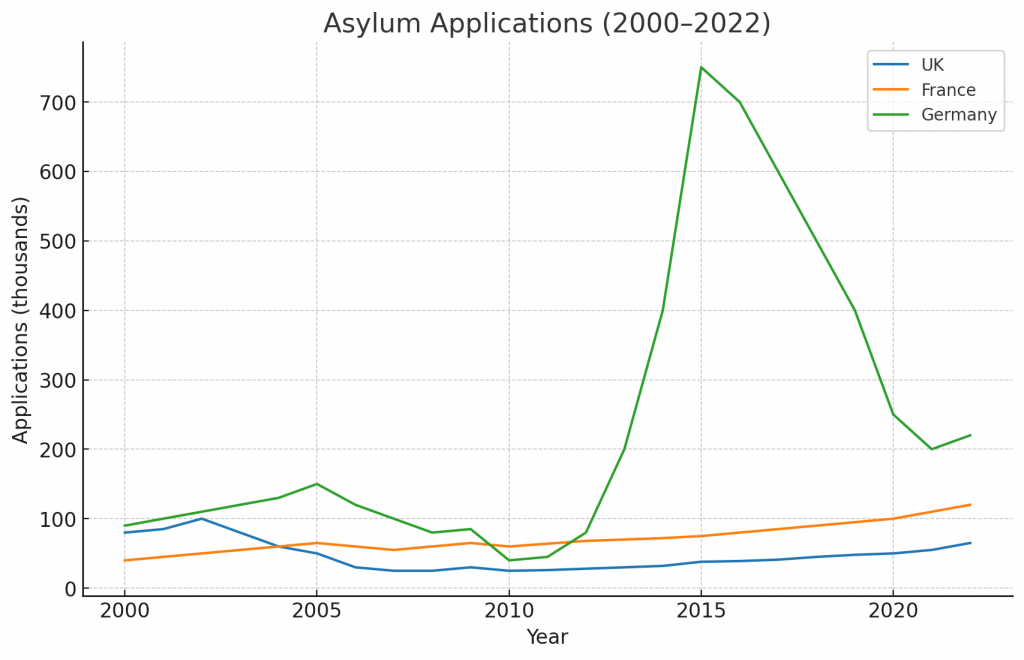
Germany bore the heaviest burden in 2015–16. France remained steady. The UK was far lower, though the political argument was louder.
Population Density
Table 2: Population Density (2022)
| Country | Density (people per km²) |
|---|---|
| UK | 277 |
| France | 122 |
| Germany | 233 |
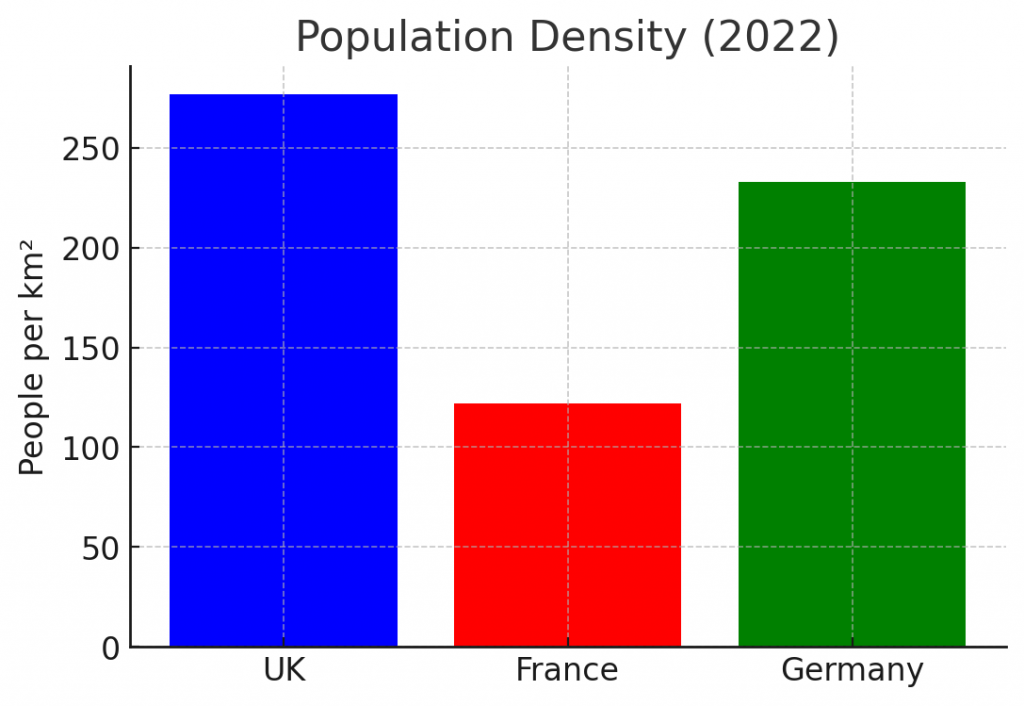
Britain is more crowded than both France and Germany, which makes immigration feel sharper even when absolute numbers are smaller.
Other states — Turkey, Sweden, Spain, Denmark, and Norway — also felt the strain, though in different ways. Turkey became the largest host country of all, sheltering over 3.5 million Syrians, mostly on temporary permits. Sweden took one of the highest per-capita shares in Europe, while Spain absorbed arrivals mainly from North Africa. Denmark and Norway tightened laws sharply to deter asylum claims.
3. Concentration and Integration
Raw numbers alone do not tell the story. Immigrants are rarely spread evenly. In some towns, particularly in northern France or German industrial regions, immigrants make up more than half the local population. Ghettos form where language, culture, and economics cluster.
This is not new. In colonial times, Europeans abroad also kept together in closed communities, dressing differently and insulating themselves against the “foreign” environment. Human psychology does not change: communities group together for protection when they feel threatened.
Yet integration also happens. My own teaching career has placed me in a unique position to observe this — in Libya, Germany, Eastern Europe, India, and Britain. Over decades, I have taught almost exclusively immigrant children in Britain. The pattern is consistent:
- The first generation struggles.
- The second mixes languages and loyalties.
- The third is almost always integrated, provided the host society allows it.
What all families seek, East or West, is the same: security for themselves and their children.
4. Economic and Social Pressures
Immigration places uneven pressure on housing, healthcare, and schools. In the UK, housing shortages are acute. Large developments are built, but they are often “quality homes” aimed at wealthy buyers, not affordable housing for immigrants or the young. This fuels resentment, as immigration is used as an excuse to build, while the beneficiaries are investors.
Healthcare and education systems also strain when population rises faster than investment. Germany invested heavily in language programmes and vocational training for migrants. France, with higher unemployment, struggled more with labour integration. Britain often framed the issue as one of border control rather than planning for integration.
Life Expectancy
Table 3: Life Expectancy (2021)
| Country | Life Expectancy (years) |
|---|---|
| UK | 81 |
| France | 82 |
| Germany | 81 |
The averages are close. What matters is not immigration itself but how social exclusion is managed. Travellers in Britain, for example, live 10–15 years less than average — showing the deeper impact of inequality.
5. Democracy Under Strain
Debates about immigration are often framed as if migration itself were the threat to democracy. In reality, immigration challenges democracy indirectly — through the way people and governments respond to it.
Switzerland, with its referendums, is sometimes cited as the closest form of direct democracy in Europe. Most nations, however, rely on representative government to provide what citizens value most: a comfortable standard of living, security, and the freedoms of an open society. On that level, immigration does not in itself undermine democracy.
The strain comes from reaction. Fear of migration can drive civil unrest — even tipping into violence — when people believe their way of life is under siege. Equally, governments under pressure may repress speech, limit debate, or criminalise dissent in an attempt to maintain order.
This makes immigration a political tool.
- On the Right, it can be used to rally support, with immigration placed at the forefront while other, more extreme policies remain concealed.
- On the Left, it can lead to a different danger: suppressing or sanitising debate in the name of tolerance, edging towards a “1984-style” denial of reality where uncomfortable truths are brushed aside.
Immigration, then, is not the death of democracy — nor is it the “death of Britain,” as some voices on YouTube and elsewhere suggest. What it does is expose the strength or weakness of our democratic culture. A society confident in itself can absorb newcomers, debate openly, and adapt. A society insecure in itself will either erupt in unrest or shut down discussion, both of which undermine democracy more than immigration itself ever could.