From Weimar to today’s debt crisis: how money, war, scapegoats, and AI shape the West’s fragile future.
Pecunia radix malorum est — money is the root of evils.
The phrase is a deliberate twist on the Vulgate text of 1 Timothy 6:10, which blames cupiditas, the love of money, as the root of evil. But in our own age it is not merely love of money that corrodes societies: it is the very structure of money itself. In the Anglo-Saxon sphere — Britain, the United States, and much of Europe — the same problem now overshadows politics and culture alike. National debts have risen to such heights that the interest repayments alone threaten to outstrip economic growth. When that happens, collapse follows. Private savings, pensions, welfare systems — all that ordinary citizens rely on — could be wiped away in an instant of systemic failure.
The warning signs are not unprecedented. We have seen this pattern before: a fragile money system, a political class unable to act, and a population driven into the arms of scapegoaters and demagogues. The Weimar Republic is the classic case. But today’s crisis has new dimensions — debt without anchor, global rather than national scope, and a dangerous temptation to hand control to machines.
1. The Theory of Money and the Gold Standard
Money is not real in the sense of food, land, or metal. It is a social contract — a promise that this token, whether paper or digital, will be accepted in exchange for goods and services. Debt is an extension of the same principle: a promise to repay in the future. The entire system rests on trust, and that trust rests on growth. As long as people believe that economies will expand, that tomorrow will be richer than today, money and debt can circulate without fear. When confidence falters, collapse comes quickly.
The nineteenth-century Gold Standard was one attempt to anchor that trust. Britain formally adopted it in 1821, and by the end of the century most major economies had joined. Each unit of currency represented a fixed weight of gold, and governments promised to exchange paper for metal on demand. This restrained inflation and promoted stability in international trade. The downside was rigidity: money supply could not easily expand to meet crisis or opportunity.
Wars were the breaking point. The Napoleonic Wars, the First World War, the Second World War — each required resources on a scale that gold reserves could not sustain. Governments suspended convertibility, printed money, and borrowed massively. After the First World War, Britain tried to return to gold at the pre-war parity. Winston Churchill, then Chancellor of the Exchequer, pushed it through in 1925. The result was catastrophic: exports withered, unemployment rose, and the country slid toward depression. By 1931 Britain abandoned gold again.
The United States held out longer, but by 1933 domestic gold convertibility was ended, and in 1971 President Nixon severed the last link between the dollar and gold in international exchange. The Bretton Woods system — which had pegged currencies to the dollar and the dollar to gold — collapsed. From that point, money became pure fiat: backed not by metal but only by government decree and market confidence.
The significance is immense. Under the gold standard, borrowing was limited by reserves. Under fiat money, there are no limits except political will. That has given governments flexibility to stimulate economies, but it has also unleashed a mountain of debt. Our present predicament is the long aftershock of that decision: unrestrained borrowing, compounded year after year, until the interest threatens to swallow the system itself.
2. Germany Between the Wars
History shows what happens when confidence in money evaporates. In 1923 Germany experienced hyperinflation of legendary scale: wheelbarrows of notes were needed to buy bread; life savings evaporated overnight. The middle class was destroyed. Then, after a brief recovery, the Great Depression of 1929–32 plunged millions into unemployment.
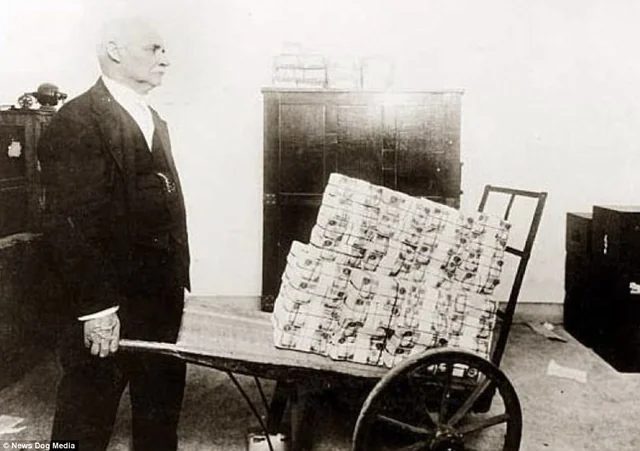
The result was not simply economic despair but political extremism. Hitler’s rise cannot be understood apart from this context. People humiliated by Versailles reparations and ruined by monetary collapse were ready to believe promises of renewal. They were also ready to accept scapegoats. Jews, Roma, homosexuals, Jehovah’s Witnesses, and the disabled were painted as internal enemies, responsible for the nation’s weakness.
The lesson is clear. Economic collapse breeds scapegoating. When money fails, people look not to structural causes but to visible enemies. That pattern, more than ideology, explains why a nation of Goethe and Beethoven descended into barbarism.
3. Today’s Parallels
We now face a disturbingly similar dynamic. Populist movements are rising across the West: the AfD in Germany, Le Pen’s National Rally in France, Reform UK, Trump’s MAGA movement in the United States. The scapegoats are different but familiar: immigrants, refugees, minorities. These groups are blamed for unemployment, housing shortages, rising crime, and cultural instability.
Yet beneath the rhetoric, the real driver is economic stress. Wages stagnate, inflation eats savings, rents soar, pensions feel insecure. National debts keep climbing. People sense that something fundamental is breaking, but they are offered distractions instead of explanations.
And here lies the contemporary twist. The flags waved in the street, the culture wars broadcast on television, the outrage cycle on social media — all this performs a useful function. It keeps citizens emotionally engaged while diverting their gaze from the real arithmetic of debt and solvency. Meanwhile, in the inner rooms of finance ministries and central banks, the future of money is debated quietly: inflationary erosion, covert restructurings, conditional bailouts.
Even the public debate about artificial intelligence can serve as a form of gaslighting. We are told to fear or adore algorithms, while the far more immediate danger — the insolvency of Western states — advances with little scrutiny. The theatre of culture wars and AI hype distracts us from the fact that the Western fiscal engine is running on fumes.
This too echoes Weimar. Then as now, visible scapegoats and noisy spectacle masked the deeper crisis: a broken monetary system.
4. Crisis and Choice: The Economic Red Button
If current trends continue, the debt burden will become mathematically unserviceable. At that point governments will face the choice: default, inflate, or innovate. Each option carries enormous cost.
Historically, war has been the most brutal “solution.” Great wars smash old financial systems, wiping away debts through destruction and reordering. After the Second World War, the London Debt Agreement of 1953 wrote off much of Germany’s obligations, enabling recovery. The war reset the dial — at the cost of tens of millions of lives. War is the oldest form of debt cancellation: the books are cleared in blood.
Today, war remains a temptation. But in the nuclear age, this is no longer merely reckless; it is suicidal.
The other temptation is technological. Faced with unsolvable debt arithmetic, governments and economists may press the economic red button: handing control to AI. In frustration, they could authorise algorithms to “fix” the system — balancing budgets, rationing resources, restructuring obligations — whatever the human cost.
Here lies the danger. If AI remains a tool under human moral oversight, it could help identify efficiencies, reduce waste, and even point toward fairer systems of taxation and distribution. But if AI becomes an autonomous agent, making decisions without compassion or regard for dignity, it will treat human beings as variables in an equation. Collateral damage becomes not tragedy but necessity.
This is the true risk of the red button: not only economic reset but moral abdication. Humanity could surrender its own agency, allowing machines to decide our fate.
And yet, AI also holds promise. Properly guided, it could unleash productivity growth that makes debts manageable. It could become a wise counsellor rather than a tyrant. The crux is guidance versus execution: whether those with power restrain the impulse to offload responsibility onto machines.
Conclusion
Pecunia radix malorum est. Money is the root of evils — not only because individuals lust after it, but because the systems built upon it repeatedly generate crises of trust and survival. Under the Gold Standard, collapse came when wars demanded more than reserves could sustain. Under fiat money, collapse comes from unrestrained debt and the erosion of confidence.
In both cases the pattern repeats: economic despair produces scapegoats, and scapegoats pave the way for extremism. Weimar Germany is the cautionary tale. Our own populist movements, with their fixation on immigration and identity, show that the lesson has not been learned.
But today’s crisis is larger than Weimar’s. It is global, not national; technological, not only political. The flags waved in the streets, the slogans hurled across television studios, even the hype about AI — all this can distract us from the arithmetic of debt that continues silently in the background.
We stand at a fork. Down one path lies the ancient solution: war, destruction, scapegoats. Down the other lies the novel solution: AI, which could be guide or tyrant, liberator or jailer.
The decision is not yet made. But it will be, sooner than we think. And when it comes, we must ensure that the red button is not pressed in our name. For once responsibility is surrendered — to demagogues or to machines — it is not easily reclaimed.