
When Henry VIII severed England’s ties with Rome in the 1530s, the Church of England did not instantly become “Protestant.” Its hierarchy, liturgy, and sacramental life remained recognisably Catholic.
What changed was authority: the King replaced the Pope as Supreme Head. The deeper transformation came a century later, through a single text that gave English Christianity its distinctive voice and conscience — The Book of Common Prayer.
⚜ 1. Origins of the Book of Common Prayer
The first Book of Common Prayer appeared in 1549, compiled under Archbishop Thomas Cranmer for Edward VI. It sought to unify worship throughout the realm by replacing the many Latin service books — Missal, Breviary, Manual, and Pontifical — with a single English liturgy “for the edifying of the people.”
Cranmer’s purpose was pastoral and theological:
- To make the faith intelligible to ordinary worshippers.
- To remove superstitious practices that obscured the Gospel.
- To create a moral and devotional rhythm binding the nation together.
Revised in 1552, suppressed under Mary, and restored in 1662 after the Civil War, the BCP of 1662 remains the doctrinal standard of the Church of England, authorised by the Act of Uniformity.
🕯 2. The Roman Foundations
Despite its Reforming intent, the Book of Common Prayer was built upon the Roman rite. Its sources were chiefly:
| BCP Section | Roman / Sarum Source |
|---|---|
| Collects and Introits | Roman Missal and Breviary |
| Eucharistic Prayer (Canon) | Canon Missae — translated and abbreviated |
| Daily Offices (Matins, Evensong) | Simplified from Matins, Lauds, Vespers, Compline |
| Marriage, Baptism, Burial | The Sarum Manual |
| Ordination Rites | The Pontifical |
The Sarum Use, developed at Salisbury in the 11th–12th centuries, was the English form of the Roman Mass. Cranmer translated much of its structure almost intact: the Collect–Epistle–Gospel pattern, the Preface and Sanctus, the rhythm of confession and absolution.
His reform was one of purification, not destruction — pruning away what Reformers saw as medieval accretions while preserving the liturgical bones of Western Christendom.
✒️ 3. Cranmer’s Distinctive Additions
Where Cranmer innovated, he did so to express the theology of grace and repentance that defined English Protestantism.
- The Prayer of Humble Access – “We do not presume to come to this thy Table, O merciful Lord…”
A uniquely English statement of humility and justification by grace alone. - The General Confession and Absolution – corporate repentance placed at the heart of worship, replacing private auricular confession.
- Communion in Both Kinds – restoring the chalice to the laity as a sign of full participation in Christ’s body and blood.
- English throughout – theology made audible: no longer a mystery performed by the priest, but a shared act of conscience and understanding.
The result was Catholic in form, Protestant in spirit — retaining the shape of the Roman rite while replacing its sacrificial theology with one of memorial and thanksgiving. Elizabeth I could therefore describe herself, without irony, as “a Catholic according to the Prayer Book.”
🕊 4. Marriage in the Book of Common Prayer
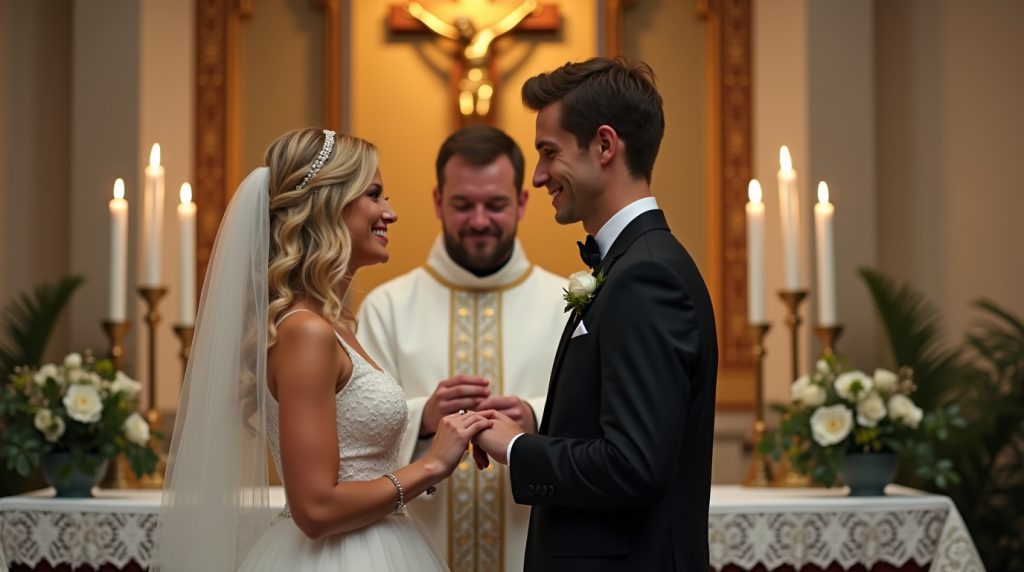
The Solemnization of Matrimony opens with words that still define Anglican teaching:
“Instituted of God in the time of man’s innocency, signifying unto us the mystical union that is betwixt Christ and his Church.”
and lists three causes for which marriage was ordained:
- For the procreation of children,
- For a remedy against sin,
- For the mutual society, help, and comfort that the one ought to have of the other.
Marriage is thus covenantal, heterosexual, and moral in purpose — an institution reflecting divine order rather than private contract.
Because this theology is woven into its very structure, the BCP cannot accommodate same-sex marriage without ceasing to be itself. Its anthropology is binary; its symbolism Christ-and-Church.
This principle endures in Canon B 30:
“The Church of England affirms, according to our Lord’s teaching, that marriage is in its nature a union permanent and lifelong of one man with one woman…”
Clergy may bless same-sex couples pastorally, but no authorised rite of marriage may contradict that definition.
✝️ 5. Ordination and the Question of Women Priests
The Ordering of Priests in the BCP defines ministry in spiritual, not biological, terms:
“Receive the Holy Ghost for the office and work of a Priest in the Church of God… Be to the flock of Christ a shepherd, not a wolf; feed them, not devour them.”
Masculine pronouns reflect the idiom of the age, but no doctrinal statement limits ordination to men. The priest’s role is functional — preaching, teaching, administering the sacraments — and grounded in vocation.
Hence, when the Church of England ordained women in 1994 (and consecrated women bishops in 2014), it did not overturn any article of faith. It simply amended Canon C 4 to include “he or she.”
Scripture itself records women exercising leadership — Priscilla, Phoebe, Junia — and the BCP’s theology of calling is broad enough to admit them.
🕯 6. The Roman Catholic Position
The Roman Catholic Church, by contrast, defines the male priesthood as a matter of sacramental validity, not discipline.
Its position is enshrined in the 1983 Code of Canon Law:
“A baptized male alone (vir) validly receives sacred ordination.”
(*Sacram ordinationem valide recipit solus vir baptizatus.*)
Three major documents make this irreversible:
Ordinatio Sacerdotalis (1994) – Pope John Paul II: “The Church has no authority whatsoever to confer priestly ordination on women and this judgment is to be definitively held by all the Church’s faithful.”
Responsum ad Dubium (2018) – Congregation for the Doctrine of the Faith under Pope Francis: “This teaching has been set forth infallibly by the ordinary and universal Magisterium and is to be held definitively by all the faithful.”
In Catholic doctrine, even the Pope lacks authority to alter this.
The same fixity applies to marriage: Catechism 1601 defines it as the covenant between one man and one woman, for the good of the spouses and the procreation of offspring.
⚖️ 7. Comparing the Two Traditions
| Issue | Church of England | Roman Catholic Church |
|---|---|---|
| Authority Source | Scripture, Tradition, Reason; Synodical law | Scripture, Tradition, Magisterium |
| Women Priests | Permitted (since 1994) | Forbidden (Canon 1024; infallible) |
| Same-Sex Marriage | Prohibited (Canon B 30) | Prohibited (Catechism 1601) |
| Flexibility | Reformable by Synod | Immutable in doctrine |
| Liturgical Root | Reformed Roman rite | Roman rite unaltered |
The two churches began from nearly identical ground.
The Reformation did not create a new religion; it altered the axis of authority.
The Book of Common Prayer became the English Church’s doctrinal engine — Catholic in structure, Reformed in emphasis, moral in tone.
🌿 8. The Enduring Measure of the Prayer Book
Because the BCP grew out of the Roman Missal, it carries the weight of tradition; because it was reshaped by Reformers, it allows conscientious development.
It is, in a sense, the hinge between Rome and Geneva — uniting reverence with reason.
On the two great modern questions:
- It forbids same-sex marriage by its own internal logic of creation and covenant.
- It permits women’s ordination by its silence on gender and its focus on calling.
Thus, it remains both guardian and guide — conserving moral order while leaving space for grace and growth.
📜 9. The Language of the Church: Stability and Change
The question of language lies at the heart of both Anglican and Roman identity.
For centuries, the Latin Mass in the Catholic Church and the Jacobean English of the Book of Common Prayer in the Church of England served as the very sound of the sacred.
Their power lay not in clarity, but in continuity — a linguistic sanctuary untouched by ordinary life.
As spoken English evolved, the BCP’s cadences — “the quick and the dead,” “meet, right, and our bounden duty” — became increasingly remote from everyday speech.
Yet they were retained long after comprehension faded, out of reverence for their rhythm and permanence.
To alter them seemed to threaten the very rock on which the faith stood.
This reverence for archaic language is mirrored in other faiths:
- Hinduism preserves Sanskrit, the timeless language of its scriptures.
- Islam clings to classical Arabic, the tongue of the Qur’an.
- Judaism still reads Biblical Hebrew in the synagogue.
Each tradition treats sacred language as a symbol of eternity — a verbal mirror of the divine.
It resists the erosion of time and the seductions of modernity.
Perhaps the first subtle attack on both the Catholic and Anglican traditions came not through doctrine but through language itself — through the modernisation of worship.
The vernacular reforms of Vatican II, and later the Series 2 and Common Worship liturgies in the Church of England, opened the door to accessibility but also to transience.
Once the language of faith became ordinary, the mystery began to thin.
Both Churches long believed that the eternal Word should be clothed in adamantine language — durable, solemn, and separate.
Modernisation broke that spell.
It invited the modern world in — with all its freedoms, and all its temptations.
Conclusion
The Book of Common Prayer was not a revolution but a translation — a rendering of ancient Catholic worship into the moral vernacular of an English conscience.
Its cadences have shaped national character as much as theology, teaching humility, repentance, and dependence on divine mercy.
Where the Roman Church fixed its doctrine in law, the English Church embedded its theology in language — a subtler, living form of authority.
And that language still resists every attempt, ancient or modern, to turn religion into ideology.
Yet it is not merely the beauty of the language that guards the Church: it is the substance of what it says.
Its theology of sin and grace, its penitential realism, its recognition of human frailty and divine sovereignty — these are irreconcilable with the moral optimism of modern secular culture.
To “reform” the Church in the modern sense would require jettisoning the Prayer Book itself, for within its pages lie doctrines that cannot be reconciled with contemporary relativism: the sinfulness of man, the need for repentance, the divine order of creation, and the absolute moral seriousness of salvation.
And the language itself deepens that resistance.
Its rhythm and archaism act almost as a chant, a kind of sacred hypnosis through which the mind, with its restless reasoning, is suspended in another order of sound — a cosmic resonance that draws the worshipper into the stillness of eternity.
It is not argument but incantation that holds the soul before God.
This is why modern paraphrase feels so thin: it breaks the spell, dissolving the mystery into the chatter of the moment.
For this reason, the Book of Common Prayer stands as a stumbling block to every movement that would secularise or sentimentalise the faith.
You cannot modernise the Church without dismantling the very structure of belief that the Prayer Book articulates.
It is not simply the English of another age — it is the theology of another world, and upon that world the Church of England was built.
To discard it would be to discard the faith itself.
It calls the faithful, in Cranmer’s own spirit, to common prayer — to truth spoken humbly, and grace received gratefully.


Comments
Interesting
Interesting