
On my way to Lidl this morning, I found the road blocked with traffic — a sight so familiar it has become part of modern life. Our towns have turned into car parks with houses built upon them. Older streets, designed for horses and handcarts, now overflow with vehicles. Once, children played safely in quiet roads; today, the same streets are death traps.
The Invention and Spread of the Motorcar
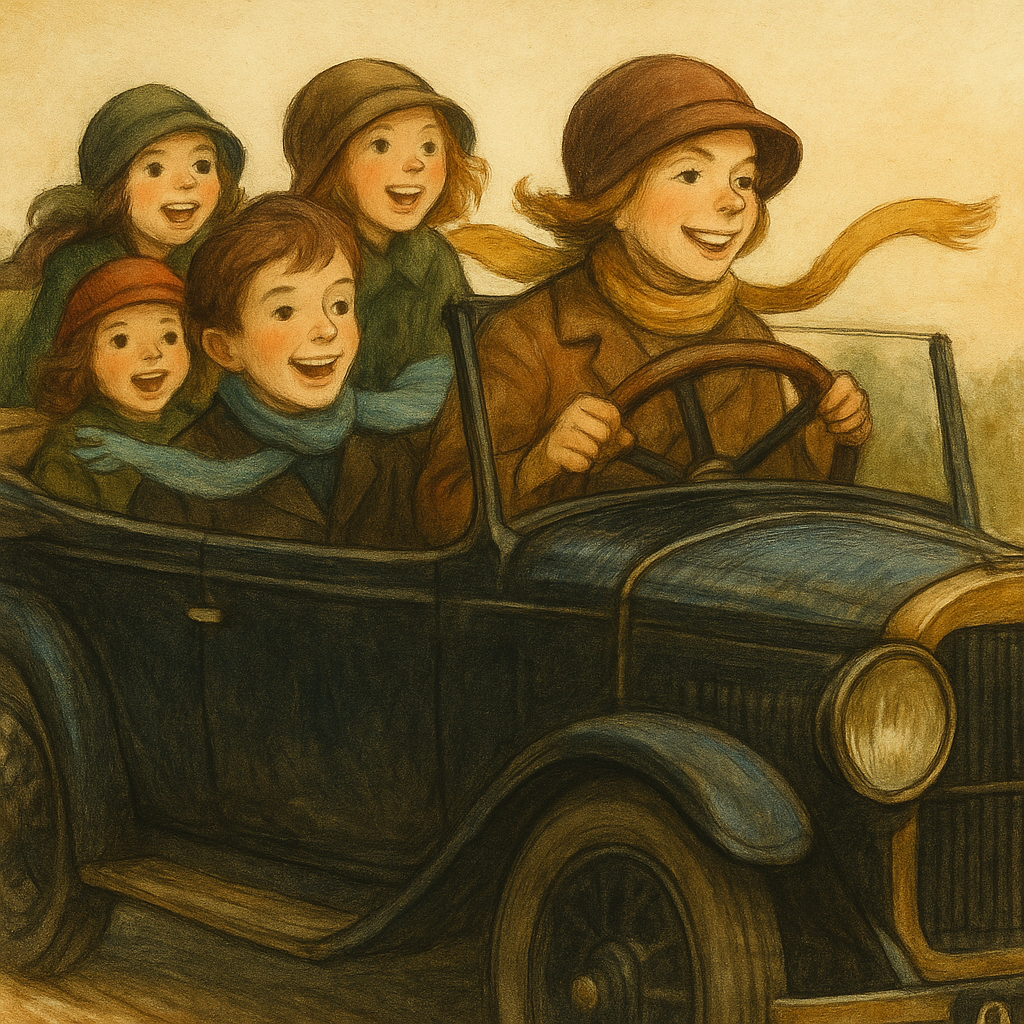
The modern motorcar was born in the late nineteenth century. Karl Benz patented his Motorwagen in 1886, and Henry Ford’s introduction of the Model T in 1908 made cars affordable for the masses. By the 1920s, motoring symbolised progress and personal freedom. Roads were widened, cities re-shaped, and the hum of engines became the soundtrack of modernity.
The glamour and danger of early motoring were embodied in figures like the dancer Isadora Duncan, who in 1927 was tragically strangled when her long silk scarf caught in the wheel of an open car — a haunting symbol of human elegance undone by machinery. The car had become not only a means of transport but an emblem of speed, power, and fatal romance.
The graph below traces the approximate rise in global car sales from 1900 to today — from a few thousand handmade models to over 90 million vehicles produced each year.
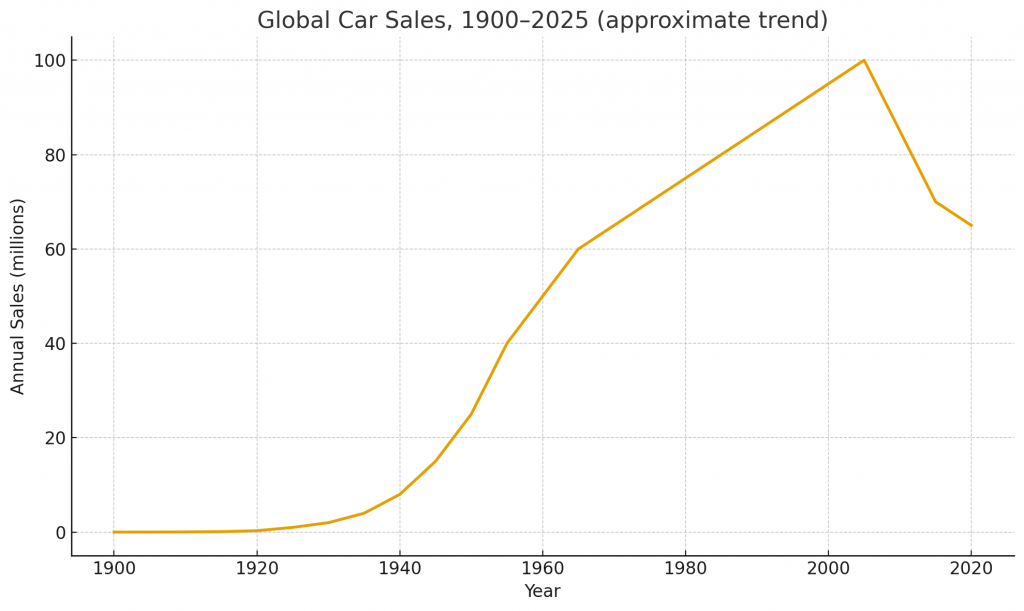
📊 Global Car Sales, 1900–2025 (approximate trend)
From Rail and Horse to Car and Lorry
Before the motorcar, Britain’s transport network revolved around the railways. Trains moved both people and goods efficiently, connecting cities and ports. But with the growth of car ownership after World War II, governments shifted investment from rail to road. The car became not just a convenience but a cultural ideal — independence on four wheels. Lorries replaced freight trains; suburban housing sprawled into the countryside; and the daily commute became an inescapable feature of life.
The result was a kind of tyranny of convenience: the more roads we built, the more cars filled them.
Oil, Cars, and the Machinery of Profit
The car industry and the oil industry have always been partners in profit. The twentieth century was fuelled — quite literally — by petroleum. Every engine sold guaranteed consumption of oil; every gallon burned guaranteed revenue. From Rockefeller’s Standard Oil to ExxonMobil and BP, the alliance between car manufacturers and oil giants shaped global economics and foreign policy alike. Wars were fought over access to oilfields. Even as the dangers of pollution and climate change became clear, both industries resisted reform with powerful lobbying and advertising.
Government Ineptitude and Policy Drift
Governments, far from controlling the industry, became dependent on it. Tax revenue from fuel, vehicle sales, and road building made the motor economy politically untouchable. Public transport was allowed to decay; rail privatisation fragmented the system; and successive administrations promised “green transitions” while continuing to subsidise car ownership.
Crucially, the people who make decisions about traffic rarely live in the areas most affected by it. They do not wake to the sound of revving engines, or walk through one-way streets choked with fumes and noise. This principle extends far beyond traffic policy. Living conditions tolerated by government — homelessness, overcrowding, and urban neglect — exist far from where most political decision-makers live. Out of sight, out of mind: nimbyism in its purest form.
The result is paralysis: a society locked into its own congestion.
Depletion of Resources
Car production devours resources — steel, aluminium, copper, rubber, and rare earth metals for electric vehicles. Each car represents tons of mined material and thousands of litres of water. The end of a car’s life is equally wasteful: millions of tonnes of scrap metal and toxic waste must be processed or buried. Meanwhile, oil reserves continue to decline, and extraction grows ever more destructive.
The Impact on Quality of Life and Health
The social cost is immense. Traffic accidents kill over a million people globally each year. Air pollution from engines contributes to respiratory and heart disease. Noise, stress, and sedentary lifestyles are part of the hidden toll. Urban space that might have been used for trees, playgrounds, or communal squares is sacrificed to parking lots and ring roads. The car promised freedom, but what it delivered was dependence.
Conclusion
The motorcar transformed the twentieth century — a marvel of engineering that reshaped the human landscape. But it also trapped us in a system of perpetual motion without rest. To reduce traffic is not only an environmental goal but a moral one. We must ask again what kind of movement truly serves human life — and whether, in the rush to go everywhere, we have forgotten how to live anywhere.
🜂 Timeline — Milestones in Motoring History
1908: Henry Ford introduces the Model T, making cars affordable for ordinary families.
1927: Dancer Isadora Duncan dies in a motoring accident, symbolising both glamour and peril.
1930s–1950s: Mass road-building programmes reshape cities and countryside alike.
1960s–1980s: Suburban expansion and motorway culture reach their peak.
1990s: Global car ownership surpasses 500 million vehicles.
2010s: Environmental protests challenge the dominance of fossil-fuel transport.
2020s: Transition to electric vehicles begins, though production remains resource-intensive.