There’s something deep in all of us that craves belonging. You see it not just in humans, but in animals too. Most mammals are born entirely dependent—needing their parent for food, warmth, and safety. But they also need emotional connection. That early bond, especially in humans, shapes more than how we behave—it shapes how we see ourselves and others.
When that bond is threatened, stress hormones flood in, and we go into survival mode. Over time, this response forms patterns: who we trust, how we love, even what we believe.
Why Belonging Feels Like Survival
From the moment we’re born and through the rest of our lives, our brains are wired to connect. When those connections feel secure, we release chemicals like oxytocin (for closeness) and dopamine (for pleasure). But when they’re threatened or broken, we release cortisol—our stress hormone.
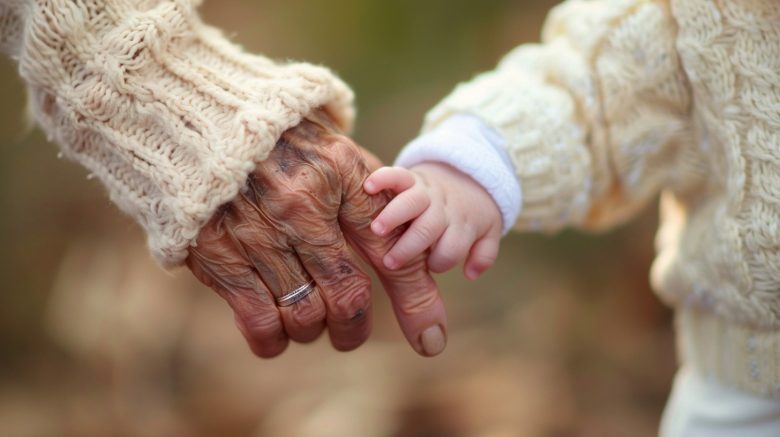
This touching image captures a poignant moment between two generations: an elderly person and a young child. The elderly’s hand, showing signs of a long life with its wrinkles and a simple ring, is held by the much smaller, softer hand of the child. The warm, soft focus of the background emphasizes the tenderness of this interaction, evoking emotions of love, continuity, and the passing of wisdom and values from one generation to another.
A poignant moment between two generations
For animals, rejection is often clear-cut: a mother stops nursing, or a weak pup is left behind. In humans, it’s more complicated. It might be a cold silence, a disapproving look, or love that comes with conditions: “I’ll care for you if you behave.”
This teaches children to adapt—not just their behaviour, but their personality. They learn to be obedient, careful, even silent, Jesus meek and mild, not out of choice, but to avoid being left out.
And that’s where certain emotional habits come in:
Authority tells us who we must follow to feel safe.
Fear warns us not to upset those we depend on.
Shame teaches us what parts of ourselves to hide.
Identity gives us a role to play, so we’ll be accepted.
These survival tools go on shaping us, long after childhood ends.
The Emotional Cost of Leaving
That’s why leaving a belief system—especially a religious one—can feel so difficult. The beliefs may no longer hold, but the emotional scaffolding remains. And walking away can feel like exile.
From Sparta to Today
We like to think we’ve moved beyond ancient cruelty. But have we?
In ancient Sparta, weak or disabled infants were said to be left on Mount Taygetus to die. The elderly, once no longer useful, were left behind. Strength and usefulness came before compassion.
The same cold logic returned under Nazi Germany, where the idea of “racial hygiene” led to the murder of the disabled and mentally ill under the Aktion T4 program. Many of them were children. These crimes were justified, as before, as necessary for the health of the state.
When strength and usefulness become the highest values, compassion is the first thing to go.
We say we believe in dignity. We say every life matters. But our systems often tell a different story:
- The disabled are sidelined.
- The elderly are warehoused.
- The poor are blamed.
- The mentally ill are medicated but not integrated.
We don’t leave people on mountains anymore. We leave them in corridors, on waiting lists, in underfunded institutions. And we call it policy.
The Mask of Macho
We see another echo of this thinking in macho culture. Boys and men are taught that strength means being dominant, unemotional, and independent. But beneath that show of confidence is often fear—a fear of weakness, of needing others, of being exposed.
And the traits that macho culture mocks—sensitivity, care, openness—are exactly the ones that might lead to connection. Instead, many men stay trapped in a role that keeps them isolated—from others, and from themselves.
When Balance Becomes a Casualty
Feminism has rightly fought against injustice. It’s helped reshape a world that once confined both women and men to narrow roles. But like many movements, it risks tipping into overreach.
In some circles, masculinity itself—not bad behaviour, but male nature—is treated as something dangerous. Boys are taught to mistrust themselves, to apologise for who they are, to hide traits that are not toxic at all—strength, confidence, protectiveness.
A striking example of this was the 2021 incident at Brauer College in Victoria, Australia, where male students—including 12-year-olds—were asked to stand in assembly and apologise to girls for the behaviour of their gender. Unsurprisingly, many felt humiliated and unfairly judged. The school later apologised, but the damage was done.
What’s most troubling isn’t just the decision—it’s the lack of consequences. Who holds people accountable when they shame children in public, supposedly in the name of education?
Cold Systems, Warm People
And yet—amid all this—there is light. Because while the system may be cold, people are not.
There are parents who care for disabled children into adulthood. Carers who give up rest to uphold someone else’s dignity. Nurses who stay late. Volunteers who check in when no one else does.
These people don’t do it for applause. Their care shows us what still matters.
Holding Two Truths
Society often fails those most in need, but that failure doesn’t define us entirely.
Some people choose a different path—quietly, stubbornly, and with love.
To criticise the system without recognising them would be dishonest, and their defiance is the truest form of hope we have.