The early 1980s were a fertile time for television adaptations of stage plays and short stories. With the likes of Rex Harrison, Wendy Hiller, Judi Dench, and Ian Holm available for the small screen, the medium could deliver not only polished performances but also probing examinations of class, love, and failure. Three works stand out in sharp relief: William Douglas-Home’s The Kingfisher (1983), Noël Coward’s Mr. & Mrs. Edgehill (1985), and Terence Rattigan’s The Browning Version (1985).
The Kingfisher – Wit Without Weight
Douglas-Home’s The Kingfisher is a brittle comedy of manners, typical of its author’s light touch and aristocratic milieu. The story concerns Sir Cecil (Rex Harrison), an ageing bachelor who, on learning that his youthful rival has died, summons Evelyn (Wendy Hiller), the woman he once loved, in the hope of rekindling romance. Much of the action unfolds in a genteel garden, overseen by the butler Hawkins (Cyril Cusack), whose repressed devotion to Cecil provides an undercurrent of homosexual longing.
The play depends on urbane dialogue rather than dramatic substance. Evelyn briefly considers a neighbouring horse breeder as an alternative suitor, but her return to Cecil implies an imminent marriage — a resolution of sorts, but hardly a catharsis. Hawkins’ jealousy supplies poignancy, though in 1983 it could only be hinted at rather than stated.
The title is symbolic. The kingfisher, dazzling yet elusive, recalls the lovers’ youth. Like the bird that dives headlong but often frightens off its prey, Cecil pursues love too recklessly and too late. For today’s viewer, the dilemmas of privilege ring hollow; the play survives more as an actor’s showcase than as a drama with universal appeal.
Mr. & Mrs. Edgehill – Empire in Miniature
Coward’s Mr. & Mrs. Edgehill is altogether more enigmatic. Ian Holm and Judi Dench portray Eustace and Dorrie Edgehill, colonial servants in the fictional Pacific island of Samola on the eve of the Second World War. Their ventures have failed, their status is precarious, and the higher-ups in the colonial administration regard them with cold contempt.
Here the tone is cynical. The Empire has no use for failure, and loyalty counts for nothing. Yet Coward’s class analysis is nuanced. Dorrie’s friendship with a titled lady softens the critique, suggesting that kindness can exist even within rigid hierarchies. More compelling still is the portrait of marriage: the Edgehills’ wounds are not openly acknowledged but allowed to fester quietly, producing a relationship at once tender, resigned, and corrosive.
The film’s shifts between domestic intimacy, bureaucratic indifference, and geopolitical threat can feel confusing, but they create an atmosphere of unease. The ending is ambiguous: whether the Edgehills are abandoned, absorbed back into the system, or even murdered by the Japanese remains uncertain. What lingers is not resolution but Coward’s intuitive grasp of how authority works — callous, impersonal, and merciless to those who fail.
The Browning Version – Tragedy in Miniature
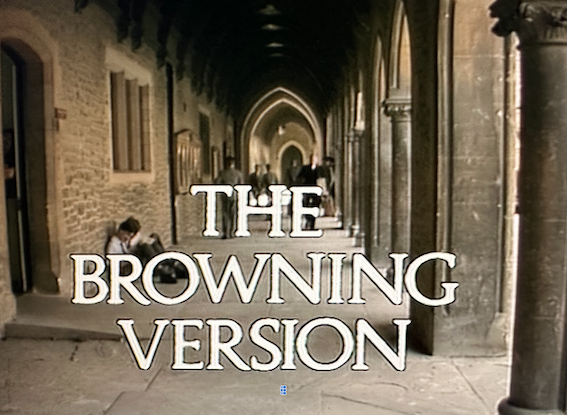
If Douglas-Home provides comedy and Coward cynicism, Rattigan offers tragedy. The Browning Version depicts the downfall of Andrew Crocker-Harris (Ian Holm), once an outstanding Oxford scholar, now reduced to a despised and unpromoted schoolmaster. His wife Millie (Judi Dench) despises him, his pupils mock him, and the school’s management packs him off to a post for “backward boys”—a final humiliation.
Andrew’s tears on receiving the gift suggest redemption, but Millie’s spiteful dismissal robs him of even this fragile comfort. Rattigan’s genius lies in restraint. He shows how failure accumulates quietly: ambition thwarted, marriage curdled, dignity eroded by institutions. Unlike the privileged trivialities of The Kingfisher or the imperial ambiguities of Mr. & Mrs. Edgehill, The Browning Version is devastatingly direct — a portrait of unredeemed loss.
Conclusion
Taken together, these three dramas chart a spectrum of human diminishment. Douglas-Home dresses it in light comedy, Coward in satirical cynicism, Rattigan in tragic austerity. All are bound by themes of class and authority: the privileges of the drawing room, the callousness of empire, the manipulativeness of the public school. What unites them is the recognition that devotion — to love, to duty, to scholarship — may count for little when set against systems that prize success, appearance, and power.