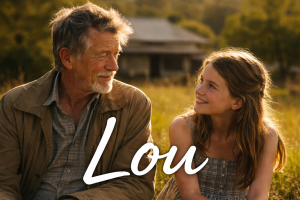
Burns’s words frame this unsettling film, where each attempt at renewal — reconciliation, romance, community — becomes the very channel through which destruction enters.
*“The best laid schemes o’ Mice an’ Men
*“The best laid schemes o’ Mice an’ Men
Gang aft agley,
An’ lea’e us nought but grief an’ pain,
For promis’d joy!”*
— Robert Burns, To a Mouse (1785)
Broken Fences (2008) is a small, independent film, but it lingers with the weight of tragedy. Set in the Colorado mountains, it follows Joe, a widowed rancher, and his estranged son Dylan, newly released from prison. Their uneasy reunion, tentative and fragile, is marked from the beginning by the irony that every act of goodwill, every hopeful gesture, turns into the channel through which misfortune enters.
The film unfolds as a chain of “best laid plans” undone, each gesture of renewal collapsing into misfortune:
- Joe’s change of heart — he decides to welcome Dylan home, though only on the condition that he has changed.
- The prodigal return — father and son attempt a fragile restart.
- The invitation to the pub — meant as a gesture of welcome.
- The pub fight — ostensibly over a spilled beer, but quickly poisoned by deeper hostility.
- The slur on the barn wall — “FAGG…” scrawled crudely, proof that prejudice lies beneath the quarrel.
- The night-time intrusion — a shadowy visitor at the ranch.
- Dylan kills the man — but here the film refuses clarity. Was it the aggressor from the pub, pursuing the quarrel? Or was it someone else — a figure from Dylan’s past, even a prison “buddy,” whose arrival re-opened old bonds as much as old wounds?
- Dylan’s immediate grief — hands smeared in blood, pounding the earth in despair. He knows it could mean a return to the trauma of prison, and his anguish suggests more than guilt: perhaps he has destroyed someone who once mattered to him.
Yet an awkward question remains: why did Dylan shoot at all? He fired before he could even see who the intruder was. Was this the reflex of someone shaped by prison, where hesitation can be fatal? Or is it a mirror of how many of us might react when fear and darkness close in — shoot first, ask questions later? The film offers no answer, leaving us with the unease that Dylan’s tragedy may lie as much in instinct as in circumstance.
- The re-opening of the shop by Kim Clark — a symbol of renewal in the community.
- Joe’s tentative romance with Kim — the beginnings of ordinary happiness.
- The sheriff’s new baby daughter — another emblem of new life.
- The cougar kills the hens — the natural world reminding us of its indifference.
- Joe’s second cougar hunt — leaving Dylan alone and exposed.
- The sheriff’s unexpected arrival at the farm — ending in his murder.
- Kim’s unexpected arrival — bringing her into the fatal chain.
- The struggle over the gun — culminating in Kim’s accidental impalement on a piece of farming equipment.
What emerges is not melodrama but a tragic logic: each hopeful step—whether reconciliation, romance, or community renewal—becomes the very channel through which destruction enters. Dylan’s grief at his first killing is the turning point, throwing into sharp relief both the threat of prison that shadows him and the possibility that he has destroyed someone who once mattered to him. Violence here is not clean or decisive but messy, unresolved, and marked by sorrow as much as guilt.
Here we glimpse the deeper irony: that events are often driven by an unrecognised dynamic beneath the surface. A pub fight may look like a quarrel over spilled beer, yet it is fuelled by buried hostility. This is the butterfly effect of human fate: a small shift in the kaleidoscope of circumstance can create unforeseen patterns, setting in motion a chain of misfortune that no one intends and no one can control. Dylan’s stutter, whether congenital or the scar of prison trauma, embodies this truth — that we are marked by forces we neither see nor command.
The film finally confronts us with the empty, mindless relentlessness of fate. Human beings strive for order and meaning, yet their plans are swept aside by currents they cannot name — chance encounters, old resentments, natural intrusions. Joe himself voices it plainly when he says his son is cursed — that there have been other examples before, as if Dylan’s life is woven into a pattern of misfortune he cannot escape. The Colorado landscape, beautifully filmed, underscores the point: nature itself is indifferent, a silent witness to human striving.
And perhaps one final question remains, pressed upon us by the closing image: how much misery can a person endure before capitulation? Joe, shattered and in tears, stands as a modern Job, stripped of everything he cared for. But unlike Job, there is no redeeming God at the end, no voice from the whirlwind, no restoration of what was lost. Only silence, and the open question of whether any future remains when all that gave life meaning has been taken away.