A New Look at Transport (1963): Britain’s Road to Ruin
1️⃣ The Dream of the Motor Age
When A New Look at Transport appeared in cinemas in 1963, Britain was on the cusp of what it proudly called a transport revolution.
The film opens with soaring orchestral music and camera sweeps over the newly-built M6 viaduct at Gathurst and the futuristic Thelwall Bridge — “spectacular new routes,” the narrator declares, “spanning road, river, rail, and canal.”
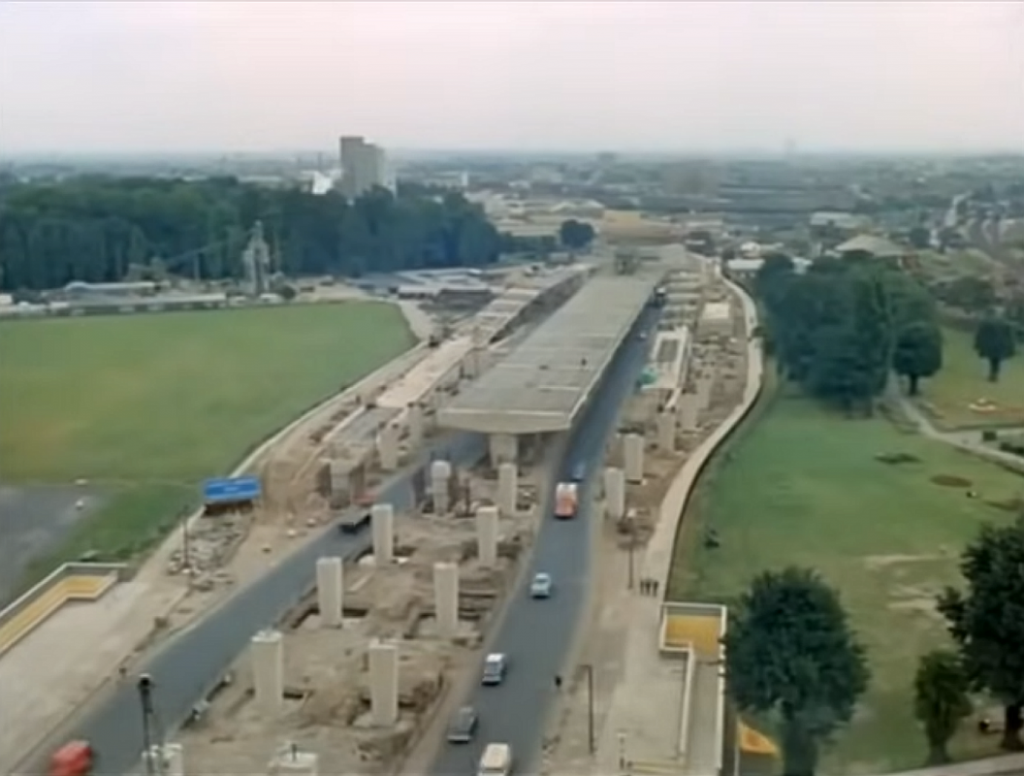
“On the railways, the same story — an archaic system laid down by cheap labour in the age of Victoria, forming what’s been called the most extravagant railway system in the world.”
Motorways were the new cathedrals of progress. Concrete was the sacrament, and mobility the new creed.
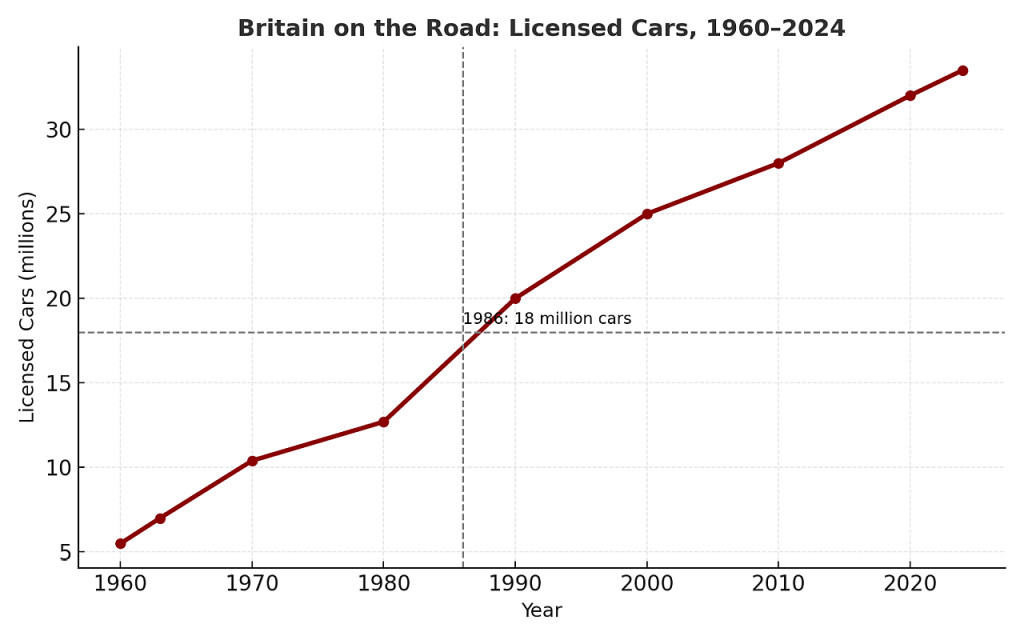
Compared with Europe, the film admits, Britain was “a late starter,” but the tone is buoyant: by 1980 there would be eighteen million cars on our roads.
The commentary exudes confidence:
“The revolution in transport — the new look for our roads, railways, and ports — is coming none too soon if Britain is to move with the tide of progress.”
It was the sound of a civilisation confusing movement with meaning.
The Age of the Motorcar
When the film appeared in 1963, there were only seven million cars on Britain’s roads; by 1970 the number had already climbed beyond ten million, and by 1990 it had doubled again to twenty million. Today there are around thirty-three million, an astonishing fivefold increase since the motorway age began. Analysts predict that Britain will reach “peak car” in the early 2030s, as congestion, cost, and climate policy begin to slow growth — but the real ceiling may not be economic at all. It lies in the finite geometry of road space: there are only so many square inches of tarmac to occupy, and every new vehicle competes for the same few acres of navigable surface. In Wales, as elsewhere, new bypasses and widened carriageways are still being built as if extra space could ease congestion, when in reality traffic expands to fill whatever space exists. The more we build, the more we drive, and the circle tightens. It is the classic case of induced demand — or, more simply, madness.
2️⃣ The Gospel According to Beeching
In the same breath, the film celebrates the Beeching Plan — “to stop losing money on services that aren’t used and concentrate on those that are needed today.”
Branch lines were deemed quaint, stations inefficient, and freight slow. Modernisation meant diesel, marshalling yards, and “a faster, smoother ride for those who pay the fares.”
The quiet moral of the story is clear: profit before service.
The narrator’s approving tone conceals an act of national vandalism — the closure of 2,300 stations and 5,000 miles of track, isolating entire communities.
It was the moment when Britain’s transport policy ceased to be about connection and became a matter of accountancy.
The closures followed The Reshaping of British Railways (1963), written by Dr. Richard Beeching — a former industrial chemist turned railway manager — whose cost-accounting logic, approved by Ernest Marples’s ministry, dismantled one-third of the network in less than a decade.
Why People Accepted the Beeching Cuts
Most people tolerated Beeching’s proposals because they were told they represented progress. In 1963, the word modernisation carried a near-religious force. Motorways, new towns, and tower blocks were symbols of the “scientific age,” and anyone opposing them seemed nostalgic or backward. The media — including the BBC — largely echoed the government’s line that the railways were “uneconomic” relics of the Victorian era, while the car embodied freedom and prosperity.
Few ordinary citizens grasped what the closures would mean until they happened. The idea that local stations could vanish, or that rural Britain might be cut off, seemed implausible. Many assumed replacement bus services would appear — they didn’t. Within a few years, hundreds of villages lost their only link to the outside world. The social effects were severe: depopulation of rural areas, loss of local employment, and greater dependence on the car, which in turn deepened the very congestion the policy claimed to cure.
By the early 1970s, public opinion had shifted. The promised efficiency never came; many lines that were profitable in community terms but not in Beeching’s ledger had disappeared forever. Later governments quietly admitted the policy had been too extreme — a short-term financial fix that caused long-term social and environmental harm.
Nationalisation, Privatisation, and Diverging Futures
At the time of the Beeching report, Britain’s railways were still nationalised under the British Railways Board. Three decades later, between 1994 and 1997, the network was privatised, fragmented into separate train-operating companies, rolling-stock owners, and infrastructure managers. The result has been a system plagued by high fares, unreliable services, and a lack of long-term planning — a commercial patchwork where profit often trumps public need.
Germany took a different path. Its national operator, Deutsche Bahn AG, remains a state-owned company, structured as a joint-stock corporation but wholly owned by the Federal Republic of Germany. Far from dismantling its local lines, DB has expanded them, maintaining frequent, affordable regional connections and an integrated ticketing system. In 2023, Germany introduced the Deutschlandticket, a nationwide pass costing just €49 per month, valid on all local and regional trains, trams, and buses. The contrast could not be clearer: where Britain sold its railways as a business, Germany preserved them as a public service.
3️⃣ Lorries, Caravans, and Car Parks
The film’s second half exalts the road builders — “the men who travel with the motorways” — who live with their families in caravans “on the edge of tomorrow.”
That phrase now feels grimly literal. The edge of tomorrow — once imagined as progress — proved instead to be the edge of civic collapse. What the film celebrated as mobility became the beginning of social disintegration: towns hollowed out, high streets surrendered to traffic, and rail links cut in the name of efficiency. The motorways that promised freedom bound the nation to a pattern of dependence — on oil, on cars, on endless expansion — that eroded the very communities they were meant to connect. In hindsight, the “caravan on the edge of tomorrow” was not a symbol of optimism but of exile, moving ever forward into a future from which the public realm would quietly vanish.
Motorways did not liberate the traveller; they enslaved the landscape.
Every new route demanded miles of tarmac, acres of signage, and vast car parks.
By the century’s end, the “revolution” had achieved its logical conclusion: towns that are “little more than car parks with houses on them.”
Even the film’s music, once triumphant, seems today to drone with irony — an industrial hymn to the god of congestion.
On major carriageways like the A38, accidents occur with unsettling frequency, often several times a week, a reminder that what was once hailed as mobility’s triumph has become one of its chief hazards; the asphalt miracle has become a corridor of hazard and exhaust.
4️⃣ The Triumph of Profit and Favour
Many decisions affecting the quality of everyday life are made on the basis of profitability and reciprocal favour.
That truth is older than the motorways but nowhere more visible.
The haulage lobby got what it wanted — a rail network weakened enough to make road transport indispensable.
Politicians and contractors, wreathed in the rhetoric of progress, shared the spoils.
Behind the gleaming surfaces of the Look at Life films lay a new moral landscape: one in which the public realm was no longer an inheritance to be cared for, but a market to be exploited.
5️⃣ The Long View
Sixty years later, A New Look at Transport survives as an unintentional prophecy.
Its “master plan for Britain’s roads” produced not harmony but dependence — on oil, on cars, and on perpetual rebuilding.
The railway, once a metaphor for connection, was dismantled; the road became a monument to disconnection.
We are still paying the price in pollution, isolation, and the slow death of local life.
To watch that short film today is to see the beginning of our undoing: a nation cheerfully paving over its own coherence.
6️⃣ Afterword: The Reckoning of the Carbon Age
The motorway was not the end of the story but its emblem. Beneath the rhetoric of freedom and growth lay a deeper dependency — the one fuelled by oil. Every revolution since the mid-nineteenth century has been powered by hydrocarbons: the factory, the motorcar, the aircraft, the container ship, the combine harvester. Oil became the bloodstream of civilisation — invisible yet indispensable — the common denominator of modern life.
The cost was deferred — until now. The burning of fossil fuels has raised the atmospheric concentration of carbon dioxide from about 280 parts per million in 1750 to over 420 ppm today, the highest in three million years. This invisible surplus traps heat in the lower atmosphere, warming the planet by an average of 1.3°C above pre-industrial levels. The number seems small; its effects are immense: melting polar ice, rising sea levels, drought, wildfire, flood, crop failure. The very climate in which civilisation evolved is being rewritten.
The irony is brutal. The substance that gave humanity its greatest power — stored sunlight from the deep past — has become the instrument of its undoing. The moral framework for its use was not reverence or restraint but money and profit. Efficiency replaced ethics; expansion substituted for purpose. In the calculus of progress, only growth counted; externalities like atmosphere, ocean, and soil were treated as infinite sinks. Oil made us powerful before we were wise.
The consequence is not a sudden apocalypse but a long unravelling. Cities built for cheap fuel will struggle to survive without it. Food systems depend on oil for fertiliser, transport, and mechanisation. Wars are still fought to secure supply lines. The modern world cannot yet imagine itself without oil because it was born from it — every convenience, every journey, every product an echo of carbon combustion.
A “reset,” if it comes, will not be willed but forced — by the limits of chemistry and physics. Whether through climatic tipping points, economic collapse, or moral awakening, the age of effortless energy is ending. The choice that remains is not between progress and decline but between awareness and denial.
The future will belong to those who learn again to live within the bounds of the earth, not in defiance of them. Until then, the motorways stand as monuments to our brief illusion of mastery — the concrete script of an age that mistook power for wisdom and movement for meaning.