How the silencing of dissent—from the Church Fathers to Nazi Germany—still shapes the dangers facing European democracy today.
Preface
This essay begins with a personal fascination: the study of the Psalms in Latin, a language whose complexity and endurance shaped European thought for over a millennium. From there, the thread widens—to the silence of the educated, the suppression of dissent, and the psychology of power that repeats itself across the centuries. From the fall of Rome to the Inquisition, from Nazi Germany to today’s populist tensions, the same dynamics emerge: fear, conformity, and the abuse of authority. My aim is not only to trace these echoes in history but to ask what they reveal about our present age—and about ourselves.
Latin and the Challenge of the Psalms
A particular interest of mine is a study of the Psalms in Latin. Latin is the most challenging language I have encountered so far outside French, German, Spanish, Welsh and Russian. I cannot claim more than a passing knowledge of the last three, but all are accessible with a knowledge of grammar and vocabulary and some practice.
The Labyrinth of Endings
Latin presents a special difficulty, not only because of its free word order but also because so many case endings are built on the same vowels. The ending -a, for instance, can signal quite different functions:
- Nominative or vocative singular of first-declension nouns (puella – “girl”).
- Ablative singular of the same declension (puellā – “with the girl”).
- Neuter plural nominative or accusative across several declensions (bella – “wars”; maria – “seas”).
- Imperative singular of first-conjugation verbs (ama! – “love!”).
- A variety of loanwords, particles, and proper names.
This overlap means the reader must rely not on endings alone, but on context, syntax, and idiom. Latin’s vocabulary is vast, and its history spans more than a millennium, during which both words and style shifted. Virtus, for example, in Cicero (106–43 BC) carries the sense of “courage” or “moral excellence,” but in medieval writers shades into “virtue” in the Christian sense of discipline. Mastery of Latin is therefore not one but many tasks, depending on the period or author.
A Treasury of Learning
It is astonishing how many scholars achieved that mastery. Jerome (c. 347–420), struggling to render the Hebrew Psalms, chose not to polish his Latin but to preserve the aspectual feel of Hebrew verbs—hence the muddle of tenses, where present, future, and perfect appear side by side. Centuries later, Erasmus (1466–1536) restored Latin elegance in his editions of the New Testament, while John Milton (1608–1674) in England and Johann Wolfgang von Goethe (1749–1832) in Germany drew on their classical grounding to create new literatures. For them, Latin was not merely a school subject but a treasury of thought and a training in freedom of expression.
The Gap Between Classroom and Life
Modern teaching, by contrast, too often races from primer to Cicero as though the leap between Mother Goose and Charles Dickens could be made in a single stride. The result is frustration: students pore for hours over dictionaries or compare parallel texts without ever feeling the life of the language. Even the Psalms, which might seem simple because they dwell on the single subject of the relation of God and man, prove elusive. They show that meaning is not a matter of endings alone but of history, context, and patient attention.
Latin After Rome
After the collapse of the Western Empire in 476, Latin underwent a double fate. On the one hand, it fractured into vernaculars that would become the Romance languages. On the other, it remained the language of law, theology, and learning. Ordinary people soon found the Church’s liturgy alien, while the educated classes retained fluency. The result was a widening gulf: the masses reliant on priests for the words of Scripture, the elite shaping a new European civilisation in a common but exclusive tongue.
Why the Educated Remained Silent
Why did the intelligentsia not challenge the Church’s monopoly more forcefully?
- Continuity and Stability. After Rome’s fall, the Church was virtually the only body preserving administration, law, and education. Even sceptics preferred an imperfect Church to chaos.
- Intellectual Dependence. The educated elite were steeped in Christian categories; even doubters could scarcely step outside them.
- Political Power. Bishops were spiritual leaders and temporal magnates. To challenge them was not only intellectual dissent but political rebellion. Think of figures like John Scotus Eriugena (c. 815–877), whose daring speculations — that reason could stand above authority, that all creation would return to God, and that even damnation might not be eternal — ended in censure. His great work Periphyseon was later condemned by the Church (at the Council of Sens in 1225), precisely because it blurred the line between orthodoxy and pantheism.
- Mass–Elite Divide. The majority were occupied with subsistence. The few literate laymen often depended on clerics, reinforcing orthodoxy.
- Gradual Criticism. From the Renaissance to the Reformation, ancient sources reopened, but centuries passed before alternatives gained strength.
Thus the silence of the educated was not cowardice but the product of a social ecology: a Church that both preserved and monopolised knowledge, an elite trapped in its own framework, and a populace excluded by language and circumstance.
Suppression of Dissent in Antiquity and the Middle Ages
Yet critical voices were not absent. Celsus (fl. c. 170 AD), Porphyry (c. 234–305), and even the emperor Julian the Apostate (331–363) dared to expose the absurdities of Christian doctrine: Can the dead truly rise? How can one man’s execution atone for the guilt of the world? Why does Paul preach a theology so unlike Jesus’ moral teaching? Their writings survive only in fragments, quoted by apologists in order to be refuted. They were censored precisely because they struck at the heart of Christian claims — bodily resurrection, atonement, and the uniqueness of Paul’s theology — and therefore threatened both doctrine and imperial unity.
The same pattern marked later centuries. The Cathars of southern France (12th–13th centuries)—denounced as heretics—offered an alternative Christianity that stressed purity, renunciation, and a radical dualism: the belief that reality was divided between two opposing powers, one wholly good and spiritual, the other evil and bound up with the material world. Their flourishing communities in Languedoc drew thousands, until the Albigensian Crusade (1209–1229) and the subsequent Inquisition (established 1231) crushed them with fire and sword. Criticism never vanished, but repression ensured it seldom gathered enough force to alter the dominant narrative.
The Psychology of Recurrence
Discontent with Christian teaching resurfaced in the Renaissance and the Enlightenment. Yet my concern is less with these movements than with the psychology of repression. We like to imagine the past safely buried, but an honest view shows the same dynamics recurring: fear and conformity among the many, suppression of dissent by the powerful, and the perennial temptation of authority to abuse its strength. It is not enough to tear down statues or relabel exhibits; unless we confront the motives that once led to persecution, we will repeat the same mistakes.
Germany Between the Wars
Those mistakes returned with terrifying clarity in the twentieth century. Extremism grows in the soil of discontent. In Germany after the First World War, that soil was rich: the humiliation of Versailles, the ruin of hyperinflation, and the despair of the Depression. Dissatisfaction with Weimar governments, paralysed by faction, left many Germans ready to embrace radical solutions. The Nazis thrived not because their arguments were reasonable, but because others failed to restore stability and dignity.
The Bureaucrats and the Burning of Books
Hitler’s movement did not merely seize power; it imposed a creed of eugenics and of “cleansing” German culture. On 10 May 1933, Nazi students staged vast burnings of books by Jewish and “un-German” authors—Heinrich Heine (1797–1856), Sigmund Freud (1856–1939), Karl Marx (1818–1883), Erich Maria Remarque (1898–1970), even Albert Einstein (1879–1955). Heine had written a century earlier, “Where they burn books, they will end by burning men.” His prophecy was fulfilled within his own homeland.
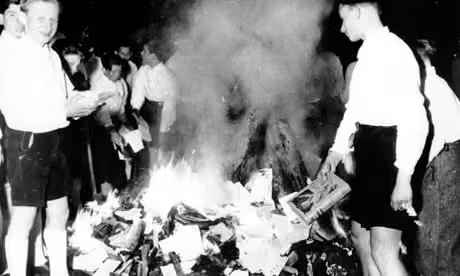
At the same time, a grotesque antisemitic “criticism” claimed that Jewish writing betrayed an alien, corrosive style. Such fantasies gave cultural cover to exclusion and destruction. Ordinary Germans, meanwhile, were subdued by fear or dulled by conformity. The clerks and bureaucrats, blessed in their own eyes by the hand of the bureaucracies they served, imagined themselves beyond guilt—and became blindly impervious to the suffering that ensued.
The Echo in Our Own Time
The situation in pre-war Germany may seem extreme, yet the underlying psychology—the silence of the many, the power of propaganda, the readiness of institutions to protect themselves at any cost—remains familiar. Already in Germany, France, and Britain, popular movements have arisen that threaten democratic decency, while elected governments, entrusted with power by the people, seem prepared to use any means to hold on to it and to silence their challengers.
Germany: The AfD
In Germany, the rise of the Alternative für Deutschland (AfD) has been met not merely with political opposition but with legal instruments. The Verfassungsschutz (Office for the Protection of the Constitution) has placed the party under surveillance, citing extremist tendencies. In some Länder, AfD organisations have been labelled “proven extremist” groups, a designation that paves the way for bans and restrictions. The Federal Constitutional Court is already examining whether the party itself might be outlawed entirely. To critics, this looks like the state deciding which parties may exist, rather than voters deciding at the ballot box. To supporters of the restrictions, it is a necessary defence of democracy against forces seeking to undermine it from within. The effect, however, is to give the AfD precisely the aura of martyrdom it craves, allowing it to claim the mantle of free speech and victimhood in a society that no longer tolerates dissent.
France: Marine Le Pen
In France, the case of Marine Le Pen (b. 1968) shows a similar pattern. In April 2025 she was convicted in the long-running “fake jobs” scandal, accused of misusing European Parliament funds to pay party staff. The Paris court imposed not only a prison sentence and a heavy fine but also a five-year ban on holding public office. The Constitutional Court confirmed that such bans could be enforced immediately, even before appeals are exhausted. The practical result is that the strongest challenger to Emmanuel Macron’s legacy and the French establishment has been legally barred from standing in the 2027 presidential election. To her critics, this is the proper consequence of financial malpractice; to her supporters, it is the political elimination of a rival by judicial means. Whatever the truth of the allegations, the perception of two-tier justice feeds the very resentment that sustains her movement.
Britain: Free Speech Under Pressure
In Britain, the restriction of free speech has followed a more gradual but equally troubling path. Laws framed as measures against “hate speech,” “online harms,” or “incitement” have steadily narrowed the scope of what can be said in public without fear of prosecution. Protest legislation now allows police to limit demonstrations on the grounds of noise or disruption. Universities are under pressure both to guarantee freedom of speech and to prevent “harmful” or “offensive” expression—a paradox that leaves room for censorship from both directions. Supporters of these measures argue that they protect minorities and preserve social peace. But the cumulative effect is to convince many that free expression is no longer secure in Britain, and that only those willing to break taboos—often on the far right—are truly willing to defend it. Once again, heavy-handed suppression risks turning populists into champions of liberty in the eyes of disaffected voters.
The Perennial Danger of Power
Taken together, these measures are music to populists. They allow movements that would otherwise remain marginal to pose as defenders of liberty. Today’s populist parties edge into the same space once occupied by Hitler’s movement before power—outsiders emboldened by every attempt to silence them.
The real problem with democracy is that it grants near-absolute power to whichever party wins, regardless of turnout. Once in office, those who hold power feel the temptation to push it to the limit. As Albert Camus (1913–1960) has Caligula confess, « Je m’entraîne à l’abus. » — “I train myself in abuse.” That line captures the perennial danger: the lure of power is not service but its abuse.
History has shown this again and again—from the dominance of the medieval Church to Nazi book burnings, from the silencing of dissenters in antiquity to the suppression of populists today. The names and methods change; the psychology does not. Unless we confront that pattern directly, we will go on rehearsing the same tragedies, each time imagining they are new.
Just as the Church once imposed its will on Europe, so too a victorious party today can enforce its political vision by fair means or foul. It is a lesson written across European history, taught again and again through conflict, repression, and upheaval—yet it is a lesson we seem determined never to learn. The irony is that we cannot know which poses the greater danger: elected governments, determined to silence opposition, or the forces that loom darkly on the right.