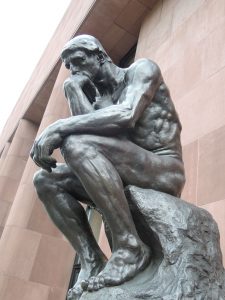
Every culture has wrestled with the same mystery: what is consciousness, and where does it come from?
Is it a divine spark, a property of matter, or an illusion we mistake for depth?
Modern thought has produced three overlapping answers — the mythic, the scientific, and the existential.
Patrick Harpur’s Daimonic Reality gives voice to the first; neuroscience grounds the second; Sartre exposes the third.
Each, in its own language, asks what it means to be aware — and to know that awareness will end.
1. The Mythic Imagination
Patrick Harpur proposes that we live within a daimonic world, an imaginal field between spirit and matter.
Here dwell the figures of folklore and vision — gods, faeries, angels, aliens — autonomous presences shaped by culture but not invented by it.
The imagination, he argues, is not fantasy but perception: a faculty that reveals a hidden level of reality co-extensive with consciousness itself.
When we see apparitions, experience synchronicities, or dream of luminous beings, we are not hallucinating but glimpsing the daimonic realm, the half-real territory between thought and thing.
Yet Harpur’s evidence is experiential rather than empirical.
Across cultures, similar patterns recur — beings of light, abductions, teachings from the sky — but their consistency proves only a shared human imagination, not an independent world.
The daimonic may be no more than the psyche meeting itself through symbol.
It tells us less about other worlds than about the depth and plasticity of our own.
2. The Neural Turn
Where Harpur sees transcendence, neuroscience sees circuitry.
Every alteration in consciousness corresponds to a change in the brain: injury, drugs, anaesthesia, dementia.
The case of Alzheimer’s disease makes this dependence unarguable.
As the neural web frays, personality, memory, and moral awareness dissolve.
If consciousness were independent of the brain, why should its gradual disintegration follow so precisely the brain’s decay?
The answer seems plain: awareness is what the brain does when it is whole.
And yet the brain itself is capable of creating worlds.
Each night, when we dream, we enter landscapes as vivid as waking life.
We see, touch, and believe — until we wake, and the illusion collapses.
Dreaming shows how completely perception can detach from external stimulus; it is hallucination made safe by sleep.
The slowing of the brain’s functions seems to free imagination from constraint, allowing the mind to project its own contents outward.
Hallucination is not the invasion of unreality but the overflow of image into perception.
It shows how thin the membrane is between the seen and the imagined — between the world as it is and the world as we construct it.
3. The Existential Horizon
If Harpur externalised imagination as daimonic beings and neuroscience internalised it as brain chemistry, Sartre turned the question inward.
In L’Être et le Néant — Being and Nothingness — he argued that consciousness is not a substance at all but a gap within being.
Objects simply are; they exist in themselves. Any meaning they have exists only by proxy, as the result of whatever arbitrary meaning we bestow upon them. But consciousness is aware of itself, and in that awareness it creates a distance — a void — what Sartre calls “le Néant.
To be conscious is to step back from what one is, to see being against the background of its own possible absence.
That inner space is le néant, nothingness, the birthplace of freedom and anxiety alike.
Consciousness, then, is not a light shining on reality but a hole in it.
We live suspended between presence and absence, compelled to make meaning where none is given.
As you wrote, “Consciousness is the place where being encounters its own absence. Our fear of death is not an error but the price of knowing that we are.”
In that single recognition, Harpur’s daimons, the neuroscientist’s neurons, and Sartre’s void converge: all describe the same encounter from different sides.
The mythic imagination calls it the Otherworld, science calls it the brain, philosophy calls it nothingness.
Each is a mirror held to the same abyss.
4. From Myth to Mechanism to Meaning
Across these perspectives runs a single thread — our refusal to accept finality.
The daimonic world promises continuation. For Harpur, the daimonic realm is not subjective fantasy but a subtler mode of reality — the level of form and imagination that underlies both mind and matter. When the physical body dies, the psychic or imaginal self continues to exist within this dimension, because the daimonic is the natural medium of soul rather than flesh.
Neuroscience, by contrast, explains our longing as a neural function — a side-effect of the brain’s need for pattern, purpose, and continuity. But what we long for is not merely pleasure or survival. It is the continuation of consciousness itself — the hope that our awareness and our sense of meaning do not end with physical death. In religious language this becomes the idea of eternal life; in psychological terms, it is the desire that our existence should matter and endure beyond the moment.
Sartre accepts mortality and calls it freedom. For him, death is not liberation into another realm but the final limit of being — and within that limit lies our greatest freedom: to choose what our finite life shall mean.
We fear extinction because consciousness can imagine its own end but cannot imagine non-being. Our recoil from that thought — the instinctive resistance of awareness to its own erasure — is perhaps the defining feature of consciousness itself.
The history of thought could be read as a series of strategies for managing that dread. Myth externalised it as gods and spirits; religion sanctified it as afterlife; science deflected it into progress; philosophy faced it head-on. But none escape it. Consciousness, aware of its own limits, fills the void with symbols, systems, and stories — anything to delay the recognition that the light which sees the world must one day go out.
5. The End of the Day
Death, you observed, is the end of a sunny day at the beach.
It’s a line that says more than a library of metaphysics.
The scene remains — the sea, the sky, the rhythm of waves — but the light that made it ours is gone.
That is what consciousness is: the brief illumination of being before night.
The brain gives it form; imagination gives it colour; philosophy gives it courage.
Our difficulty in accepting finality is itself a deep feature of consciousness — its instinctive recoil from non-being.
That recoil is the fer dans l’âme — the iron in the soul — of modern humanity: the weight of lucidity we cannot lay down.
To recognise this is not despair but clarity.
The daimons fade, the neurons fail, the void remains.
Yet in facing it, we become most ourselves — aware, finite, and awake in that short walk between two darknesses which we call life.