Iran and the Middle East: A Century of Consequences
For nearly four hundred years, the Ottoman Empire governed most of the Middle East, North Africa, and southeastern Europe. When it collapsed at the end of the First World War, the political map of the region was fundamentally redrawn. Many of the conflicts and tensions that shape the Middle East today can be traced back to decisions made during and immediately after that period.
1. The turning point: the First World War
The Ottoman Empire, which had governed much of the Middle East for centuries, was already weakened by economic decline, nationalist revolts, and political instability when it entered the First World War in 1914 on the side of Germany and Austria-Hungary.
When the Central Powers were defeated in 1918, the empire collapsed. Much of its territory was then divided among the victorious powers, especially Britain and France, often without a comprehensive understanding of the cultural, ethnic, and religious complexities of the regions involved.
Although the First World War often appears as distant history, many of the political borders and tensions in the modern Middle East can be traced directly to decisions taken in its aftermath.
2. Redrawing the Middle East
The collapse of Ottoman authority created a political vacuum across the region.
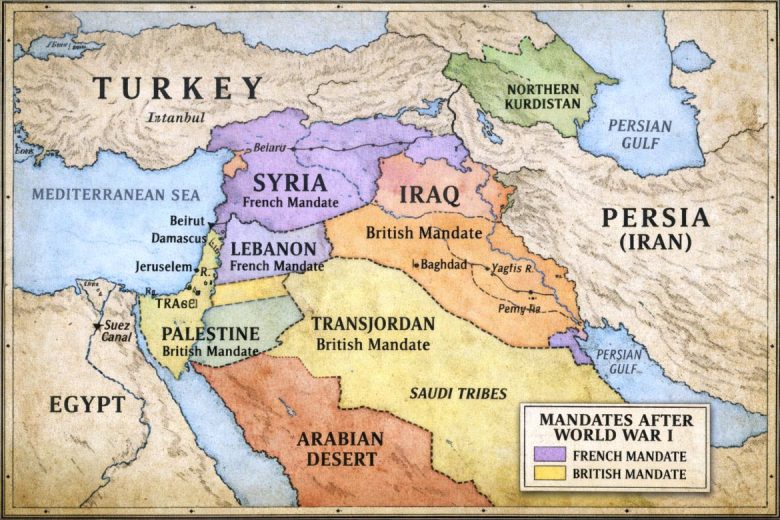
During the war Britain and France had already discussed how Ottoman territory might be divided. The Sykes–Picot Agreement of 1916 proposed spheres of influence in the Middle East, with France expected to dominate Syria and Lebanon, and Britain taking a leading role in Iraq, Jordan, and Palestine.
After the war the League of Nations formalised many of these arrangements through a system of mandates.
Examples included:
Iraq – administered by Britain
Palestine – administered by Britain
Transjordan – under British supervision
Syria and Lebanon – administered by France
In several cases the borders of these states were drawn with limited reference to ethnic or religious divisions.
Another important decision was the Balfour Declaration of 1917, in which Britain expressed support for the establishment of a national home for the Jewish people in Palestine. During the British mandate Jewish immigration increased, while the population of Palestine remained largely Arab (Muslim and Christian).
Following the United Nations Partition Plan for Palestine in 1947 and the withdrawal of British administration, Jewish leaders proclaimed the establishment of the State of Israel in May 1948, an event that immediately triggered the Arab–Israeli War and the displacement of large numbers of Palestinians. Despite occasional ceasefires and diplomatic agreements, the region has experienced recurring conflict ever since.
3. Iran after the Second World War
Although Iran had not been part of the Ottoman Empire, it was nonetheless affected by the geopolitical tensions that shaped the wider Middle East in the twentieth century. Much of the region had previously existed within a broad Islamic political framework under the Ottoman Empire, whose rulers also claimed the title of caliph, regarded by many Sunni Muslims as the symbolic leadership of the Islamic world.
Within this imperial system diverse peoples—Arabs, Turks, Kurds, Greeks, Armenians and others—were governed under a single political authority. Religious life was organised largely around Islamic institutions and law, although Christian and Jewish communities were recognised within the empire through separate communal arrangements. Despite this diversity, the overarching political order rested on a Muslim ruling framework that provided a degree of continuity across a vast and culturally varied region.
In the European imagination these territories have often been treated as a single undifferentiated “Middle East,” yet in reality the region contains a diversity of languages, ethnic traditions, and national cultures comparable in many ways to those found across Europe itself. One might therefore say that, just as Christianity historically provided much of the cultural and intellectual framework of Europe, Islam has long played a comparable civilisational role across much of the Middle East. While the region contains many different languages, peoples, and national traditions, Islam has often served as a shared religious and cultural reference point linking otherwise diverse societies.
When the Ottoman Empire collapsed after the First World War, the imperial political framework that had held much of the region together disappeared. The territories that had once formed part of that empire gradually developed into separate states with their own political systems and national identities. Yet many of these societies continued to share a common religious and cultural inheritance rooted in Islam.
A further symbolic break occurred in 1924, when Mustafa Kemal Atatürk, the founder of modern Turkey, abolished the Ottoman Caliphate. Although the Ottoman Empire itself had already collapsed after the First World War, the caliphate had represented for centuries a symbolic form of leadership within the Sunni Muslim world. Its abolition marked the final disappearance of the last institutional link to the old imperial order.
In some respects the Ottoman Empire played a role in the eastern Mediterranean and Middle East not unlike that of the Roman Empire in earlier centuries: a large imperial framework that governed diverse peoples for centuries before eventually giving way to a landscape of smaller states. In this sense the Ottoman Empire, like the Roman Empire before it, left behind more than political boundaries. Each imperial system also transmitted a dominant religious framework that continued to shape cultural life and social organisation long after the empire itself had disappeared.
The result was a region that had once been politically unified under a large imperial structure but was now divided into multiple independent countries. This fragmentation sometimes weakened central authority within individual states while leaving intact a broader sense of belonging to a shared Islamic civilisation.
Although Iran had historically belonged to a different political and religious tradition—most of its population being Shi’a rather than Sunni—it was nonetheless affected by the wider transformations taking place across the Middle East. When the Second World War ended in 1945, Iran was formally independent but remained influenced by major powers. During the war the United Kingdom and the Soviet Union had occupied the country to secure oil supplies and vital transport routes, leaving behind a political environment shaped by international rivalry.
In this atmosphere of post-war instability, foreign influence, and growing nationalist sentiment, the struggle over control of Iran’s oil industry soon became the central political issue, bringing the government of Mohammad Mosaddegh into confrontation with Britain and eventually the United States.
4. Mossadegh and the oil crisis
In 1951, nationalist politician Mohammad Mosaddegh became prime minister of Iran.
One of his most significant actions was the nationalisation of the Anglo-Iranian Oil Company, which had been largely controlled by Britain. Many Iranians believed that the existing arrangement allowed a disproportionate share of the profits from Iran’s oil to flow abroad, while the country itself received relatively limited revenues from its own natural resources. Mosaddegh and his supporters argued that the oil industry should be placed under national control so that its income could be used for Iran’s economic development and for the benefit of its population.
Britain strongly opposed the decision. The Anglo-Iranian Oil Company was one of Britain’s most valuable overseas assets and a major source of energy and revenue. In response, Britain imposed an economic blockade, withdrew technical staff from Iranian oil installations, and applied diplomatic pressure in an effort to reverse the nationalisation.
The dispute over oil soon escalated into a major international crisis and became one of the defining events in modern Iranian history.
5. The Shah’s Rule and Modernisation (1953–1979)
In 1953, the governments of the United States and the United Kingdom organised a coup known as Operation Ajax, which overthrew Mohammad Mosaddegh. The operation involved figures including Christopher Montague Woodhouse, Winston Churchill, Dwight D. Eisenhower, Allen Dulles, John Foster Dulles, and Kermit Roosevelt Jr.
The coup restored Mohammad Reza Pahlavi, the Shah, to full authority and installed a pro-Western government. In later decades many Iranians came to see the event as a significant instance of foreign intervention in their country’s political development.
During the 1960s the Shah launched a programme of modernisation known as the White Revolution. These reforms included land redistribution, industrial development, the extension of voting rights to women, and a major expansion of education.
The reforms contributed to rapid economic growth and social change. Education expanded significantly, urban development accelerated, and women played a growing role in public life.
At the same time the Shah’s government relied increasingly on strong central authority and internal security institutions such as SAVAK, the secret police. While some observers emphasised political repression and growing inequality, others later remembered the decades before the 1979 revolution as a period of modernisation, relative stability, and greater social freedom than those that followed.
6. The Iranian Revolution
By the late 1970s protests were spreading across Iran. Dissatisfaction with authoritarian rule, economic inequality, resentment of Western influence, and religious opposition to secularisation all contributed to growing unrest.
In 1979 the Shah left the country and Ruhollah Khomeini returned from exile. The monarchy collapsed and Iran became an Islamic Republic governed by religious leadership.
Unlike most Muslim countries, which are predominantly Sunni, the new Iranian state was built explicitly around Shiʿa clerical authority. Under the doctrine of velayat-e faqih (rule of the jurist), senior religious figures were given ultimate political authority and the political system incorporated strong religious oversight of government and society. This produced a more explicitly theocratic structure than existed in many other Muslim-majority states.
7. War with Iraq
In 1980 Saddam Hussein of Iraq invaded Iran.
The Iran–Iraq War (1980–1988) lasted eight years and caused roughly one million casualties. The conflict included trench warfare reminiscent of the First World War and the use of chemical weapons by Iraqi forces.
8. Nuclear tensions
The origins of Iran’s nuclear programme go back to the 1950s, when the United States helped establish Iran’s civilian nuclear infrastructure under President Eisenhower’s “Atoms for Peace” initiative. During the rule of the Shah, American assistance included nuclear technology, scientific training, and the construction of a research reactor in Tehran. After the 1979 revolution and the breakdown of relations between Iran and the United States, the programme continued under very different political circumstances.
By the early twenty-first century Iran had significantly expanded its nuclear activities, leading Western governments to express concern that the programme might eventually lead to the development of nuclear weapons.
In 2015 Iran signed the Joint Comprehensive Plan of Action, which limited aspects of its nuclear programme in exchange for partial relief from international sanctions.
However, in 2018 the United States, under President Donald Trump, withdrew from the Joint Comprehensive Plan of Action and re-imposed economic sanctions on Iran, leading to renewed tensions between the two countries.
9. Internal unrest
Iran has also experienced significant domestic protests in recent years. Human-rights organisations estimate that about 5,000–7,000 people have been killed during government crackdowns on demonstrations since 2022, with many more imprisoned.
10. Wider regional instability
Across the Middle East instability intensified again during the Arab Spring beginning in 2010–2011. Uprisings occurred in Tunisia, Egypt, Libya, and Syria.
In several countries weakened central authority led to prolonged conflict, including the civil war in Syria and continuing instability in Iraq. These conflicts displaced millions of people, many of whom sought refuge in Europe.
Not all states in the region experienced the same outcome. In countries where political authority remained firmly in place—such as Iran—the government succeeded in maintaining control despite internal tensions and protests. By contrast, in states where existing leadership collapsed or state institutions weakened, power vacuums sometimes developed, contributing to prolonged instability and civil conflict.
11. Recent Tensions and the Risk of Wider Conflict
Tensions between the United States and Iran have periodically escalated through economic sanctions, military incidents, and confrontations involving regional allies. Relations between the two countries have remained strained since the Iranian Revolution of 1979 and have been further complicated by disputes over Iran’s nuclear programme and its role in regional conflicts.
Several episodes of military confrontation have raised fears of a wider war. Analysts have warned that large-scale strikes against Iranian territory could produce significant civilian casualties and destabilise the broader Middle East. Recent events in Iran would confirm the seriousness of these concerns.
Actions taken by the United States under President Donald Trump have provoked strong and often sharply divided reactions from commentators and governments around the world. Some governments have supported stronger measures against Iran, citing concerns about missile development, regional influence, and nuclear activities. Others have called for restraint and renewed diplomatic negotiations in order to prevent a wider war.
The legality of military action against Iran has also been widely debated. Under the United Nations Charter, the use of force between states is generally prohibited except in cases of self-defence or with authorisation from the United Nations Security Council. Some legal scholars argue that unilateral military strikes would violate these principles, while others maintain that they might be justified under certain interpretations of self-defence.
Because of these competing interpretations, and because of the complex regional situation, tensions surrounding Iran remain one of the most sensitive and potentially dangerous issues in contemporary international politics.
12. A continuing historical chain
The consequences of the collapse of the Ottoman Empire continue to shape events today.
For centuries the empire had provided a loose political framework across much of the Middle East. After its disappearance following the First World War, the region was reorganised into a number of new states whose borders and institutions were often fragile.
Over the following century many of these states experienced periods of authoritarian rule, civil conflict, and external intervention.
In recent decades these crises have driven millions of people to leave their homes. Many refugees have travelled to Europe, placing pressure on social systems such as healthcare, housing, employment, and welfare provision while raising broader questions about cultural integration and social cohesion.
Decisions taken during and immediately after the First World War reshaped political structures across the Middle East, and their consequences remain visible in many of the region’s conflicts and tensions today.
Note on the “special relationship”
The close cooperation between the United Kingdom and the United States in events such as the 1953 Iranian coup is often described as part of the so-called “special relationship.” The phrase was popularised by Winston Churchill, particularly in a speech delivered in 1946, in which he referred to the “special relationship between the British Commonwealth and Empire and the United States.” Churchill believed that shared language, political traditions, and wartime cooperation had created an unusually close partnership between the two countries.
Since the Second World War, Britain and the United States have frequently collaborated in diplomacy, intelligence, and military operations, including within the NATO alliance. At the same time, the idea of a uniquely privileged relationship has sometimes been questioned. Critics argue that the partnership has often reflected changing strategic interests rather than a permanent alignment, and that the phrase itself may exaggerate the degree of equality or mutual influence between the two countries.
The limits of the relationship became particularly visible during the Suez Crisis of 1956. When Britain and France attempted to regain control of the Suez Canal after its nationalisation by Egypt’s president Gamal Abdel Nasser, the United States refused to support the intervention and instead applied strong financial and diplomatic pressure on Britain to withdraw. The episode is widely seen by historians as a turning point: it revealed the extent to which Britain could no longer act independently as a global imperial power and marked a significant moment in the shift of political and strategic leadership within the Western alliance toward the United States.