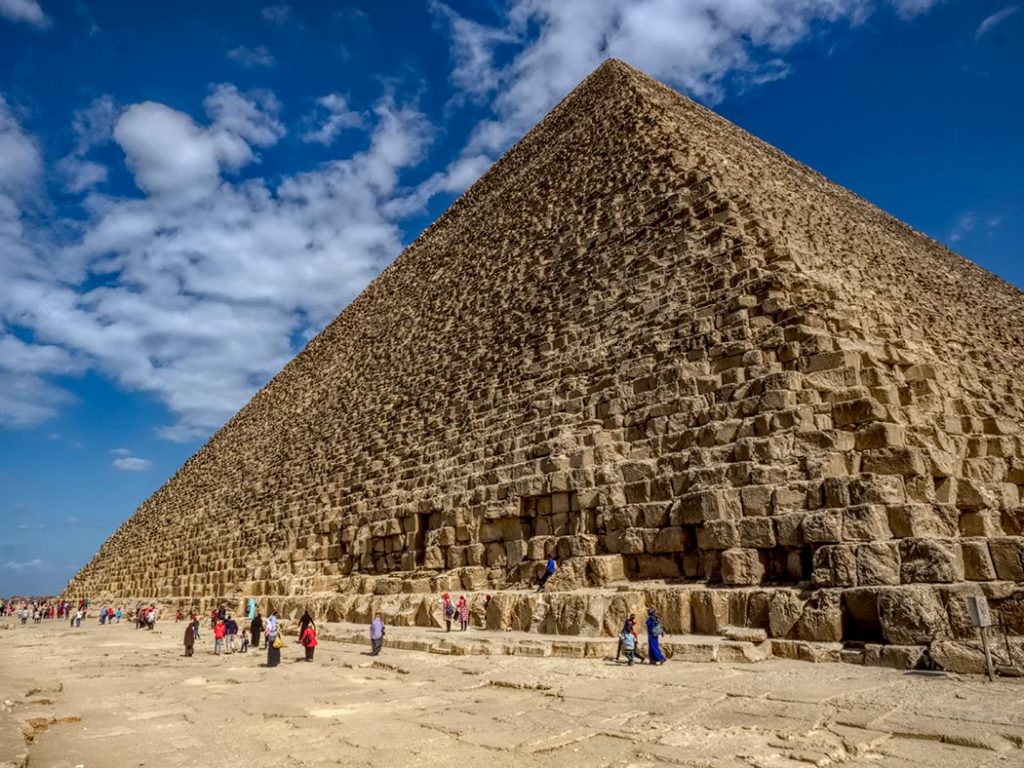
Few monuments grip the imagination like the pyramids. Their vast stones, perfect alignments, and enduring presence make them both marvels of engineering and riddles of history. After centuries of study, we still do not know quite how they were built, or why with such precision.
The orthodox view
Archaeologists explain the pyramids in terms of manpower, ramps, and simple tools. The Great Pyramid at Giza contains around 2.3 million blocks, some weighing up to 80 tons. Egyptologists calculate that 20,000 workers over 20 years could, in theory, maintain a rate of construction that seems almost mechanical in its relentlessness. Copper chisels, sledges, and rollers are held up as the essential tools of the trade. In similar fashion, experimental archaeology has shown that groups of modern volunteers can move multi-ton stones with ropes and timber.
Why it feels inadequate
The trouble is that these explanations strain belief. Moving, aligning, and placing stones of such magnitude with such speed and accuracy is difficult to square with human experience. The evidence we have — quarry marks, sledges, images of ramps — seems to point in that direction. Yet when we calculate what it would actually require, the problems mount. A ramp long enough to reach the upper levels of the Great Pyramid would have stretched close to a mile. Building, maintaining, and dismantling such a structure would itself have been an immense engineering project, rivaling the pyramid it was supposed to serve. And then there is the problem of transport: while much of the limestone was quarried locally, the massive granite blocks were brought from Aswan, some 500 miles away. To haul and lift such stones without modern machinery compounds the mystery. The orthodox story is possible — but it often feels more like arithmetic than explanation.
Another striking feature often noted is the pyramid’s apparent alignment with “true north.” In modern terms, the sides of the Great Pyramid deviate only a fraction of a degree from the north–south and east–west axis. To us, this is astonishing. But we should be cautious about the language. “True north” is a modern concept, rooted in maps, compasses, and global coordinates. The ancient Egyptians did not think in those terms. Their builders most likely relied on careful astronomical observations — perhaps of the circumpolar stars or of the sun’s rising and setting. Whatever method they used, the precision remains remarkable. The difficulty is not whether they aimed at some abstract “north,” but how they achieved such consistency with the means available to them.
The case for alternatives
It is here that curiosity presses us further. If the conventional story is the “best we have,” it is also profoundly unsatisfying. We cannot rule out the possibility that knowledge has been lost, or that ancient builders were in contact with others who possessed skills they themselves only half mastered. Nor can we ignore the global parallels: pyramids in Mesoamerica, Asia, and Europe. Are these coincidences, convergent solutions, or faint echoes of contact? To dismiss such questions as “pseudo-archaeology” is to close inquiry prematurely.
The seductions of numbers
The pyramids have long attracted mathematical speculation. Some claim that the builders encoded π, the golden ratio, or even the circumference of the Earth within their dimensions. The elegance of these claims is undeniable — they offer a sense of hidden design, as though the stones themselves were whispering cosmic truths.
But evidence is another matter. The dimensions of the pyramids are not perfectly preserved; erosion and damage make exact measurements uncertain. Ratios can be found, but only by rounding, adjusting, or ignoring inconvenient figures. It is easy to make numbers say what we want them to say.
The danger is that we mistake numerical coincidence for intention. To suppose that ancient builders consciously encoded π or the golden ratio assumes not only advanced knowledge but also that they designed monuments as coded textbooks for posterity. There is no inscription, no plan, no surviving text that tells us this was their aim.
Such theories are like the armchair I am sitting on as I write this. It has dimensions too — height, width, depth, even the curve of the armrests. With enough ingenuity I would be surprised if I couldn’t “discover” π, the golden ratio, or even the circumference of the Earth within it. Numbers can always be coaxed to yield patterns. But that does not mean they were deliberately built in.
The pyramids deserve better than armchair numerology. Chasing after hidden numbers distracts us from the real mystery: how such vast stones were actually cut, transported, and placed with such precision.
Holding wonder and evidence together
Sherlock Holmes warned that “when you have eliminated the impossible, whatever remains, however improbable, must be the truth.” The orthodox account is not impossible — but its improbability is enough to leave the field open. Better to admit what we do not know than to force certainty where there is none.
Superficial and deeper history
Perhaps the real distinction is between superficial history and deeper history. The superficial record is what we have actually found: quarry marks, broken chisels, fragments of ramps. It deserves respect, because without it we would have no history at all. But deeper history is what presses in through improbabilities and gaps: the knowledge that may have been lost, the skills that left no trace, the cultural exchanges that textbooks overlook.
To cling only to the superficial is to weave neat stories from fragments and mistake them for the whole truth. To leap only into the deeper is to float free of evidence. The challenge is to keep both in play. The pyramids invite us to respect what we know, but also to admit what we don’t — to hold the surface and the depths together without collapsing one into the other.
Science, imagination, and the magisteria
Some thinkers divide reality into two distinct “magisteria”: one enclosing science, the other everything outside it. In this view, science is the sole anchor of truth, while everything beyond it — myth, story, imagination — belongs only to entertainment. It is a tidy division, but also a troubling one.
For if imagination has no place in truth-seeking, how do we explain the countless moments when inspiration, intuition, or even dreams have preceded scientific breakthroughs? Kekulé’s reverie of a snake biting its tail, which suggested the ring structure of benzene; Mendeleev’s dream of the periodic table; Otto Loewi’s dream that led to the experiment proving chemical transmission between nerves. These were not idle fancies that remained entertainment. They were imaginative leaps that, once tested and verified, became science.
The pyramids pose us with a similar challenge. The evidence we have must remain our anchor — quarry marks, tools, ramps. But the sheer improbability of the orthodox account presses us toward hypotheses that lie outside what is strictly provable. To exclude imagination here is to silence the very faculty that so often opens the path to new discovery. Imagination is not the enemy of truth. It is its forerunner.
Conclusion
The pyramids remain what they have always been: monuments of wonder. They challenge us not only to marvel at human ingenuity but also to acknowledge the limits of our knowledge. To keep both orthodoxy and imagination alive is not weakness, but the only way to remain faithful to the mystery.