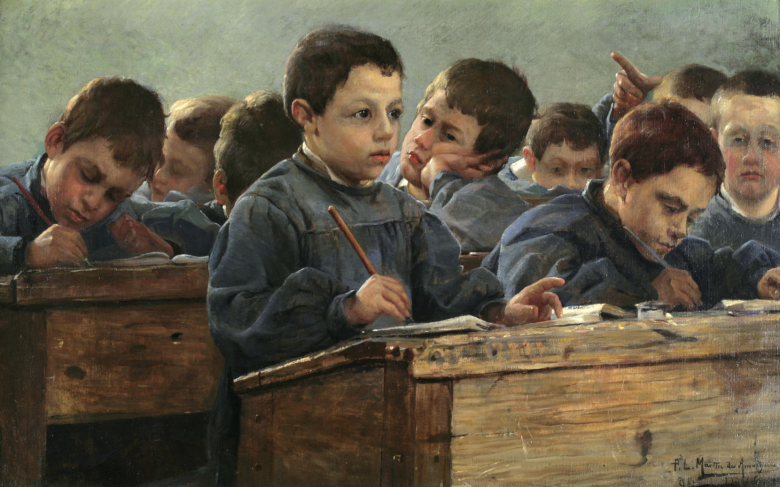
In an earlier reflection, I wrote: “It may be easier to make better lives for our children than to rescue the Church. But the message of Jesus remains—for those willing to hear it.” I see no future in the institutionalised Church. Nor do I believe that alternatives would fare better unless they addressed the same structural flaws. But I do believe, increasingly, that the most meaningful investment we can make is in those who will inherit what remains of this world. And right now, that investment is not being made.
I. A Neglected Generation
In Britain today, children are spoken of often but seldom taken seriously. We invoke them when it’s politically convenient—in debates about crime, education, or “family values”—but rarely ask what kind of world we are actually handing down to them. The numbers are stark:
What is the poverty line? In the UK, a household is considered to be in poverty if its income is less than 60% of the national median income after housing costs. For 2023–24, this equates to approximately £330 per week. This is a relative poverty measure: it doesn’t just reflect material deprivation, but also social exclusion. Families might afford food and shelter, but still lack access to basic societal standards—like internet, transport, extracurricular activities, or heating.
📉 Child Poverty in the UK
- As of 2023–24, around 4.5 million children in the UK—30% of all under-18s—live in relative poverty after housing costs.
- In some regions such as the West Midlands, more than 25% to 30% of children live below the poverty line, with some constituencies showing rates above 35%.
- Regional disparities are pronounced: while child poverty in Scotland stands at approximately 23–24%, other areas like England and Wales hover around 29–30%.
💭 Youth Mental Health Crisis
- According to NHS England’s 2023 data, about 1 in 5 (20.3%) of 8–16-year-olds, and 23.3% of 17–19-year-olds, had a probable mental disorder.
- From 2017 to 2020, the proportion of children aged 5–16 with a likely mental health issue rose from 1 in 9 (≈11%) to 1 in 6 (≈16%).
- Young women aged 17–23 are particularly affected, with roughly 20.8% reporting eating disorders—four times higher than rates in 2017.
- A report from February 2025 estimates that childhood mental health problems will cost the UK over £1 trillion in lifetime earnings lost due to school absence, unemployment, and long-term underperformance.
📟 Public Services Under Strain
- Access to Child and Adolescent Mental Health Services (CAMHS) is limited: in 2023, 239,715 young people were awaiting assessment in England, with frequent waits over a year for specialist care.
- Public youth services—clubs, libraries, extracurricular programs—have seen significant funding cuts nationwide, severely reducing social and developmental infrastructure.
The above figures show not abstract hardship—but structural neglect. When a generation spends weeks—yes, weeks—waiting for help with mental health, or goes hungry because social systems have been starved, we have not had a crisis in leadership; we have failed morally.
II. Childhood as an Afterthought
In medieval society, according to historian Philippe Ariès, “the idea of childhood did not exist.” What he meant was not that children were unloved, but that they were not seen as fundamentally different from adults. They worked, played, and worshipped alongside their elders. There was no distinct culture of childhood, no protected developmental stage.
Of course, part of the reason was brutal necessity. Many children did not survive into adulthood. In such conditions, it made little sense to invest emotionally or materially in their long-term development.
And yet, despite all our progress, how different are we, really? We now know that children are psychologically and emotionally complex. We understand the importance of early development. And still, we treat children more as consumers than as beings in formation. Childhood has become a market segment, not a sacred trust.
III. Children as Unfinished Systems
I see children not as blank slates, but as unfinished systems. The task of society is to enable their growth into full individuation—not in the mystical sense, but in the Jungian sense of becoming whole, coherent persons through the integration of all parts of the self. That requires space, challenge, guidance, and care. It cannot be outsourced to screens, metrics, or underpaid teachers stretched beyond capacity. And fundamentally, raising children is not the duty of the State—it is the duty of parents. What we need are political interventions aimed at two things: first, to encourage and empower parents to take that responsibility seriously; and second, to ensure that they have the resources to do so—food on the table, money in their pockets, and a society that recognises child-rearing as the vital, nation-shaping work that it is.
Our educational system often measures performance rather than fostering character. Our media saturates children with stimulation, but little meaning. And our politics speaks of opportunity while withdrawing the very structures that make opportunity possible.
IV. Looking Abroad
Other countries are not perfect, but many do better—though even they are not immune to the tendency to treat children as extensions of state agendas rather than as developing individuals in need of nurturing environments.
- Finland invests heavily in early education, with low-stress environments and strong social supports (EdWeek). But even there, critics note the growing pressure of digital conformity and standardisation (Issues in Science & Technology).
- Germany offers robust apprenticeships and vocational paths that treat young people as capable contributors (IZA Report). Yet it too struggles with growing bureaucratisation and the risk of institutionalising youth too early (OECD Evaluation).
- Even in the United States, despite deep inequality, there are dynamic experiments in youth-led civic engagement and education reform—though these tend to be isolated and uneven (What Works Growth).
But is Britain really behind others? On child poverty, yes: around 30% of UK children live in relative poverty, compared to ~11–12% in Finland and ~20% in Germany. Youth mental health and life satisfaction also lag behind our European peers. UK teens report the lowest life satisfaction among major European countries—about 25% of British 15‑year‑olds report low well‑being, compared to 7% in the Netherlands.
Knife crime is increasing across all countries. In England and Wales, over 55,000 knife‑enabled crimes were recorded in 2023–24, with youth offenders comprising most possession cases, and 42 homicides affecting 16–19-year-olds. Germany recorded fewer knife assaults—under 9,000 serious cases in 2023—and fewer homicides involving youth. The data challenges the notion that knife crime is a youth epidemic: while troubling, violent youth crime remains a minority phenomenon in both nations.
Britain is not short on rhetoric—but when it comes to children, the results fall far short of the promises. We shuffle exam boards and sloganise about “levelling up,” while leaving millions behind.
V. A Moral Imperative
This is not just a policy failure. It is a moral failure. The young are not a special interest group. They are the condition of the future. To neglect them is to vote for collapse.
The institutional church may not be salvageable. But the message of Jesus remains: “Let the children come to me.” He did not say, “once they’re productive” or “once they’ve passed their SATs.” He said it plainly.
We must stop viewing childhood as a waiting room for adulthood. It is a living, formative state. If we are to have any future that is worth inhabiting, it begins here—not with power, but with care.
Let us invest not in monuments to ourselves, but in the raw, unfinished lives that still have a chance to grow whole.