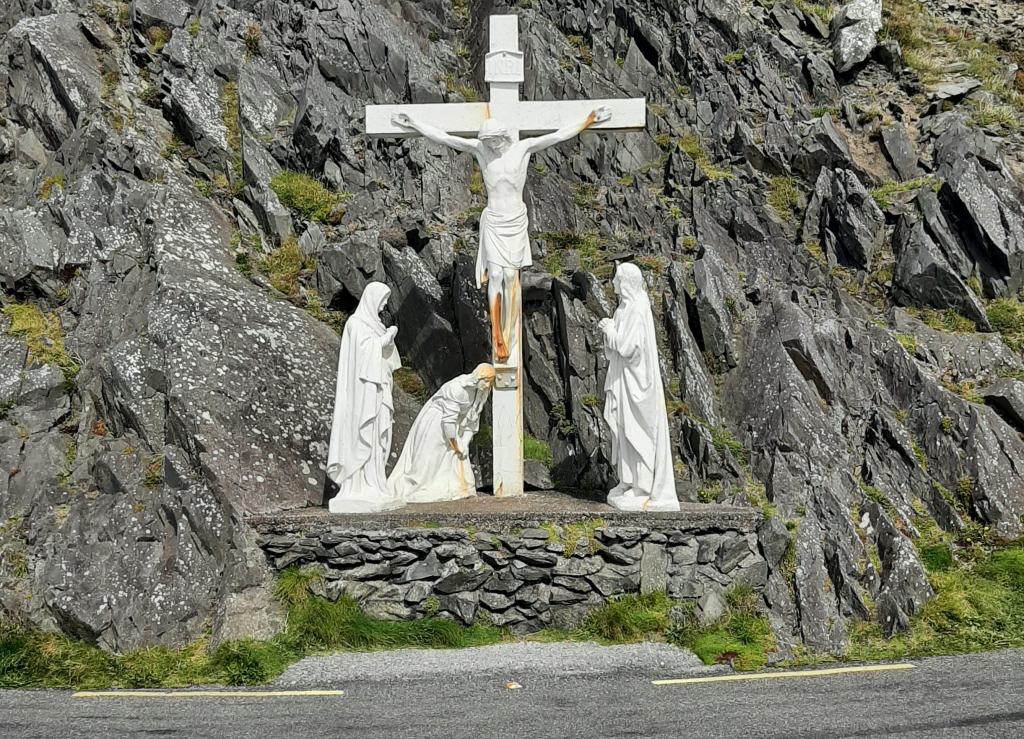
The Crucifixion, Slea Head, Dingle Peninsula, Co. Kerry, Republic of Ireland
📜 Then Came Paul
Everything changed when Paul began to write. Paul never met Jesus in person—only in a visionary encounter on the road to Damascus. And in his letters, we see Christ undergo a dramatic evolution.
Paul rarely speaks of Jesus’ earthly life. Instead, he writes of:
Christ the Redeemer – “Christ died for our sins…” (1 Corinthians 15:3)
Christ the Divine Being – “In him all things were created…” (Colossians 1:16)
Christ in You – “It is no longer I who live, but Christ lives in me.” (Galatians 2:20)
Paul takes the Jewish title Messiah and expands it into a vast cosmic figure: pre-existent, divine, and spiritually dwelling in believers. This is not the Jesus who walked dusty roads teaching parables. This is a theological Christ, layered with Greco-Roman concepts of divinity and mystery.
And here lies the tension: the Christ of Paul is not quite the Jesus of the Gospels.
🔄 Two Visions of Faith
Much of modern Christianity is built on Paul’s Christ, not Jesus’ teachings. Salvation becomes something that happens through faith in Christ’s death, not through living the way of Jesus. Over time, this theology began to shape how Christians saw themselves: not as empowered image-bearers of God, but as broken souls in need of outside rescue.
Jesus didn’t say we were broken. He said we were asleep. His call was not to guilt, but to awakening.
He taught that we already carried something sacred inside us—“The kingdom of God is within you.” The task was not to be saved from ourselves, but to return to our authentic selves—the self that sees clearly, loves freely, and lives without fear.
🧠 An Innate Moral Awareness
Just as Noam Chomsky proposed that humans are born with an innate language acquisition device (LAD)—a biological structure that enables us to learn language when exposed to it—I believe we are also born with an innate moral awareness (IMA): a kind of genetic pre-programming for ethical life. This moral capacity is not taught from the outside in, but wired into us from the beginning. It may be obscured, damaged, or buried by life’s experiences—but it is never entirely lost. The moment of rediscovery may come quietly or suddenly, through what the Gospels call metanoia—a change of heart, a reorientation of being. I’m not concerned here with mapping how that clarity arrives; it differs for everyone. For some, it may be prompted by relationship or reflection; for others, it may come unbidden, like light reaching into a deep place.
The task, then, is not to be rescued but to return to our true selves. Philosophers like Rousseau imagined this core as a kind of tabula rasa—a blank slate—but I think that’s only partly true. The inner self isn’t empty; it’s seeded with potential, pre-tuned to reflect the best in humanity—if given the right conditions.
🌱 The Parable of the Sower
This is what the Parable of the Sower (Mark 4:1–20) illustrates: the seed is good, but the ground—the mind, the life, the circumstance—determines whether it takes root. In that sense, we are all damaged soil to some degree. Some of us are choked by weeds; others are trampled, hardened, or shallow. But the possibility of sanity, clarity, and moral vision remains—if we find our way back to that buried self and allow it to live again through our thoughts and deeds.
The Parable gestures in this direction, but its fatalism troubles me. Unlike plants, humans are not bound by their soil. However dark or compacted our inner ground may be, we are not without movement. We can reach. We can stretch. Change is never easy—especially for those who have lived in deep trauma, or spent much of their lives in institutional or emotional exile. But I believe the possibility of return always exists, however distant it may seem. The Kingdom within is not a reward for the righteous. It is a buried truth, waiting to be reclaimed.
✨ Metanoia vs. Modern Awakening
Today, the language of “awakening” is everywhere. From mindfulness workshops to self-help podcasts to YouTube gurus promising abundance and alignment, modern spirituality often speaks of expanded consciousness. But this awakening is frequently framed as a tool for personal growth, emotional balance, or life enhancement—a way to feel better, attract more, or live with greater ease. It’s not always shallow, but it tends to be inward-facing, therapeutic, and ultimately individualised.
By contrast, Jesus’ call to awakening—what the Gospels call metanoia—was not a technique, but a turning. It meant a radical shift of vision and action. Metanoia is often translated as “repentance,” but that word doesn’t quite capture it. It’s not about guilt or penance; it’s about reversing direction, seeing clearly, and living differently—with integrity, compassion, and courage.
Jesus didn’t urge people to escape the world or perfect themselves. He urged them to wake up within it: to see injustice for what it is, to recognise the divine image in the poor, and to understand that real change begins not in heaven but in the heart. His message was deeply personal, yes—but never private. Awakening was always meant to ripple outward—into relationships, communities, and the world.
The New Age language of consciousness often borrows from this tradition, but in doing so, it can lose its moral sharpness. Jesus wasn’t inviting people to feel enlightened. He was inviting them to live transformed—and to do so in the face of fear, pressure, and power.
👑 The Messiah as Political and Spiritual Figure
In the first-century Jewish imagination, the Messiah was expected to restore Israel, defeat foreign occupiers, and usher in a new age of justice. Jesus certainly invoked this vision—“The kingdom of God is at hand” (Mark 1:15)—but he also redefined it.
The kingdom he described wasn’t about thrones or armies. It was something already near, already present, “within you” (Luke 17:21). And the path to it wasn’t political rebellion, but inner transformation. He called this metanoia—a turning of the heart, a change of mind.
Jesus wasn’t uninterested in justice. He confronted corruption, challenged power, and stood with the poor. But his message was not about seizing control. It was about changing consciousness.
It’s clear from the Gospels that Jesus did not publicly claim to be the Christ, nor did he encourage others to announce it. When Peter exclaimed, “You are the Christ, the Son of the living God” (Matthew 16:16), Jesus acknowledged the statement—but immediately warned the disciples not to tell anyone (Matthew 16:20). The same pattern appears in Mark and Luke. The implication is striking: Jesus may have been moved—even flattered—by the recognition, but he also understood how politically explosive and dangerously misunderstood the title could be. To declare someone Messiah in Roman-occupied Judea was to invite trouble—not only from imperial authorities but also from nationalistic factions hoping for a revolutionary king.
Jesus’ entry into Jerusalem on a donkey—often framed as a bold messianic declaration—can just as plausibly be read as a quiet subversion of that very expectation. Rather than arriving on horseback like a conquering king, he chooses a humble beast of burden, evoking Zechariah 9:9 but simultaneously undercutting its militaristic edge. It was a deliberate act: nonviolent, ironic, disarming. Far from confirming a claim to royal power, it reads more like a theatrical refusal—a symbolic gesture that unsettled rather than satisfied popular hopes. In this light, the so-called triumphal entry becomes a living parable, shifting attention away from political deliverance toward his deeper message: inner transformation, humility, and the arrival of a kingdom that begins within.
This reframing also casts new light on Jesus’ response to Peter’s famous confession. He may have been moved by the recognition—“You are the Christ, the Son of the living God” (Matthew 16:16)—but he immediately instructed the disciples to tell no one. The reason is clear: in Roman-occupied Judea, the term Messiah was politically loaded—evoking rebellion, restoration, and vengeance. That wasn’t the kind of liberation Jesus offered. His message was more radical and more inward. He wasn’t preparing his followers for a holy war, but for a revolution of the heart—for the return of God’s kingdom within (Luke 17:21). The silence he demanded was not denial, but protective restraint—a way of shielding both his mission and his message from being hijacked by false hopes.
📖 Gospel Layers and Later Theology
Scholars agree that Mark is the earliest Gospel, likely written around 70 CE, and forms the narrative backbone for both Matthew and Luke. Strikingly, in the earliest manuscripts—such as Codex Sinaiticus, preserved at St Catherine’s Monastery in the Sinai—Mark ends at 16:8, with no resurrection appearances, only an empty tomb and a group of frightened women. The story ends not with a triumphant return, but with silence and confusion. This abrupt conclusion suggests that the original account contained no postmortem Jesus—the resurrection was proclaimed, but not visually depicted. It was left, perhaps intentionally, as a mystery.
The earliest references to a risen, appearing Christ come not from the Gospels, but from Paul, whose letters predate all four. Paul never met Jesus in life but claimed to have encountered him in visionary form. In 1 Corinthians 15, he lists resurrection appearances—including one to himself—as a matter of revealed faith. This idea of a spiritually embodied, postmortem Christ finds no direct narrative expression in Mark. It is Paul who first gives flesh to the resurrection as an event, not just a hope. Later, Matthew and Luke expand Mark’s outline, adding infancy stories, resurrection scenes, and teachings tailored to their communities. John, writing last, presents a fully mythological Christ: the pre-existent Logos, divine in origin, speaking in elevated monologues and performing symbolic “signs.”
What begins in Mark as a mysterious and open-ended story ends in John as a cosmic theological myth. And the bridge between the two is Paul, who reframed Jesus’ death not as a tragedy, but as a cosmic turning point—and resurrection not as a whispered mystery, but a transformative fact.
📖 Myth and Memory
This process of mythologising is not unique to the Gospels. It’s a common cultural phenomenon, especially in oral and semi-literate societies. Stories like the Chanson de Roland, Beowulf, or even Homeric epics all began with historical or legendary figures, whose lives were later embellished with symbolic, moral, or supernatural elements. The early followers of Jesus—many of whom lived within a pre-critical, mythopoeic worldview—were not concerned with strict historical accuracy in the modern sense. For them, narrative decoration was not deception—it was a way of expressing truth through story, often elevating a figure’s significance by surrounding them with signs, prophecies, and cosmic language. The Gospels reflect this same instinct: to honour what Jesus meant, not just to report what he did.
️✝️ Can We Recover the Gospel Jesus?
Today, there are movements seeking to recover the message of Jesus without the overlays of later theology. Some of these are called Jesus-centered communities, some are part of the Emerging Church, others operate outside formal religion altogether.
A segment on BBC Radio 4 (27 July 2025, between 06:15 and 08:45) highlighted such a movement—one that seeks to return to the ethics, simplicity, and spiritual insight of Jesus himself, without dogma or inherited creeds. These groups see Jesus not as a figure to worship from afar, but as a model of awakened life.
This is not about rejecting Paul entirely. His insights into spiritual identity are real and deep. But we must be honest: Paul reshaped the story. And in doing so, he led the Church down a different path—one where Christ became a cosmic redeemer, and Jesus’ teachings were often sidelined.
🛍️ Conclusion
We don’t need to worship Socrates or Descartes to take their insights seriously. So why have we turned Jesus into a figure to be worshipped, rather than followed?
The Crucifixion, Slea Head, Dingle Peninsula, Co. Kerry, Republic of Ireland
Worship, in the way it’s often practised, can become a distraction—a kind of reverent distance that keeps the actual message out of reach. At its worst, it becomes a substitute for action: bowing instead of becoming, reciting instead of reflecting, admiring instead of living differently. There’s no evidence in the Gospels that Jesus ever asked to be worshipped. In fact, texts like the Gospel of Thomas suggest the opposite: that he called us to become one with him, not to elevate him to a pedestal and stand back in awe. In Saying 108 of the Gospel of Thomas, Jesus says, “Whoever drinks from my mouth will become like me; I myself shall become that person, and the hidden things will be revealed to them.” This is not the language of worship, but of inner transformation and identification. It suggests a path of becoming, not adoration.
Hero worship is easy. Transformation is not. If we want to change—if we want to live the kind of life Jesus described—we have to get up and do the work. That’s the real challenge.
Maybe that’s the point to end on: that Jesus wasn’t simply a political activist, and certainly not the founder of a religion. He was, above all, a moral philosopher of rare depth and clarity. His teaching remains, I believe, the most powerful call to integrity, compassion, and inner renewal the world has ever received. A message not bound by time or place, but one that still speaks—the same yesterday, today, and forever.