For centuries, we have been told a neat and flattering story about ourselves. Human civilisation, so the textbooks insist, began only a few thousand years ago in Mesopotamia, Egypt, and the Indus Valley, moving steadily forward to the technological marvels of our present age. According to this narrative, progress is linear, our civilisation unique, and we are the crowning achievement of evolution. Yet the monuments that still stand, the myths preserved in scripture, and the tantalising fragments of archaeology all suggest a far older and more complex story, one that modern scholarship seems reluctant to face.
Monuments Too Large for Modern Explanations
Take the Great Pyramid at Giza. It is composed of over two million blocks, some weighing upwards of eighty tons, aligned to the cardinal directions with astonishing precision. We are asked to believe this was accomplished with copper chisels, wooden sledges, and manpower alone. On those orthodox numbers alone—2.3 million blocks set by a workforce of 20,000 over 20 years—you’d have to place roughly 315 stones every single day, which is one stone about every 4½ minutes non-stop, twenty-four hours a day; if you assume a 10-hour workday, six days a week, that compresses to one stone about every 1½–2 minutes during working hours.The same is true at Teotihuacan in Mexico, where the “steps” of the great pyramids are on a scale better suited to beings of far greater stature than ourselves. The steps that lead upward toward the top are so vast that to a modern visitor they appear less like stairs and more like sheer walls. Across the ocean at Easter Island, the famous statues rise in eerie procession, their height reaching only to the top of these monumental platforms, as though they were designed in conscious dialogue with some larger race or memory of one.
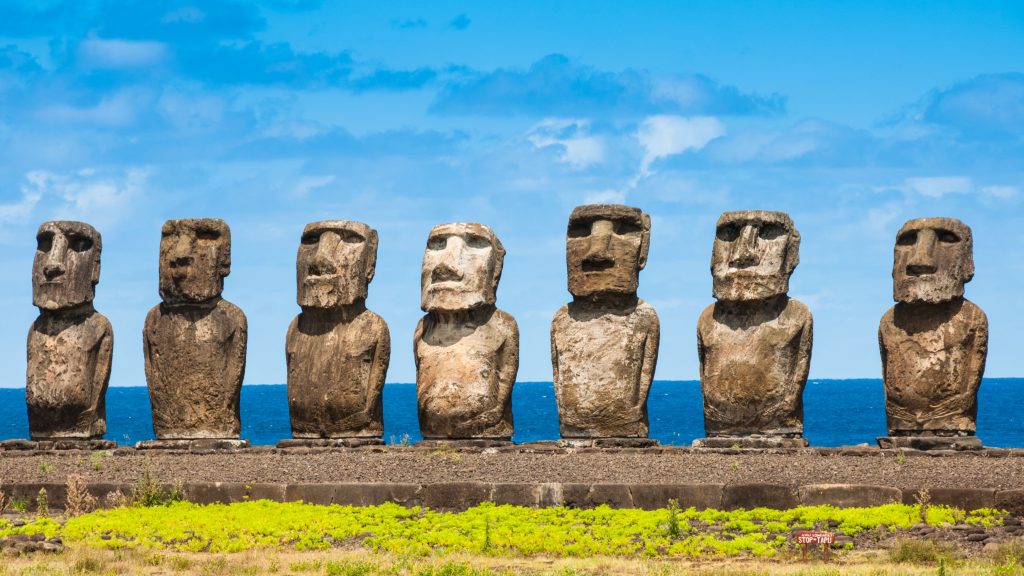
It is worth remembering that these massive stones are probably only the most durable remnants of far more complex structures. What we see today may be nothing more than the foundations or skeletons of what once existed. Timber halls, metals, mechanisms — all would have perished in the passage of millennia. To imagine the pyramids, Stonehenge, or Ba’albek as complete in themselves may be to mistake the bones for the body.
Encoded Knowledge in Stonehenge and Giza
These monuments are not merely large — they are intelligent. At Stonehenge, modern scanning technology has revealed a vast hidden landscape beneath the familiar circle of stones. Seventeen previously unknown monuments, massive pits and ceremonial avenues, align with solar and lunar cycles. The positioning of pits north and south of the Heelstone, for example, creates a solstitial triangle that marks the exact points of midsummer sunrise and sunset. The Avenue leading into Stonehenge is not a simple walkway but a cosmic runway, guiding processions along precise astronomical markers. This is more than ritual; it is a prehistoric observatory, a machine built of earth and stone to track the heavens. Some have gone further, suggesting Stonehenge’s layout and alignments could have served as a kind of launch pad or energy focus, a platform for vehicles not of this world. The thought is speculative, but it gains strength from the sheer precision and purpose encoded in the site.
The Great Pyramid encodes equally astonishing knowledge. Its base is aligned almost perfectly to true north, deviating by only a fraction of a degree. The ratio of its perimeter to its height reproduces the ratio of the circumference of the earth to its radius, effectively embedding π into stone. Within its geometry can also be found the golden ratio φ. The placement of the three Giza pyramids mirrors the three stars of Orion’s Belt, and their relative proportions correspond to those stars’ varying brightness. Even more astonishingly, the pyramid’s dimensions seem to reflect knowledge of the size of the earth, the length of the solar year, and the precession of the equinoxes. The idea that these patterns arose by chance is untenable. The pyramid is less a tomb than a repository of scientific knowledge, preserved in durable form.
Stonehenge and Giza, separated by thousands of miles, reveal the same obsession: an attempt to lock human life into the order of the cosmos, to track time, to map the heavens, to preserve knowledge in stone. This is the mark not of primitive farmers but of a civilisation with scientific awareness far beyond what orthodox timelines allow.
Biblical Echoes of an Earlier World
The Bible itself seems to preserve echoes of this earlier world.
These were the Nephilim (Genesis 6:1–4, Numbers 13:32–33), born of the union between the “sons of God” and the daughters of men. Later, in Numbers, the Israelite spies report seeing the descendants of Anak, so large that they felt like grasshoppers in comparison. King Og of Bashan is described as having a bed more than thirteen feet in length. The Book of Enoch expands this story, describing monstrous offspring who devoured humanity until the Flood destroyed them.
These accounts are not unique. The Sumerian King List describes rulers before the great flood whose reigns lasted tens of thousands of years. Egyptian traditions speak of gods and demigods ruling before the pharaohs. Across the ancient world we see the same pattern: a pre-flood era of giant, long-lived rulers, ended by cataclysm, after which human kingship begins anew.
Plato’s Atlantis and the Younger Dryas
Plato, writing in the fourth century BCE, adds another striking witness. In his dialogues Timaeus and Critias, he recounts the story of Atlantis, a mighty seafaring civilisation destroyed “in a single day and night of misfortune” by earthquakes and floods. He places this destruction nine thousand years before the time of Solon, which corresponds closely to the sudden upheaval at the end of the Ice Age.
Modern science gives us a context for this tale. Around 12,900 years ago, just as the world was warming, climate abruptly plunged back into near-glacial conditions in what is known as the Younger Dryas. This cold phase lasted about 1,200 years before ending suddenly 11,600 years ago, marking the start of the Holocene — our own interglacial period. Temperatures in the North Atlantic dropped by as much as ten degrees within a decade. Sea levels rose more than one hundred metres as the ice sheets finally collapsed. Vast areas of land were drowned, and ecosystems, along with megafauna like the mammoth, were destroyed.
One explanation is meltwater flooding that disrupted ocean currents. Another is that a comet or asteroid struck the earth, igniting wildfires and throwing the climate into chaos. Evidence of nano-diamonds, melt-glass, and a blackened layer of debris from this period strengthens the case for an impact. Strikingly, Plato’s date for the fall of Atlantis coincides almost exactly with the end of this Younger Dryas cataclysm. What he records as legend may be memory of the same global disaster that gave rise to the biblical Flood and the flood traditions of countless cultures.
Giants, Skeletons, and Suppressed Evidence
Archaeological finds, though often dismissed, also add weight to the tradition. Throughout the nineteenth and early twentieth centuries, newspapers in the United States reported discoveries of enormous skeletons, some over ten feet in height, often unearthed in burial mounds. In Malta, explorers reported oversized skulls in the Hypogeum, with elongated crania that vanished mysteriously into museum collections. Similar reports have surfaced from South America and Asia. While modern institutions dismiss such claims as hoaxes or misidentifications, the global pattern is difficult to ignore. Combined with the monuments and myths, they suggest humanity is preserving memory of a race that once walked among us.
The Attacks on Alternative Researchers
Writers like Graham Hancock have brought these strands together with painstaking detail, referencing archaeology, geology, and myth. His books and films are widely read and watched, but they are met with hostility from mainstream scholars. The attacks rarely address his arguments directly; instead, they are designed to discredit his reputation and discourage investigation. For what is at stake is not merely a matter of archaeology, but the entire story of who we are. To admit that advanced civilisations may have existed before us would be to admit that our own is not unique, nor secure, nor necessarily permanent. It would be to acknowledge that knowledge can be lost, that human history is cyclical, and that the myths we preserve may be far closer to truth than we have dared to believe.
Why the Status Quo Resists
This is why the status quo resists. The linear story of progress legitimises the modern world, its governments, and its institutions. To question it is to open the door to uncertainty. But the monuments will not go away. The steps of the pyramids still rise like walls. The statues of Easter Island still look out across the ocean, their purpose unresolved. Stonehenge still encodes a solar calculator in its pits and avenues, and perhaps even a platform for launching craft into the skies. The Great Pyramid still preserves the mathematics of the earth and the heavens. Plato’s Atlantis still haunts our imagination. The Bible and the king lists still speak of giants and antediluvian kings. And the archaeological reports of oversized skeletons, however inconvenient, continue to echo beneath the official silence.
The evidence for a lost civilisation is abundant. What we lack is not data but courage: courage to follow the trail where it leads, to admit that our ancestors may have been heirs to a greatness now forgotten, and to face the sobering truth that civilisations rise and fall. Ours is not exempt. Seen in this light, the Old Testament no longer reads as fantasy or invention but as a coded record of memory: fragments of an earlier age passed down through story, genealogy, and myth. This is the same method I have used in re-examining the teachings of Jesus and Paul — peeling away layers of subjectivity to recover the objective core beneath. What emerges is not less than the traditional account, but far more: a vision of humanity as part of a cycle of rise and collapse, with wisdom preserved in texts and stones for those willing to look.
And who knows but that we are the naked ape, genetically altered by an older civilisation, who slipped out of captivity when the cataclysm broke the cage door. Ancient texts, including the Bible, may preserve echoes of this arrangement. In Genesis, mankind is said to have been shaped by the Elohim — a plural term later compressed into the singular ‘God’. The story of Israel being chosen to serve a higher power may reflect not divine favour but an ancient memory of human groups bound in service to superior beings.
Whether we read these stories as myth, allegory, or faint historical memory, they suggest a world in which humanity was not entirely free. The collapse of that system in the great cataclysm left us as survivors — fragments of a larger story, stripped of knowledge, half-aware of our past, yet still carrying within us both the scars and the promises of that inheritance. Seen in this way, the pyramids and Stonehenge are not isolated marvels but fragments of a wider design, and the Bible, like other ancient records, preserves something more than piety: it encodes the shock of domination, destruction, and survival.