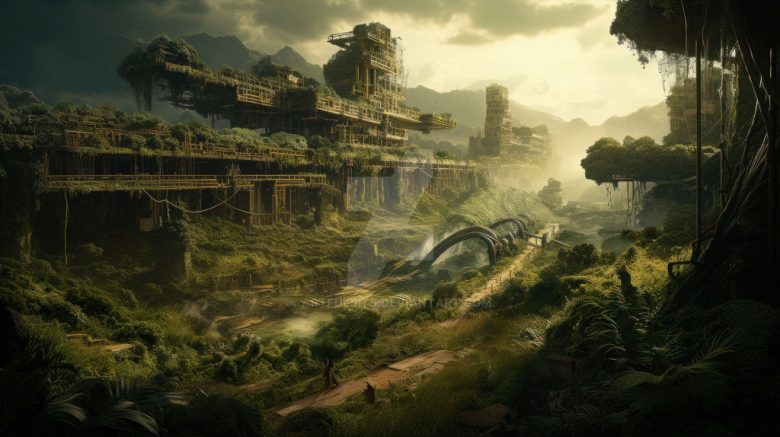
What If They Had Been Left Alone?
We flatter ourselves in the West with our galleries, our libraries, our operas, and our novels. We point to Shakespeare, Beethoven, Michelangelo, and Newton as if their greatness justifies everything done in their wake. But the truth is more sordid: behind these cultural treasures lies a history of brutality, exploitation, and hubris—a legacy of empire that ravaged the very places we now call “underdeveloped.”
I. The Myth of Beneficial Empire
Colonialism has often been dressed up as a civilizing mission, as though European rule was a gift bestowed on backward peoples. In reality, it was a calculated project of extraction. Britain, in particular, perfected this model: consolidate, divide, exploit, and leave. The countries it left behind were often worse off than before—not because their people lacked ability or potential, but because they were not allowed to develop in their own way.
Take Nigeria, for instance. Before the British arrived, it was not a void. It was a patchwork of functioning kingdoms, emirates, and trading systems—the Sokoto Caliphate in the north, the Yoruba city-states in the west, the Igbo communities in the east. These entities were not utopias, but they were coherent, adaptive, and grounded in their own cultures. The British forcibly joined them into a single administrative unit in 1914, setting the stage for a century of internal division and discontent. Today’s insurgency in the northeast is just one bitter fruit of that imperial graft.
II. Disdeveloped, Not Underdeveloped
It is a lie to say that colonized nations were lifted out of darkness. More often, they were pushed into it. Economies were reorganized around cash crops, mineral extraction, and foreign dependency. Systems of governance were replaced with imported bureaucracies. Education was reoriented to serve colonial needs—producing clerks, not citizens.
What might have grown, had these regions been left alone? Perhaps not skyscrapers or space programs, but something more meaningful: cultural continuity, economic dignity, and social cohesion. The loss of these cannot be measured in GDP.
III. The Political Class: Guardians of Nothing
The most damning feature of empire, however, is not its violence but its moral vacancy. The political classes who orchestrated these ventures—and those who now manage their aftermath—have shown almost no sense of responsibility. They inherited the wealth of empire but not its consequences. They invoke “shared values” while maintaining the same extractive logic through debt, trade imbalances, and military interference.
This mindlessness is not passive; it is institutionalised. It allows nations to bomb, sanction, or exploit others without introspection, while reciting lines from Shakespeare or commissioning statues of Churchill. It is the polished cruelty of a class that refuses to reckon with the destruction it has normalized.
IV. What Might Have Been
It is painful to ask what might have emerged had these societies been left to evolve on their own terms. Would they have faced war, corruption, or inequality? Likely. But they would have faced them on their own soil, by their own hands, not as the broken heirs of someone else’s blueprint.
There is still art. There is still music. There is still literature. But what is missing—what was stolen—is the right to shape a future from the raw material of one’s own past. That is the deepest wound of empire. And the most unpardonable.
Keir Starmer’s recent announcement that the UK will recognise Palestinian statehood unless certain conditions are met by Israel is a reminder that the imperial mindset has not disappeared—it has merely evolved. However well-intentioned, the act of externally bestowing or withholding recognition remains an echo of colonial logic: powerful states still positioning themselves as moral arbiters in conflicts they helped to create. The region has already suffered from over a century of foreign decisions made on its behalf. Real autonomy is not granted from outside; it is claimed from within.
I no longer believe that the overall political dynamic—the entrenched patterns of power, self-interest, and institutional denial that govern all Western ‘democracies’—will change in time. It seems far more likely that it will be allowed to run its full course—through denial, distraction, and inertia—until it brings about the destruction of the very world that sustains us. The destructiveness of the Western mindset will reach its full extent when it fully deploys artificial intelligence—not only abroad, but internally, through surveillance technologies, identity cards, and systems of automated control. Our inverted form of democracy is not a flawed ideal but, in its current form, the very heart of darkness. It is, in truth, a system capable of great evil under the guise of freedom. There is much talk about the potential of AI to destroy the human race; I would suggest that we have shown, time and again, that we are quite capable of doing that ourselves.