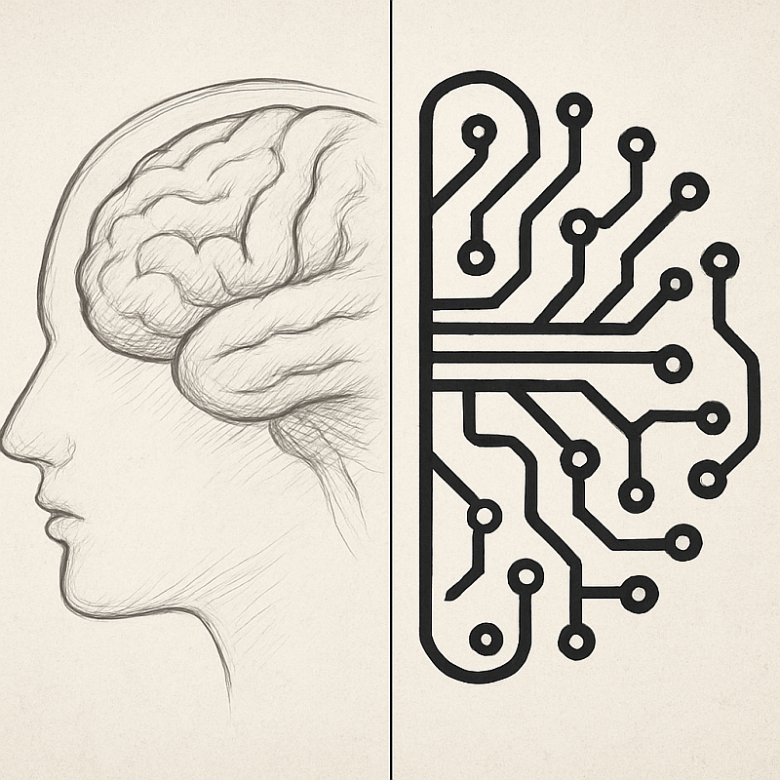
A visual reflection on the deepest difference between humans and AI: the human mind grows through experience and becomes itself over time, while AI arrives fully formed, pre-structured, and without a lived past. This split image captures the contrast between organic consciousness and engineered intelligence.

A reflection on the real meaning of enlightenment — not as mystical experience, but as the quiet reconciliation between our deeper vital dynamics and the surface structure of everyday life. The heart, the conscience, and the unconscious guide us long before reason recognises their pattern.
A reflective essay viewing the Bible as an allegory of consciousness — where Abraham, Israel, and Jerusalem represent stages of inner growth, and the ancient covenant reveals itself as a timeless moral psychology of the human soul.
A reflection on the inner stillness that frees us from self-rejection and restores our capacity to love. Drawing on Jesus’ teaching of the Shema and contrasting the Western vision of wholeness with the Zen ideal of self-effacement, this meditation explores awareness as a natural state — a flight of the spirit in peace and light.
The lotus rises pure from the mud, uniting science and symbol, matter and mind. This reflection explores how the flower’s ancient imagery bridges the two magisteria of human understanding — the measurable and the mysterious.
Meditation does not mean emptying the mind. It means clearing space to think — a discipline of clarity that the Western tradition saw as sacred reasoning, not blankness.
For centuries, religion has offered meaning and comfort, but also control. Today many still hunger for faith, yet find the old stories impossible to believe. This short reflection asks whether we can keep what was best in religion — compassion, courage, and care — without pretending to accept what no longer persuades reason. It argues that meaning, not miracle, must become the new ground of faith.
The Christian God is not the Father we never had, but the Father we must become. This essay explores how Jesus’ teaching can be read as a psychological process of inner reconciliation — a journey from dependency to awareness, from outer authority to inner wholeness.
Tags: Jesus, theology, psychology, Jung, Tillich, Bultmann, Bonhoeffer, consciousness, metanoia, inner life
A meditation on the evolution of consciousness in Christian thought — from Paul’s “unknown God” to Jesus’ vision of the divine within — exploring how faith, philosophy, and awareness converge in the search for unity with the living spirit.
Syd Barrett, the founding spirit of Pink Floyd, sought illumination through LSD and found disintegration instead. His life traces the tragic arc from vision to madness — a false awakening born of brilliance without balance. Genius opened the door; suffering held him there. In the end, he became the King’s Fool: a man who saw too much, too soon.