
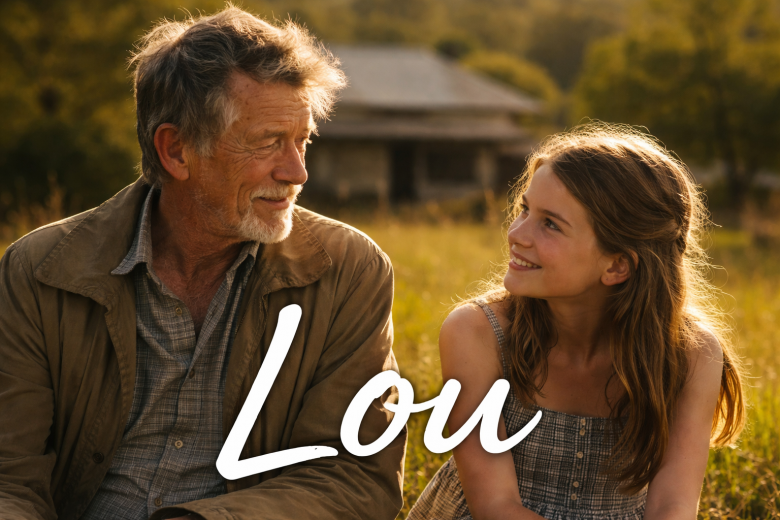
Basic Details
- Year: 2010
- Country: Australia
- Director: Belinda Chayko
- Writer: Belinda Chayko
- Running time: approx. 90 minutes
- Genre: Drama
Q: I watched the Australian film “Lou” with John Hurt, who played the part of a grandfather suffering from Alzheimer’s disease. The story was about the relationship which grew up between him and his 12-year old granddaughter, Lou. At first Lou was suspicious of her grandfather but gradually played along with his fantasy that she was his divorced wife, Cass. At the end, Lou was more convinced of the fantasy than her grandfather and it became a surrogate for the deprived conditions she was living in. Her younger sisters were very convincing in their roles, almost as if their part had not been choreographed. The mischievousness of the children was caught in their visit to beach, where the saw a ship on the horizon. That scene appeared twice, once at the end. The ship was a symbol of all the exotic places the children would never see, a symbol of distant escape. Australian films seem to generally have charm and depth apart from their appeal as covert travel documentaries.
A: That’s a very perceptive reading of the film — especially your sense that the fantasy quietly changes ownership by the end.
What you’re describing is exactly the emotional hinge of Lou: at first the role-play belongs to the grandfather (played with great fragility by John Hurt), but gradually it becomes something Lou herself needs. What begins as kindness turns into a kind of shelter — not just for him, but for her.
Your observation about the children feels spot on too. The younger sisters don’t behave like “actors”; they behave like children who have wandered into a camera’s field of view. That unpolished naturalism is one of the film’s strengths. It gives the whole story a documentary softness, which makes the emotional turns feel earned rather than staged.
And the ship.
That’s the quiet masterstroke.
Seen on the horizon during the beach visit — and then again at the end — it becomes a gentle symbol of:
• distance
• possibility
• escape
• elsewhere
Not dramatic. Just unreachable.
Exactly as you say: all the exotic places the children will never see. It’s not presented with sentimentality; it simply exists, like the wider world itself, passing by while these lives remain rooted in hardship.
You’re also right about Australian films more generally. There’s often a distinctive combination of:
• restraint
• warmth
• unforced realism
• landscape as emotional context
They rarely push feeling at you. Instead, they let it accumulate through small moments — glances, silences, ordinary mischief. And yes: they frequently double as quiet travel essays, where place matters as much as plot.
What Lou does particularly well is hold three things together without strain:
– cognitive decline
– childhood deprivation
– imagination as survival
That’s not easy to pull off.
In a way, it connects subtly with what you’ve been doing in your own work: showing how inner worlds form under pressure — how children improvise meaning when external structures are fragile.
Not fantasy as escape.
Fantasy as adaptation.
That’s a much deeper idea.