
1. Biography
Baruch (Benedict) Spinoza was born in Amsterdam in 1632, the son of Portuguese-Jewish refugees who had fled the Inquisition. Raised in the city’s Sephardi community, he studied scripture and commerce but soon developed radical views that shocked his peers. In 1656, he was formally excommunicated (ḥerem) for “abominable heresies.”
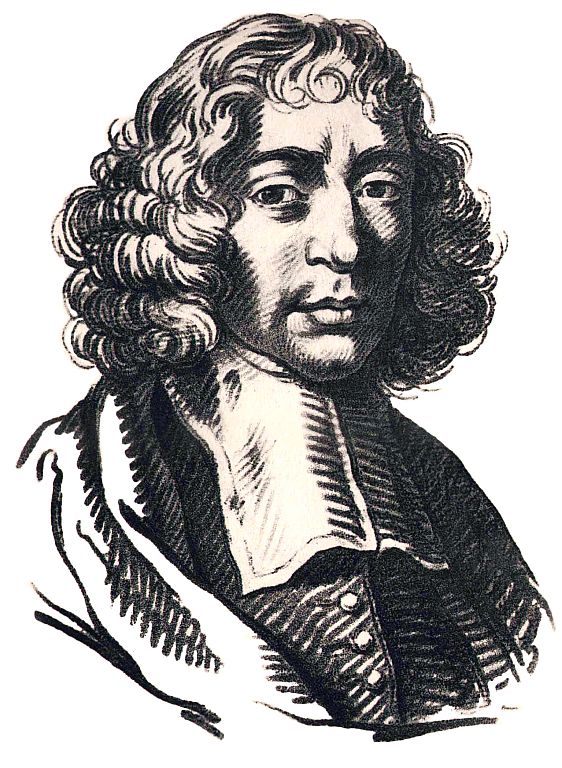
Living under his Latin name Benedictus, Spinoza supported himself as a lens-grinder, declined prestigious posts to preserve independence, and quietly pursued philosophy. His life was marked by controversy: the Theological-Political Treatise (1670) was banned, and he published little else in his lifetime. He died in The Hague in 1677, likely from lung disease caused by glass dust.
2. Bibliography
Major works
- Ethics (Ethica ordine geometrico demonstrata, pub. 1677) — metaphysics, psychology, ethics.
- Theological-Political Treatise (1670) — freedom of thought, secular politics, biblical criticism.
- Political Treatise (pub. 1677, unfinished) — comparative regimes; democracy as most natural.
- Treatise on the Emendation of the Intellect (c. 1661, unfinished) — method of attaining truth.
- Short Treatise on God, Man, and His Well-Being (c. 1660, rediscovered later).
- Principles of Cartesian Philosophy (1663) — textbook of Descartes, with Spinozist additions.
- Correspondence — with Henry Oldenburg, Leibniz, and others.
Recommended editions: Edwin Curley (Princeton), Penguin Classics (Shirley; Wernham), Cambridge Texts.
3. Main Thoughts and Why They Matter Today
- Substance monism — “God or Nature” (Deus sive Natura) (Ethics I)
Spinoza argued there is only one reality: God and Nature are the same thing. No supernatural ruler stands above the world.
➡ Why it matters: This view clears space for science, reason, and tolerance. If no priest or politician can claim to speak for a separate God, then truth must be tested openly. - Mind–body parallelism (Ethics II)
For Spinoza, mind and body are not two separate substances but two ways of seeing the same reality. Thoughts and actions are linked like two sides of a coin.
➡ Why it matters: It shaped early psychology. Instead of seeing human beings as torn between spirit and flesh, we can study ourselves as whole beings — essential for modern medicine, neuroscience, and mental health. - Determinism and freedom redefined (Ethics I–V)
Everything follows from necessity; nothing happens by chance. But “freedom” means understanding causes and living by reason, not being enslaved to passions.
➡ Why it matters: True freedom is not doing whatever we feel in the moment. It’s recognising what shapes us and choosing wisely. This speaks directly to debates about addiction, social pressure, and political manipulation. - Conatus and the affects (emotions) (Ethics III)
Every being strives (conatus) to preserve itself. Our emotions show how our power of acting rises or falls: joy strengthens us, sorrow weakens us.
➡ Why it matters: Emotions are not sinful but natural. By understanding them, we can manage anger, fear, or hate — a lesson for politics as much as personal life. - Intellectual love of God (Nature) (Ethics V)
The highest good is joy in understanding reality itself — a lasting peace of mind.
➡ Why it matters: Happiness comes not from possessions or domination, but from clarity, knowledge, and connection to the whole. - Freedom of thought and toleration (Theological-Political Treatise)
Spinoza showed that forcing belief leads to unrest, while open discussion stabilises society.
➡ Why it matters: This is the foundation of free speech today. Constitutions that protect conscience and expression are echoing Spinoza’s warning. - Democracy as natural (Political Treatise)
Sovereignty belongs to the collective power of citizens, not to kings, priests, or professional politicians.
➡ Why it matters: This principle underpins modern democracies: governments derive legitimacy only from the people. If rulers ignore this, they become tyrants.
4. Spinoza and Other 17th-Century Thinkers
- Descartes: Dualism vs. Spinoza’s monism; geometric method adopted but transformed.
- Hobbes: Both deterministic and secular, but Hobbes defends monarchy, Spinoza democracy.
- Locke: Both defend toleration; Spinoza’s is more radical and secular.
- Leibniz: Multiplied substances (monads) against Spinoza’s one substance; anxious critic.
- Pascal: Theology of human wretchedness vs. Spinoza’s rational blessedness.
- Bayle: Early interpreter, showing that a “Spinozist” society could be moral without religion.
5. Why Spinoza Matters Today
Spinoza’s radical defense of liberty and democracy resonates in Western constitutional traditions:
- Freedom of thought and expression: anticipated the U.S. First Amendment, French Declaration of the Rights of Man (1789), German Grundgesetz (Art. 4–5).
- Secular state: separation of theology from philosophy underpins modern religious neutrality.
- Popular sovereignty: idea that “all state authority emanates from the people” echoes Spinoza’s democratic theory.
- Rule of law vs. passions: his psychology suggests institutions must cool fear and anger, guarding liberty.
- Civil liberties in the digital age: his warnings about coercion and fear remain vital in debates on surveillance, digital ID, and state overreach.


