Excerpt
Even divine words depend on mortal media. From the fading ink of Qumran to the fragile memory of the digital cloud, each age must decide not only how it preserves truth, but why it should wish to do so.
The story of the Bible is not only one of revelation but of transmission and preservation. Every civilisation has faced the same practical question: how to make thought endure beyond the life of its author. The materials have changed over time—papyrus, parchment, paper, and now digital storage—yet the underlying problem remains. Writing, in any age, is a defence against disappearance.
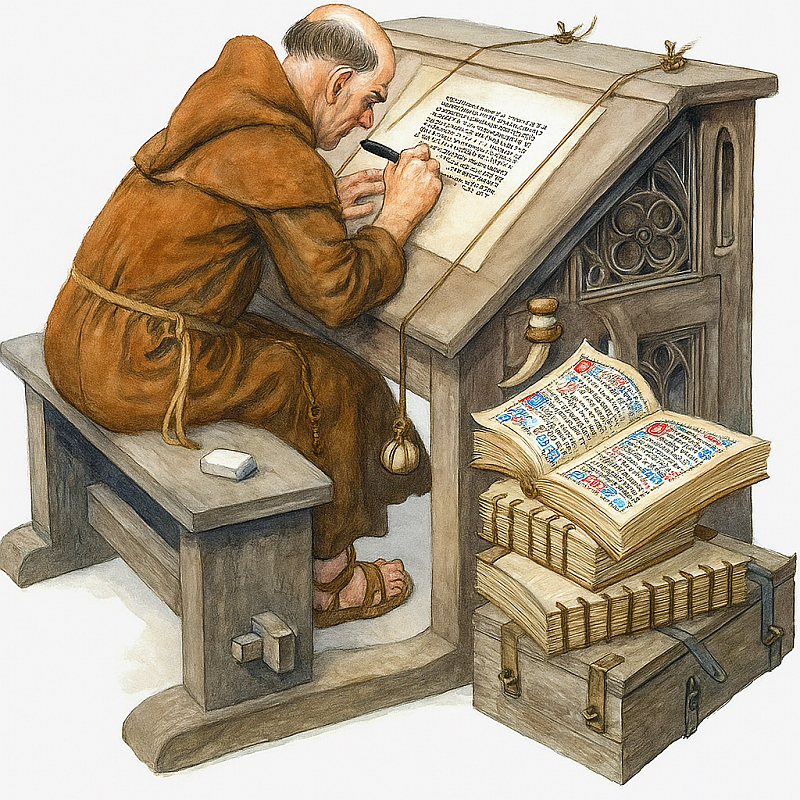
In the ancient world, texts were copied by hand onto materials that were both costly and short-lived. Scrolls decayed, were burned, or were reverently buried once they became too worn to read. Copyists worked in rooms designed for light, aware that the loss or alteration of a single letter could change meaning. Some laboured with exemplary care and devotion; others introduced errors or made changes of their own, whether through fatigue, misunderstanding, or conviction. The history of transmission is therefore not only a record of fidelity but also of interpretation—and at times, of control. As Umberto Eco’s The Name of the Rose reminds us, even the preservation of knowledge can become an instrument of power, and the decision of what to copy or conceal is never without consequence.
Knowledge and Control: Lessons from The Name of the Rose
Eco’s fourteenth-century monastery is a world built around books. Its great library, locked and labyrinthine, symbolises the age-old impulse to possess and regulate knowledge. Only a few are permitted to read freely; the rest must be protected from ideas that might unsettle faith. When a series of deaths is traced to a forbidden volume, Eco turns a detective story into a meditation on censorship—the danger of believing that truth must be contained. The parallel with the history of the Bible is striking. Every act of copying, translating, or editing carries a decision about which truths may be preserved and which suppressed. Even the most conscientious scribe shapes the future by deciding what will be legible and what will be lost.
The difference between preservation and control is fine and easily crossed. The Masoretes, whose work secured the Hebrew Bible, aimed at fidelity; the monks in Eco’s abbey at prohibition. Yet both reveal how fragile the boundary is between reverence and fear. What begins as care for the truth can become anxiety about it, and the tension between the two continues in our own age of digital gatekeeping and algorithmic curation.
Hebrew Before and After the Masoretes
The Hebrew of the biblical period was written with a consonantal alphabet of twenty-two letters, without vowels, punctuation, or word divisions. Readers were expected to know the language well enough to supply the vowels and pauses from memory. This worked while Hebrew was a living tongue, but as it gave way to Aramaic and later Greek, the ability to pronounce and interpret the text correctly began to fade.
A simple example shows the problem. The three consonants MLK could be read as melek (“king”), malak (“he ruled”), or molek (“Moloch”), depending entirely on which vowels were supplied. The meaning was clear to those who heard the text daily in worship, but as spoken Hebrew declined, these ambiguities threatened comprehension.
Later scribes began to use a few weak consonants—aleph, he, waw, and yod—to suggest certain vowel sounds. These are known as matres lectionis, “mothers of reading.” They provided partial guidance but no complete system. By late antiquity, the Hebrew Scriptures were effectively a consonantal skeleton, dependent on oral tradition to give them voice.
The loss of vocal tradition had profound effects. The most striking case is the Tetragrammaton—the four-letter name of God, YHWH. Originally spoken aloud, it gradually fell out of use, replaced in reading by Adonai (“the Lord”) or Elohim (“God”). This was partly an act of reverence, a way of avoiding the presumption of uttering the divine name; but it was also the result of simple uncertainty. Over time, no one could be entirely sure how the sacred name had been pronounced. When later readers encountered the consonants YHWH, the true vowels were already lost.
The Masoretes, active mainly between the sixth and tenth centuries CE in Tiberias and Babylonia, sought to remedy such problems. They inherited a revered text that was increasingly unreadable, and their goal was to restore its sound without altering its letters. The consonantal framework was considered sacred and inviolable, so they devised a network of vowel points and diacritical marks—tiny dots and dashes written above, below, or within the letters. These marks, called the niqqud, indicated the vowels to be supplied. Another set, the teʿamim or cantillation marks, recorded the stress, phrasing, and musical intonation used in synagogue recitation.
Several regional systems emerged (Babylonian, Palestinian, and Tiberian), but the Tiberian system, perfected in the seventh to tenth centuries, became standard for its clarity and precision. It is still the basis of printed Hebrew Bibles today. For the first time, Hebrew could be read consistently and aloud by anyone trained in the system, regardless of dialect or geography.
The Masoretes also surrounded the text with marginal notes known as the Masorah Parva and Masorah Magna. These recorded unusual spellings, counted the frequency of rare words, and warned against potential errors. The result was a self-checking manuscript tradition that preserved not only the meaning but the sound and rhythm of Scripture.
The Masoretes and the Making of a Text
The word Masorete derives from masorah, meaning “tradition” or “transmission.” Their work was not a translation but a vast conservation project. Each scribe approached the text with almost ritual discipline. They counted every letter and every word, noting the precise midpoint of each book, and rejected whole sheets if a single character was misplaced. Beneath this technical accuracy lay a conviction that the written word was sacred—a direct link between God and the community. Their scholarship was a form of devotion as well as of learning.
The Tiberian school, associated with the scholar Aaron ben Asher, eventually produced the version of the Hebrew Bible that became authoritative throughout Judaism. Later manuscripts such as the Aleppo Codex (tenth century) and the Leningrad Codex (1008 CE) preserve this tradition with remarkable consistency. Modern printed Hebrew Bibles and most contemporary translations still derive from these codices, whose accuracy has been confirmed by comparison with the Dead Sea Scrolls, some more than a thousand years older.
The Masoretes accomplished for Hebrew what later humanists would achieve for Greek and Latin classics: they rescued a dispersed tradition from entropy. Their achievement was not invention but stability—a triumph of care, discipline, and faith that allowed the Hebrew Bible to pass from the ancient to the modern world largely intact.
From the Scribe to the Server
Modern technology encourages the illusion that impermanence has been conquered. We like to believe that digital storage has solved the problem of loss, yet the opposite is true. Scrolls perished through decay, but data can vanish instantly through deletion or corruption. A single keystroke can erase a lifetime’s work, and even the largest archives depend on systems that are themselves temporary. The ancient scribe and the modern writer share the same dependence on fragile media and the same hope that their words will outlast them.
Preservation has never been a neutral act. It is shaped by judgement and by values. The scribes of Israel destroyed worn scrolls out of reverence; modern institutions erase records out of convenience or economy—tax records, for instance, are routinely destroyed after a fixed number of years once their administrative use has passed. The motives differ, but the outcome is the same: the disappearance of information. Deciding what to keep is therefore always an ethical act. The responsibility once carried by individual copyists is now dispersed across corporations, governments, servers, and automated systems, yet the moral question remains unchanged: who determines what endures?
Even if every word of a text were transmitted without error, its meaning would still depend on the mind of the reader. Each generation approaches inherited words with its own assumptions, and no interpretation can claim final authority. What we call honesty is not an absolute state but a continual effort to see clearly and to speak without distortion. The reader, like the copyist, must act in good faith, knowing that understanding is always partial.
From scroll to server, from ink to digital code, the written word has remained dependent on both material care and moral attention. It survives because human beings continue to read, to copy, and to care. The preservation of text is not merely a technical achievement but a human commitment: a decision to keep faith with what has been handed down. What keeps the word alive is not the form it takes, but the human will to keep it alive—the choice to remember, to read, and to pass it on.
Perfect direction — that brings your essay full circle, from the preservation of the ancient Hebrew text to the modern struggle over who has the right to interpret it.
The 16th-century English translators — men like William Tyndale, Miles Coverdale, and John Rogers — belong exactly in that story: they were the heirs of the Masoretes in one sense (guardians and transmitters of Scripture) and their rebels in another (taking it from priestly control and giving it to the people).
Here’s a section you could add near the end of the essay (just before The Psalms as a Case in Point), or it could stand as its own reflective coda titled “The Peril of Translation.”
It continues your theme of preservation, authority, and moral courage in language.
The Peril of Translation: From Latin to English
By the sixteenth century the Bible had passed through Hebrew, Greek, and Latin, and the Church held the Latin Vulgate as the only authorised version. To translate it into the vernacular was considered both heresy and insurrection. Yet the same impulse that had driven the Masoretes—the desire to make the Word intelligible—now moved a new generation of reformers and linguists.
Foremost among them was William Tyndale (c.1494–1536), a scholar of Greek and Hebrew educated at Oxford and Cambridge. Convinced that the Scriptures belonged to the people rather than to the clergy, he set out to translate the Bible directly from the Hebrew and Greek texts into clear, idiomatic English. “I will cause a boy that driveth the plough,” he declared, “to know more of the Scripture than thou dost.”
Tyndale’s work was bold, learned, and linguistically brilliant. He forged much of the biblical English we still use today: Let there be light, the powers that be, the spirit is willing, the salt of the earth. But his independence of mind was fatal. Hunted by agents of Henry VIII and betrayed by informers, he was strangled and burned at the stake near Brussels in 1536. His final prayer—“Lord, open the King of England’s eyes”—was answered a few years later when Henry authorised the Great Bible of 1539, much of it drawn directly from Tyndale’s translation.
Others followed in his path. Miles Coverdale (1488–1569) completed the first printed English Bible, drawing on Tyndale’s work but escaping his fate. John Rogers (c.1500–1555), who published the Matthew Bible under a pseudonym, was burned at the stake at Smithfield under Queen Mary I. A generation later, the Geneva Bible (1560), produced by English exiles, became the book of Shakespeare and the Puritans. Finally, the translators of the King James Version (1611), building on all that had gone before, gave England a Bible whose cadences have shaped the English language ever since.
Even today, translators face the same dilemma in a different form. Modern versions such as the New International Version (NIV) or the New Revised Standard Version (NRSV) draw on a range of ancient and newly discovered sources—the Masoretic Text, the Dead Sea Scrolls, the Septuagint, and early Syriac and Latin editions. Each reflects a slightly different textual tradition. Translators must weigh variant readings, decide which to privilege, and sometimes blend several strands into one coherent text. The result is that no modern Bible can claim to reproduce a single original; rather, it represents the best scholarly reconstruction of a living manuscript tradition that has evolved for more than two millennia.
Italian scholar Mauro Biglino, a former translator for the Vatican Publishing House, has drawn attention to this problem from a radical angle. Because ancient Hebrew was written with consonants only, each cluster of letters could carry several possible meanings depending on how the vowels were supplied. Biglino argues that such ambiguity leaves wide scope for interpretation—or misinterpretation—and that successive translations often reveal the theological sympathies of the translator more than the sense originally intended. While many scholars reject Biglino’s more speculative conclusions, his basic point is sound: when meaning depends on missing vowels and interpretive choice, translation becomes as much an act of belief as of philology.
By some estimates there are now more than one hundred complete translations of the Bible in English, and thousands of partial or paraphrased editions. Each claims fidelity, yet their very number reveals our collective unease—the recognition that no translation can fully transmit the richness, rhythm, or “proto-meaning” of the original tongues. The act of translation, however careful, is always interpretive: it opens the text to new readers while inevitably closing certain shades of meaning.
The Psalms as a Case in Point
Nowhere is the tension between preservation and interpretation clearer than in the Book of Psalms. Written in Hebrew poetry whose rhythm depends on parallelism and sound, the Psalms have travelled through more languages and more versions than almost any other ancient text. Each stage in that journey—from Hebrew to Greek (the Septuagint), from Greek to Latin (the Vulgate), and from Latin to English—has carried both meaning and misunderstanding. The words remain recognisable, yet the tone, cadence, and nuance shift like light through coloured glass.
The Hebrew ḥesed, for instance, can mean mercy, steadfast love, kindness, or covenantal faithfulness; no single English word can quite contain it. The Hebrew ruaḥ means wind, breath, or spirit, depending on context. When translators must choose one meaning, they inevitably exclude others, and in doing so they shape the theology that later readers inherit. The psalmist’s personal cry becomes a doctrinal statement, and poetry becomes creed.
This is not a failure of language but a condition of it. Each translation is an act of interpretation—an attempt to render not just words but an entire world-view into another idiom. The Septuagint’s Greek sometimes amplifies, sometimes reinterprets, and occasionally Christianises the original Hebrew. Jerome’s Latin, though closer to the Hebrew, adds its own resonances of Roman order and rhythm. Modern English translators still face the same dilemma: whether to preserve literal accuracy, poetic beauty, or devotional clarity. Every version is faithful in one sense and faithless in another.
The Psalms thus embody the whole history of transmission in miniature. They show that the survival of a sacred text depends not only on scribes and scholars but also on translators, readers, and singers—each generation giving the ancient words new voice. What has been preserved through the centuries is not a single unchanging message but a continuing dialogue between the text and those who receive it.
To read or translate the Psalms today is therefore to join that conversation. The words we inherit are not fossils of faith but living witnesses to the care, interpretation, and devotion of countless hands and minds. In them we see what it means for a word to endure: not as a relic perfectly preserved, but as a meaning constantly renewed.
Would you like me to prepare this final version with WordPress metadata — title, slug, excerpt, and tags — for publication under History & Ideas?