Excerpt: A meditation on how intellectual orthodoxy silences discovery—from Bruno’s pyre to Chomsky’s lecture hall—and why the courage to consider the improbable is the first condition of truth.
There is a strange kind of stupidity that passes for wisdom in the modern world — the refusal to consider what falls outside the accepted frame. We call it “academic rigour,” “peer review,” or “scholarly caution,” but more often than not it amounts to intellectual cowardice. For fear of muddying the water, our institutions have learned to repress inquiry. And yet, muddy water is where life begins.
I. The Comfort of Certainty
No civilisation willingly challenges its own foundations. Once a body of knowledge becomes institutionalised, it develops mechanisms of self-protection. Theologians once guarded the authority of the Church; scientists now guard the authority of Science. Both have their hierarchies, their gatekeepers, and their heresies. The names have changed, but the instinct to exclude remains the same.
This is why genuinely new ideas rarely emerge from the centre. They arise on the fringes — from the uncredentialled, the ridiculed, the dreamers who dare to imagine that what we call “settled” may not be settled at all.
II. The Pattern of Suppression
History provides the pattern in clear relief.
Giordano Bruno, burned in 1600 for suggesting that the stars are suns and that the universe may be infinite.
Galileo Galilei, forced to recant for placing the Sun rather than the Earth at the centre.
Ignaz Semmelweis, dismissed from his post in Vienna for suggesting that doctors wash their hands before surgery.
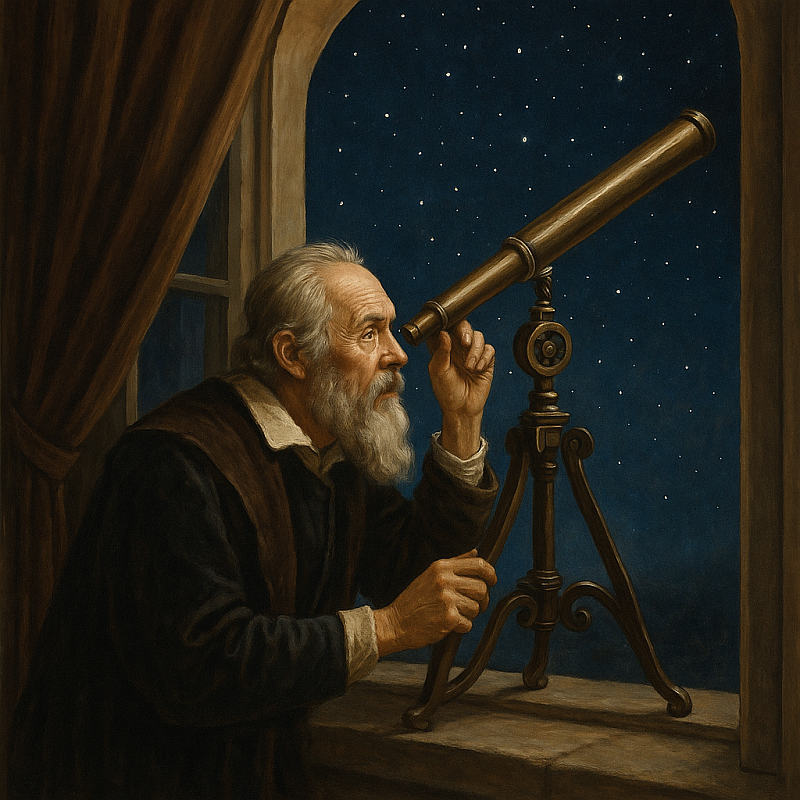
(“And yet it moves.”)
According to legend, Galileo Galilei muttered this under his breath after being forced by the Roman Inquisition in 1633 to recant his belief that the Earth moves around the Sun.
Each of them presented evidence; each was denounced for “lack of proof.” In every case the real issue was not absence of data but excess of doubt — the kind of doubt that threatens authority.
III. The Case for the Heterodox
We see the same reflex today in the academic dismissal of unorthodox interpretations of ancient history.
Writers such as Mauro Paolo and Zecharia Sitchin, though often speculative, assembled linguistic and textual material that raised questions worth asking. They may not have found the smoking gun — no spacecraft, no transistors buried in Mesopotamian clay — but they brought forward evidence of unusual linguistic correspondences and mythic coherence.
To reject such work on principle because it contradicts the current paradigm is not intellectual prudence but institutional fear. Science is supposed to weigh hypotheses against evidence, not suppress them before they are weighed. As long as interpretation remains possible, discussion remains legitimate.
Even if the Sitchins of the world are mistaken, they perform a vital service: they remind us that history is not yet written in full, and that knowledge expands only where imagination dares to trespass.
As Alexander Pope warned, “fools rush in where angels fear to tread.”
Yet it is often the so-called fool — the one who steps beyond the permitted boundary — who clears the ground for later wisdom. The line between folly and genius is drawn not by the act of trespass, but by time itself.
IV. Bruno’s Telescope
When Galileo first aimed his telescope at the heavens, theologians refused to look. They declared the instrument deceptive, a toy of illusion. Mockery is always the first weapon — the shield of those who cannot afford to see. Silence is the second — the refusal even to engage. To glance through the lens would have forced them to confront what they had already decided could not exist: the moons of Jupiter, the phases of Venus, the texture of the Sun. Their certainty blinded them.
The same mechanism operates today, though the robes are different. The modern academic fears ridicule more than error. A single flirtation with an unfashionable hypothesis can cost a career. And so the safest course is silence — the slow death of curiosity under the weight of consensus.
Universities, media, and think-tanks present the appearance of free debate, but only within carefully defined limits.
Ideas that fall outside the permitted spectrum are ignored, ridiculed, or — most effectively — met with silence.
As Chomsky writes, “The smart way to keep people passive and obedient is to strictly limit the spectrum of acceptable opinion, but allow very lively debate within that spectrum.”
In this way, thought control in liberal societies is not an act of censorship but a culture of conformity — the polite management of possibility.
Mockery and silence, the twin weapons of orthodoxy, achieve what persecution once did: the preservation of comfort through the exclusion of doubt.
V. The Mud Itself
Knowledge is born in the mud. Every scientific method began as heresy: alchemy before chemistry, astrology before astronomy, theology before psychology. The line between superstition and discovery is not moral but temporal. What we dismiss as myth may hold the first glimmer of a principle we have yet to articulate.
The Antikythera Mechanism, retrieved from a shipwreck in 1901, shows how wrong scholarship can be when it assumes too little of the past. Until its discovery, historians believed complex gearing to be a medieval invention. Yet this corroded Greek artefact — a 2nd-century BC computer of astonishing precision — modelled the movements of the Sun, Moon, and planets with interlocking bronze cogs. For nearly two thousand years humanity forgot what it once knew.
Who, then, are the real fools: those who imagine too much, or those who imagine too little?
VI. The Moral of the Matter
The deeper problem is moral rather than technical. To reject hypotheses on principle is to reject the moral duty of thought itself — the duty to remain open to surprise. Every truth begins as speculation. Every discovery begins as a doubt. The honest scholar recognises that ignorance is not an embarrassment but the engine of understanding.
Knowledge does not advance by obedience but by disobedience.
It grows through contradiction, through the clash of incompatible visions. When we censor speculation for fear of error, we do not protect truth; we protect ourselves from the discomfort of being wrong.
VII. Toward an Ethic of Curiosity
A culture confident in its reason should have nothing to fear from heresy. The test of an idea is not whether it fits the prevailing model but whether it can stand against evidence, argument, and time. If the hypothesis collapses, no harm is done; if it endures, the world changes.
To explore the improbable is not to betray reason but to extend it. Sherlock Holmes, that archetype of rational inquiry, was right: “When you have eliminated the impossible, whatever remains, however improbable, must be the truth.” The impossible must first be imagined before it can be eliminated.
The muddiest water, once stirred by courage, becomes the clearest stream.
Across centuries, the pattern repeats: ridicule first, recognition later.
History teaches us that to fear ridicule is to fear truth itself.