Excerpt
A reflective essay on how early patterns of love and fear shape adult life. From Hemingway and D. H. Lawrence to the words of Jesus, it explores how we learn courage, how dependence becomes maturity, and how the “kingdom of heaven within” points to self-knowledge rather than belief.
One cannot open a news feed today without being warned about the effects of “poor” parenting — and what it might mean to the reader! I dislike this sort of exhortation to self-examination because it can easily become a fruitless obsession. My own “domestic criticism,” as Keats once called the private weighing of one’s own affairs, is best conducted without the help of Microsoft, the BBC, or whatever other organisation happens to be moralising this week. Parenting is too complex and too deeply human to be reduced to slogans. It can be good or bad, wise or unwise, but it is never exact. My concern is not to judge but to understand what lies beneath: how parents shape the inner life, and how the patterns of childhood become the foundations of adulthood.
“It takes a great deal to destroy a man, but long before that he might concede he is defeated.”
Those words are mine, though the echo is deliberate. Hemingway wrote in The Old Man and the Sea, “A man can be destroyed but not defeated.” Yet he himself took his own life — a paradox that underlines the very point. The tragedy of the modern man is not destruction from without but surrender from within. The quiet giving-up of spirit often precedes any outward collapse. And the power to resist that inner defeat is first learnt, or not learnt, in childhood.
Every child is taught, by word or silence, how to meet the world. The earliest years form the unseen script of response: what to fear, what to hope for, and where to turn for strength. The pattern is not set by perfection but by atmosphere — by whether love, stability, and trust are present. No generation begins with a blank slate. Parents act out of what they themselves have inherited, repeating old patterns in the hope that this time they will work.
It was Jesus who observed, with extraordinary psychological insight, “They know not what they do.” The remark was not only about sin or cruelty; it was about human blindness — the tragic unawareness with which one generation passes its wounds to the next. They act from their own injuries. They pass on what they have known — sometimes light, sometimes shadow — and the cycle continues, half-blindly, from generation to generation.
Much of what is later called “personality” is really adaptation: the small accommodations made in order to secure approval or avoid rejection. The confident adult may still be the appeasing child in disguise; the defiant one, still the neglected boy or girl declaring independence. The surface self is built around early strategies of survival. It is not easy to unlearn them.
D. H. Lawrence saw this inheritance with almost prophetic insight. In his poem Falling out of the Hands of God, humanity has slipped from the divine grasp and now flails in space, frightened, longing to be held again. For Lawrence this was not theology but psychology: having lost contact with the living source within, man looks outward for meaning — to religion, politics, possessions, even love itself — and calls that search “faith.” But it is not faith; it is fear disguised as longing. It is the symptom of inner inadequacy. The tragedy of modern man is not that he is godless but that he cannot live without a surrogate god.
Most adults carry within them an unhealed division between the child that was and the adult they pretend to be. From that fracture arise both the need for gods and the craving for control. A society built on such fragility becomes restless, addicted, perpetually seeking reassurance from outside. We compensate for inner uncertainty with systems, labels, therapies, and advice — an industry of meaning that keeps anxiety alive by promising to cure it.
Those who grow up without a firm inner core of self-trust often turn outward for the stability they never developed within. They may seek certainty in religion, ideology, or metaphysical systems that promise order and belonging. Others fill the same emptiness with addiction — sometimes to numb the self, sometimes to impose an obsessive sense of order upon it. What they lack in inner authority they replace with external conviction or control. It is not hypocrisy but compensation: a search for structure to stand in for the missing parent within.
In this sense, religion becomes a psychological shelter — a symbolic substitute for the steady hand that was absent or uncertain in youth. Lawrence saw this clearly. His “falling out of the hands of God” was not only a cosmic image but an inner condition — the loss of an anchoring presence. Humanity’s hunger for the divine, he thought, was really a hunger for wholeness: the longing to be held again, not by a deity, but by an integrated self.
No wonder Jesus called God “Abba” — Daddy.
Many speak of love for their fathers, yet that love is often still a dependent one. They believe they ‘have’ a father, without realising what they are truly saying: that they have never fully learnt to stand alone. The rites of passage in older societies existed for this very reason — to mark the moment when a child no longer needed to hold the father’s hand and could begin to rule the inner kingdom for themselves.
“The kingdom of heaven is within” (Luke 17:21, in most translations). In the language of first-century Judea it meant precisely this: that the true authority, the seat of peace, lies not in another world but in the awakened self — not in any metaphysical sense, but in the sense that we develop the courage to take responsibility for ourselves, even after the knocks and blows that inevitably assail us. Such blows are the consequence of being alive. Yet there are some who pass on not courage but callousness, taking a grim delight in teaching their children to be hard, indifferent, and responsible only to themselves.
What Jesus called the kingdom within belongs not to theology but to maturity. What the ancients expressed through myth, ritual, and religion we must now learn to understand psychologically. The symbols have not changed; only the mindset that interprets them has.
The King and the Child
Every parent, knowingly or not, teaches the child how to survive, protect, and defend the self — not necessarily in violence but in spirit. In earlier ages the father, or the appointed tutor, taught his son to wield a sword and fight in battle; the mother was the sustaining heart of the kingdom. Yet the ideal of kingship was never confined to men. Elizabeth I ruled as firmly as any monarch of her time, and countless women today find themselves in a similar position — obliged to master strength in a world that still half-expects them to yield. What endures is the lesson itself: that life requires discipline, courage, and care for what is entrusted to us.
All education, at bottom, consists in presenting an appropriate challenge. The child may falter or feel defeated for a moment, but like the fallen squire, he will rise again and take up the fight. Every boy and girl must one day inherit a throne — the rule over their own nature. The task of the parent is to prepare them for that kingship.
The old myths captured it better than modern psychology. The child who cannot face challenge remains a vassal; the child who learns self-command becomes free. It is not obedience that saves us but the steady growth of an inner authority — the discovery of the rightful ruler within. The king and the child are symbols of the same person at different stages: innocence learning mastery, energy learning direction. Parenting, at its best, is the art of helping that transformation take place.
Robin Hood and His Son
Imagine Robin Hood teaching his son to joust with a staff across a log that spans a river. The boy falls, laughs, climbs out, and tries again. The father’s lesson is not in winning but in the recovery after loss. Courage is not the absence of fear but the decision to rise again. Through such play the child learns the first law of the kingdom: that strength and joy belong together, and that defeat is not the end.
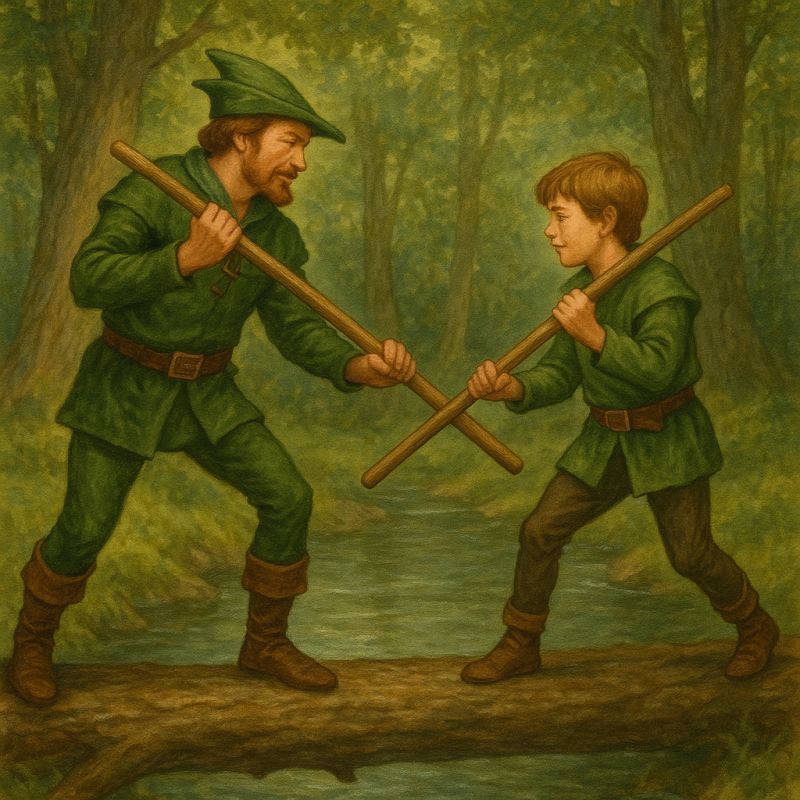
The child trained in this way carries something of the forest spirit into adulthood — the ability to act, to adapt, to balance. He learns that life is both peril and grace, and that the point is not to avoid falling but to learn how to stand again. This image of father and son in the greenwood belongs with the older ideal of kingship: both describe the awakening of inner independence, the moment when authority passes inward and the person becomes his own guide.
Falling and Finding the Centre
What Lawrence called “falling out of the hands of God” is what psychology calls losing the centre. Yet perhaps falling is necessary if we are to discover that the divine hands are also within us. Growth requires separation. The child must leave the shelter of the parent, as humanity must leave the imagined shelter of heaven, if either is to become real. The purpose of parenting — and of growing up — is to bring that truth to light: that the strength we seek from others must one day arise from within.
To become an adult is to reconcile the child who longs to be held with the adult who must stand alone. Few achieve it fully, yet each attempt matters. The world is sustained not by perfect parents or perfect children but by those who keep trying to be whole, who refuse to concede defeat even when the battle seems lost.