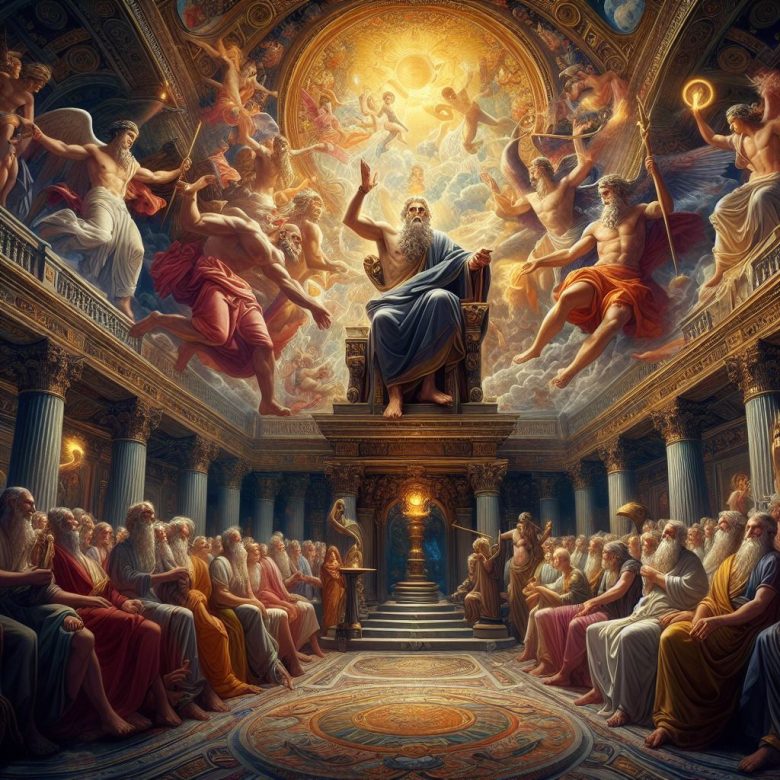
The following psalm presents an unusual scene: God presides over a council of other beings who are themselves called gods.
Psalm 82
God takes his place in the divine council;
he passes judgement among the gods:“How long will you judge unjustly
and favour the wicked?Defend the weak and the fatherless;
give justice to the poor and oppressed.Rescue the weak and needy;
save them from the power of the wicked.They know nothing and understand nothing.
They wander in darkness,
and the foundations of the earth are shaken.I said, ‘You are gods;
all of you are children of the Most High.’Yet you will die like human beings
and fall like any earthly ruler.”Rise up, O God, and judge the earth,
Psalm 82 — modern English rendering
for all nations belong to you.
Who were these gods, and why were they being judged?
English translations use God and gods, but the Hebrew suggests a hierarchy. Elohim takes his place in the council of El and judges among the other elohim. The scene is not a meeting of equals. It resembles a commander addressing officers who have been given authority and have failed in their duties.
Mauro Biglino gives the passage an even more literal interpretation. He does not regard the elohim as spiritual beings gathered for moral instruction, but as members of a ruling hierarchy. Elyon is the superior commander; the other elohim are territorial governors to whom peoples have been assigned. They have governed badly and are being called to account. “You shall die like men” is therefore not a theological mystery, but a sentence imposed upon officers who have failed.
This is not the orthodox interpretation, but it arises from the wording of the text itself. The psalm distinguishes the Most High (Elyon) from subordinate beings who are also called gods (elohim), who exercise authority over human affairs and who can be condemned to death.
The books of the Old Testament in approximate order of composition
Different religious traditions include different numbers of books in the Old Testament, ranging from 39 in the Protestant canon to 54 in the Ethiopian Orthodox canon. The table below follows the 39-book Protestant arrangement and places the books in their approximate order of composition.
The dates refer mainly to the period when each book reached its present or near-present form. Many contain stories, laws, poems and traditions that are considerably older. The date of composition must therefore not be confused with the date of the events described.
Genesis is the clearest example. It probably reached its present form during the sixth or fifth century BC, but its stories concern the creation of the world, the Flood, the dispersal of peoples and the patriarchs. These traditions may have circulated for centuries before they were gathered into a single book.
The conventional order of the Old Testament does not follow the order in which the books were written. Genesis–Deuteronomy are placed first because they provide the theological foundation for everything that follows: creation, covenant, law, the promise of land and the origin of Israel. The later history can then be presented as the fulfilment—or more often the violation—of principles established at the beginning.
Arranged by probable date of composition, however, the books reveal a less orderly development. Early traditions, prophetic criticism, Deuteronomic law, conquest, exile, priestly reconstruction and wisdom literature appear at different stages. This does not prove that no coherent theology existed before the books were written. It shows that the theology preserved in the Old Testament was transmitted, reshaped and eventually arranged into a sequence that gives the collection its unity.
| Approx. position | Book | Probable date of final form | Important qualification |
|---|---|---|---|
| 1 | Amos | c. 760–730 BC | Contains later additions, but its core comes from the eighth-century prophet. |
| 2 | Hosea | c. 750–700 BC; edited later | Based on an eighth-century northern prophet. |
| 3 | Micah | c. 735–700 BC; edited later | Some later material was added to the original collection. |
| 4 | Isaiah | c. 700–400 BC | Chapters 1–39 contain much eighth-century material; 40–55 are exilic; 56–66 are later. |
| 5 | Nahum | c. 650–610 BC | Written before or around the fall of Nineveh in 612 BC. |
| 6 | Zephaniah | c. 640–600 BC | Core associated with the reign of Josiah; later editing possible. |
| 7 | Habakkuk | c. 620–580 BC | Usually placed around the rise of Babylon. |
| 8 | Deuteronomy | Core c. late seventh century BC; final form sixth–fifth centuries BC | The earliest identifiable written Torah; later expanded. |
| 9 | Jeremiah | c. 600–500 BC | Contains the prophet’s sayings, narratives about him and later editorial material. |
| 10 | 2 Kings | Final form after 586 BC | Ends with the Babylonian exile; closely connected with 1 Kings. |
| 11 | 1 Kings | Final form sixth century BC | Part of the same historical work as 2 Kings. |
| 12 | 2 Samuel | Final form seventh–sixth centuries BC | Contains older narratives about David. |
| 13 | 1 Samuel | Final form seventh–sixth centuries BC | Combines several accounts of Samuel, Saul and David. |
| 14 | Judges | Final form seventh–sixth centuries BC | Older tribal stories were arranged within a theological pattern. |
| 15 | Joshua | Final form seventh–sixth centuries BC | Closely shaped by Deuteronomic language and theology. |
| 16 | Lamentations | Soon after 586 BC | Responds to the destruction of Jerusalem. |
| 17 | Obadiah | Sixth century BC | Usually connected with the destruction of Jerusalem and Edomite hostility. |
| 18 | Ezekiel | c. 593–550 BC; edited later | Closely associated with the Babylonian exile. |
| 19 | Genesis | Mainly sixth–fifth centuries BC | Older ancestral and primeval traditions were assembled into the opening of the Torah. |
| 20 | Exodus | Mainly sixth–fifth centuries BC | Combines liberation traditions, wilderness stories and legal material. |
| 21 | Leviticus | Mainly sixth–fifth centuries BC | Much of its present form reflects priestly thought of the exilic or Persian period. |
| 22 | Numbers | Mainly sixth–fifth centuries BC | Combines wilderness narratives, laws, lists and census material. |
| 23 | Haggai | c. 520 BC | Its prophecies are dated within the text. |
| 24 | Zechariah | Chapters 1–8: c. 520–518 BC; chapters 9–14 later | The book contains at least two major chronological layers. |
| 25 | Malachi | Fifth century BC | Belongs to the restored Temple community of the Persian period. |
| 26 | Ezra | Fifth–fourth centuries BC | Contains Hebrew and Aramaic material concerning the restored community. |
| 27 | Nehemiah | Fifth–fourth centuries BC | Contains memoir-like material associated with Nehemiah, later edited. |
| 28 | Ruth | Fifth–fourth centuries BC | Set during Judges but probably written much later. |
| 29 | Jonah | Fifth–fourth centuries BC | Set in the eighth century, but its language and concerns point to a later tale. |
| 30 | Job | Sixth–fourth centuries BC | Most scholars place it in the sixth or fifth century, though exact dating is uncertain. (Yale Bible Study) |
| 31 | 1 Chronicles | Fourth–third centuries BC | Retells history from Adam to David from a later Temple-centred standpoint. |
| 32 | 2 Chronicles | Fourth–third centuries BC | Continues through the exile and Cyrus’s decree after 539 BC. |
| 33 | Proverbs | Final form fifth–third centuries BC | Contains older collections, including royal and household sayings. |
| 34 | Psalms | Collection completed perhaps fourth–second centuries BC | Individual psalms may be much older; the Psalter was assembled in stages. Its internal order also remained variable. (Yale Bible Study) |
| 35 | Joel | Often fifth–fourth centuries BC | Its date is particularly disputed; some scholars place it earlier. |
| 36 | Song of Songs | Final collection fourth–third centuries BC | Individual love poems may be older. |
| 37 | Ecclesiastes | Third century BC | Its language and social background point to the Hellenistic period. |
| 38 | Esther | Fourth–second centuries BC | Set in the Persian period but probably written later within the Persian or Hellenistic age. |
| 39 | Daniel | Final form c. 164 BC | Its court stories may be older, but the visions address the persecution under Antiochus IV. Daniel stands among the Writings in the Hebrew Bible rather than the Prophets. (Yale Bible Study) |
Arranged solely by probable date of composition, the books of the Old Testament would not present the same coherent theology as they do in their conventional order. They would instead reveal the gradual development of Israelite religion: early traditions, prophetic criticism, Deuteronomic law, the experience of conquest and exile, priestly reconstruction and later wisdom literature.
The conventional order gives these diverse writings a theological unity. Genesis–Deuteronomy are placed first and treated as the foundation of everything that follows. Israel’s later history can then be presented as the fulfilment—or more often the violation—of principles supposedly established at the beginning.
The date of a book’s composition must, however, be distinguished from the date of the events it describes or the traditions it contains. Genesis probably reached its present form during the sixth or fifth century BC, but its stories are set in the remote past: the creation of the world, the Flood, the dispersal of nations and the age of the patriarchs. A late date of composition does not mean that these stories were invented at that time.
The British Assyriologist W. G. Lambert argued that the Enūma Eliš was composed during the reign of Nebuchadnezzar I, about 1121–1100 BC. The Babylonian epic describes the origin of the gods, the conflict between Marduk and Tiamat, the formation of heaven and earth from Tiamat’s body, and the creation of mankind to serve the gods. Genesis is much shorter and removes most of this divine drama. It replaces a world of competing gods with one God who creates by command. Genesis may therefore be understood not as the invention of creation belief in the sixth or fifth century BC, but as a later and more austere reworking of a much older Mesopotamian tradition.
The important question is therefore not why these ideas were invented so late, but why they were written down, selected and combined at that particular point. The destruction of Jerusalem and the Babylonian exile threatened Israel’s political, territorial and religious identity. Collecting its traditions into an ordered account gave the displaced community a common past and an explanation of its place in the world.
Genesis was not necessarily the creation of a new theology. It may have been the preservation, revision and consolidation of an older one, expressed partly through stories inherited from the wider culture of the ancient Near East.