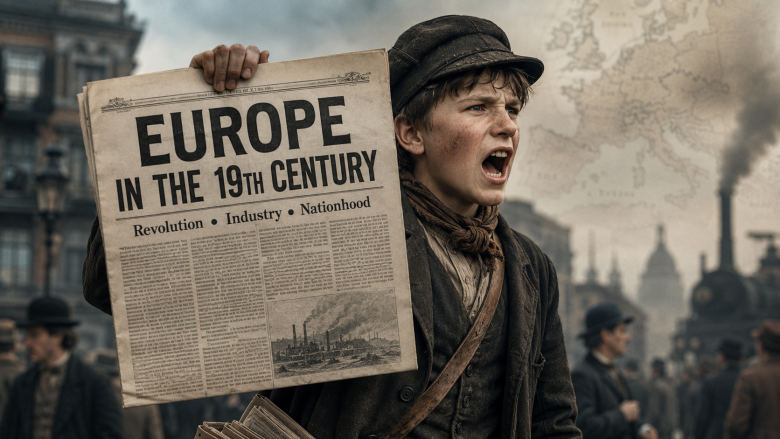
In the 19th Century, Britain, France and the German lands participated in a common European transformation, but they followed markedly different routes through it. Britain was the first country in which mechanised production, fossil-fuel energy, factories, expanding markets and sustained economic growth combined on a national scale. It did not invent every component independently, nor did the Continent merely copy it afterwards.
Britain and France: two revolutions creating modern Europe
Eric Hobsbawm (1917–2012) was a British Marxist historian, best known for his four-volume history of the modern world, beginning with The Age of Revolution: Europe 1789–1848. He described the British Industrial Revolution and the French Revolution together as the “dual revolution” that created the modern age:
- Britain supplied the economic and industrial revolution.
- France supplied the political and ideological revolution.
Britain’s transformation was comparatively continuous. The landed aristocracy was not swept away. Great families adapted: they invested in mines, canals, railways and urban property; married into commercial wealth; entered Parliament; and retained social prestige while the industrial and professional middle classes rose around them.
France underwent a far more violent political reconstruction. The Revolution abolished feudal privilege, redistributed or sold much ecclesiastical and émigré property, and established legal equality. Yet it did not eliminate social hierarchy. During the nineteenth century, France repeatedly reconstructed élites: Napoleonic officials, restored nobles, financiers, industrialists, lawyers, senior civil servants and wealthy landowners.
In England, the merging of the landed aristocracy with the new commercial and industrial élites occurred largely through accommodation, investment and marriage. In France, the élite was repeatedly broken up and reconstituted through revolution, restoration, empire and successive changes of régime.
Balzac is perhaps the supreme literary witness to this process. His world is crowded with impoverished nobles, ambitious provincials, financiers, lawyers, officials and heiresses. Money does not simply defeat rank: money and rank seek one another. A family supplies a title; another supplies capital.
Did Britain really invent the Industrial Revolution?
The first sustained industrial breakthrough occurred in Britain during the later eighteenth century, especially in cotton, iron, coal, steam power and mechanised manufacture. By the early nineteenth century, Britain possessed an industrial concentration not found elsewhere. The spread of modern economic growth is therefore conventionally described as beginning with Britain. (Cambridge University Press & Assessment)
But “invented” can mislead in three ways.
Individual inventions were international
Scientific and technical knowledge circulated across Europe. French scientists, engineers and artisans were highly accomplished. Dutch finance and commerce, French mathematics and chemistry, German mining and metallurgy, Italian experimentation and Indian textile manufacture all belonged to the wider background.
Some inventions also appeared independently or almost simultaneously because many people were confronting similar problems. Once textile demand, metalworking, mining, accumulated capital and scientific enquiry had reached a certain level, numerous inventors could see broadly the same possibilities.
Britain’s distinction was therefore not that every machine was first imagined there. It was that Britain developed an unusually effective system for turning invention into widespread, commercially successful production.
The Industrial Revolution was not one invention
It was the interaction of:
- accessible coal;
- high wages in relation to energy costs;
- commercial agriculture;
- large internal and overseas markets;
- credit and investment;
- skilled artisans;
- political and property institutions;
- transport by water and later rail;
- imperial and Atlantic commerce;
- a culture in which practical improvement could be profitable.
Historians disagree about the relative importance of these causes, but the central point is that the breakthrough was systemic. A French inventor might design an excellent machine; that did not automatically create Lancashire.
Continental Europe did not simply reproduce Britain
Recent economic history places greater emphasis on alternative paths to industrialisation. Continental development depended not merely on importing British factories but on adapting capitalism, banking, state institutions and technology to differing local conditions. (Cambridge University Press & Assessment)
France: industrialisation, revolution and the contradictions of modernity
For a long time, French industrial development was approached through the question: why did France industrialise more slowly than Britain?
That question already assumes that Britain supplied the only proper model. France followed a different path:
- its population grew more slowly;
- a larger proportion of the population remained attached to small-scale agriculture;
- skilled and luxury production retained considerable importance;
- industry was more geographically dispersed;
- water power continued to play a significant role;
- family firms and smaller workshops survived;
- the state intervened more directly in economic development;
- repeated political upheavals disrupted investment and trade.
France nevertheless possessed important industrial districts: textiles in Alsace and the north, silk production in Lyon, and coal and metallurgy around Saint-Étienne and Le Creusot. During the second half of the century, industrialisation accelerated through the expansion of railways, banking, engineering and state-supported infrastructure.
France was therefore far from economically inert. It combined industrial modernisation with a large peasant society and with specialised forms of production that did not always resemble the British factory system.
Lagarde and Michard describe the nineteenth century in France as a prolonged movement of revolution and counter-revolution. Out of this repeated conflict emerged increasingly explicit ideas of democracy, citizenship and social justice. Because political authority was repeatedly overthrown and reconstructed, questions of equality, popular sovereignty, secular government and the rights of labour had to be argued openly and urgently.
Britain also moved towards a broader democracy, but through gradual reform rather than repeated rupture. Its older institutions retained greater continuity, and social conflict was more often contained within Parliament, law and custom. France therefore developed a more dramatic and sharply contested political language of justice and democratic legitimacy, even though it repeatedly failed to realise those principles consistently in practice.
Its particular contribution to modernity may have lain less in the factory itself than in the construction of the centralised modern state:
- uniform law;
- administrative departments;
- a professional bureaucracy;
- national education;
- standard French;
- roads and railways radiating from Paris;
- the subordination of regional identities to the nation.
France became modern partly through linguistic and administrative centralisation. The same process that created national citizenship and common institutions also diminished Breton, Flemish, Occitan and its regional varieties, together with other local languages and cultures.
By the closing decades of the century, France could present itself as both a modern industrial power and a unified republican nation. Yet that modernity contained profound contradictions. Two especially revealing events were the Paris Exposition Universelle of 1889, for which the Eiffel Tower was constructed, and the Dreyfus Affair, which began in 1894.
The Exposition demonstrated France’s determination and capacity to compete in the industrial and technological transformation of Europe. The Eiffel Tower became a spectacular emblem of engineering, scientific confidence and national modernity.
The Dreyfus Affair revealed a very different aspect of modern France. The wrongful conviction of a Jewish army officer showed that republican citizenship, legal equality and scientific progress had not eliminated antisemitism. Older religious prejudice had been reinforced by modern nationalism, racial theory, conspiracy and fear of internal enemies. The affair divided France between those who defended the authority and reputation of the army and those who insisted upon evidence, justice and the rights of the individual.
These two events embody a central contradiction of European modernity. The same society that celebrated reason, technology and progress could remain governed by inherited prejudice and collective hostility. Material and institutional modernisation did not necessarily produce moral modernisation.
The Dreyfus Affair also contributed to the development of political Zionism by strengthening the belief that Jewish assimilation within European societies might never provide complete security. Political Zionism eventually contributed to the establishment of the State of Israel, although the creation of Israel and the displacement of Palestinian Arabs arose from a much longer and more complex history involving European antisemitism, Ottoman and British rule, Jewish migration, Arab nationalism, competing claims to the same territory and successive wars.
Germany: fragmentation was both an obstacle and a resource
It is misleading to imagine nineteenth-century Germany simply as a backward country awaiting unification.
Before 1871, “Germany” consisted of numerous states, of which Prussia and Austria were the greatest. Political fragmentation created:
- customs barriers;
- different currencies;
- different legal systems;
- divided markets;
- local loyalties;
- rivalry between states.
But it also produced competing courts, universities, schools, publishing centres and administrative traditions. German intellectual and cultural life was consequently polycentric, rather than concentrated overwhelmingly in one capital as French culture was in Paris.
One must therefore distinguish:
- cultural Germany—already strongly conscious of a shared language and literature;
- economic Germany—increasingly integrated through the Zollverein, banking and railways;
- political Germany—not unified under Prussian leadership until 1871.
This is why the German case is so interesting. National culture preceded the national state. Goethe, Schiller, Kant, Hegel, Beethoven and the Romantic movement belonged to a German intellectual world that had no single political centre.
The Zollverein, created under Prussian leadership, reduced customs barriers among many German states and helped form a common economic space before political unification. Railways then joined regions that had previously been commercially separate. Coal and iron in the Ruhr, engineering in Saxony and Berlin, chemicals, electrical technology, technical education and powerful banks later enabled Germany to industrialise with extraordinary speed.
By the later nineteenth century, unified Germany was no longer a follower in any simple sense. It became a leader in:
- chemicals;
- electrical engineering;
- scientific industry;
- technical education;
- organised research;
- heavy machinery.
Germany’s later industrialisation allowed it to adopt newer technologies without having to replace so much older machinery. Britain had the advantage—and eventual burden—of being first.
Three distinct patterns of modernisation
A useful preliminary comparison would be:
| Britain | France | German lands |
|---|---|---|
| Early industrial and commercial transformation | Political and administrative revolution | Cultural and economic integration before political unity |
| Aristocracy adapts to capitalism | Aristocratic privilege legally destroyed but élites re-form | Numerous courts, nobilities and bureaucracies persist |
| Parliamentary continuity | Repeated régime change | Fragmented states, then Prussian national unification |
| Coal, cotton, iron and steam | Mixed agriculture, workshops, luxury trades and selected heavy industry | Coal, steel, chemicals, engineering and technical science |
| London powerful, but several major commercial centres | Paris dominates political and cultural life | Polycentric culture: Berlin, Weimar, Leipzig, Munich, Vienna and others |
| Industrial bourgeoisie develops early | Bourgeoisie shaped by property, professions and state office | Educated bourgeoisie and bureaucracy especially important |
“Modernism” or “modernity”?
Modernism refers mainly to the later artistic and cultural movements associated with roughly the late nineteenth and early twentieth centuries.
What Britain and France pioneered earlier was modernity:
- the national state;
- industrial capitalism;
- mass urban society;
- representative or revolutionary politics;
- bureaucratic administration;
- national education;
- standardised language;
- newspapers and a public sphere;
- increasingly rapid transport and communication;
- the replacement of inherited status by wealth, profession and achievement—although never completely.
Germany contributed a somewhat different form of modernity: highly educated, bureaucratic, scientifically organised and industrially dynamic, but politically less liberal and more strongly shaped by the state and military tradition.
Rather than studying each country separately from 1800 to 1900, it would be better to follow several parallel developments:
- Great families and changing élites
Aristocracy, bourgeois wealth, marriage, property and public service. - Land and the peasantry
English landed estates, French peasant proprietorship, Prussian Junkers and western German smallholders. - Industrialisation
British factory capitalism, France’s mixed path and Germany’s later scientific-heavy-industrial surge. - Nation and language
Britain’s composite kingdom, French centralisation and German cultural unity before political unity. - Religion and secularisation
Anglican establishment, revolutionary and Catholic France, Protestant–Catholic divisions in Germany. - Literature as social witness
Austen, Dickens, Eliot and Trollope; Balzac, Stendhal, Hugo, Flaubert and Zola; Goethe, Fontane, Heine, Keller and the German realists. - The changing meaning of success
Birth, land, office, money, education, profession, entrepreneurship and public reputation.
Lagarde and Michard can supply the French literary spine, while the study of English families provides a British social comparison. Germany introduces the problem of cultural unity before political unification. But to concentrate on these three countries alone would be to neglect the roles of Spain, Portugal and Italy in the formation of the European Zeitgeist.
Before the eighteenth century, it is difficult to speak of Europe as a unified political or historical project. Christianity provided a common religious and cultural framework, but Europe remained divided among dynasties and states competing for territory, trade, empire and supremacy. The consciousness of belonging to a wider European civilisation existed, but only partially and alongside persistent rivalry.
That rivalry remained powerful throughout the nineteenth century. Antagonism between France and Great Britain had shaped European affairs for centuries and continued to influence imperial, commercial and diplomatic competition. Nationalism intensified rather than dissolved such conflicts. It ultimately took the catastrophe of two world wars to persuade European states that cooperation could be more productive—and less destructive—than the pursuit of supremacy.
Within this wider development, Italy offers a distinct path to national unity; Spain reveals the instability of liberalism amid monarchy, religion and regional identity; and Portugal shows constitutional modernisation under the pressure of imperial decline. Together, these countries demonstrate that nineteenth-century Europe did not advance along a single road. It developed through several distinct and uneven combinations of culture, state, religion, class, nationalism and industry.