Why gold keeps rising — and what that really tells us about the world
All data and research in this article have been compiled with the aid of AI from publicly available sources. The author cannot vouch for their accuracy, and the material is provided for information and reflection only. It does not constitute financial advice. Readers should obtain professional guidance before making any investment decisions.
1. The Story Behind the Chart
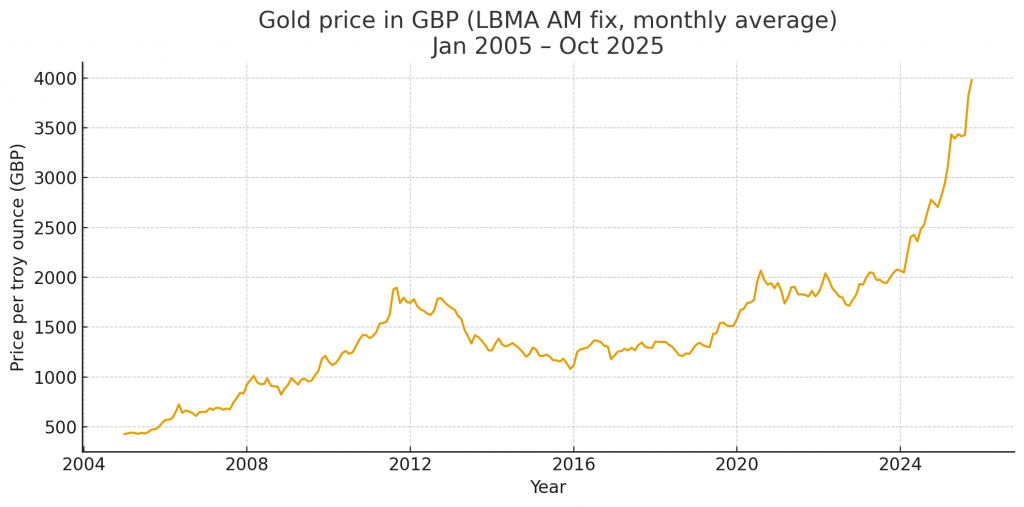
If you look at the value of gold in pounds since 2005, you’ll notice something remarkable.
Back then, an ounce of gold cost around £400. Today, in late 2025, it is close to £4,000 — almost a ten-fold rise.
That’s not because gold has become more useful. It doesn’t earn interest, build houses, or feed families.
It’s because money has lost credibility.
Whenever people grow nervous about banks, debt, or inflation, they turn to gold. It is the oldest form of trust we have — a small, bright piece of metal that no government can print or devalue. In every age of uncertainty, gold has acted as a mirror showing how little faith people have left in the paper promises of their rulers.
2. Why People Are Buying Gold Now
Since mid-2023, gold prices have surged again. Why?
- Inflation won’t die down. Even with official figures calming, everyday prices — food, rent, fuel — keep rising.
- Interest rates have dropped again. That means savings lose value in real terms.
- Central banks themselves are buying gold. Countries from China to Poland are reducing their reliance on the dollar.
- World tensions are growing. War in Europe, trade disputes, and debt crises all push investors toward “safe” assets.
- Trust in money is fading. People sense that governments can’t repay their debts honestly, only through inflation.
So the modern gold rush is not about greed. It’s about fear — and about the search for something solid when everything else feels fluid.
3. The Two Spheres: Money and Meaning
This is where the deeper story begins.
In the Gospels, the Pharisees tried to trap Jesus by asking whether it was right to pay taxes to Caesar.
He looked at the coin and said,
“Render unto Caesar the things that are Caesar’s, and unto God the things that are God’s.” — Matthew 22:21
It’s one of the simplest and most profound sentences ever spoken about economics.
- Caesar’s sphere is the world of money, law, and necessity.
It’s the system we live in — taxes, wages, markets, mortgages. - God’s sphere is the world of conscience, stewardship, and love.
It’s the inner kingdom where value isn’t measured in coins.
Jesus didn’t tell people to reject the State or escape the world.
He taught them to know its limits. Pay what you owe, obey just laws — but don’t mistake those things for ultimate reality.
4. Gold, Land, and What Really Sustains Life
A gold coin may preserve wealth, but you can’t live on a sovereign.
Land, by contrast, feeds and shelters. It represents the real economy — soil, labour, community, production.
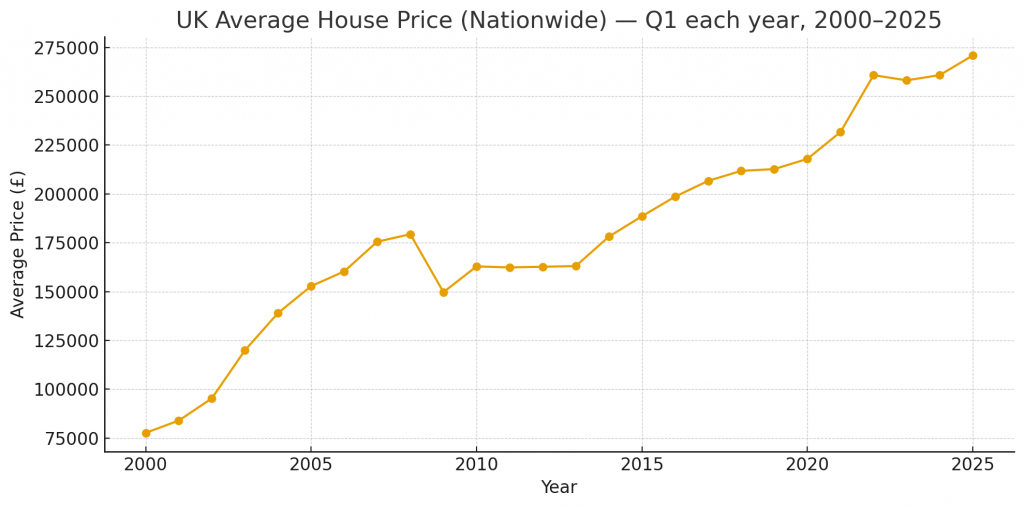
Today vast areas of land lie idle under land banking — bought and held by investors waiting for prices to rise. Meanwhile, housing shortages worsen and young people can’t afford homes.
This shows how far we have drifted from the natural purpose of wealth.
Gold and property have become symbols of power, not instruments of life.
In biblical thought, the land was never absolutely owned. It was held in trust:
“The earth is the Lord’s, and everything in it.” — Psalm 24:1
That idea of stewardship — caring for what nourishes us — is the moral counterweight to modern finance.
Gold may store value, but land sustains value.
5. Living Within the System — But Awake
Jesus accepted that coercive power exists. The Romans taxed, the priests collected, the people endured.
Yet he showed that spiritual freedom must work through coercion, not against it.
That’s the human condition: we live inside systems we didn’t design, but we remain free in how we respond.
To “go with the flow but know you’re doing it” is not passive resignation.
It’s conscious participation — the art of living sanely in an unfree world.
You pay your taxes, keep your accounts, obey the law — and yet inwardly, you remember:
none of this defines your worth.
6. The Message Behind the Metal
Gold’s steady rise isn’t just about markets. It shows how deeply people fear instability — and how little faith remains in our institutions. When trust in money or policy fades, people look for something that feels safe. Gold, for better or worse, has become that symbol of safety.
7. The Lesson for Ordinary People
For everyday life, the balance is simple:
- Be prudent in Caesar’s world.
Keep some savings real — in land, tools, skills, or a small store of precious metal. - Be free in God’s kingdom.
Measure your life not by what you own but by how well you use what you’re given.
Let money serve life, not the other way round.
That’s all “gold” was ever meant to mean — not greed, but a reminder that true value is eternal, and all other currencies fade.