“If music be the food of love, play on; give me excess of it…” — Twelfth Night, I.i
There are people in whom genius and fragility are inseparable — whose vision burns so brightly that the light consumes them. Syd Barrett was one of these: the founding spirit of Pink Floyd, poet of whimsy and wonder, and, in the end, a man undone by the very expansion of mind he sought. Like the character in Indiana Jones and the Kingdom of the Crystal Skull who demands infinite knowledge and is annihilated by its force, Barrett reached for revelation and was overwhelmed. His story is not simply that of a fallen musician, but of a seeker destroyed by too much light — a modern Icarus who mistook illumination for salvation.
Born in Cambridge in 1946, Barrett was at first a bright, creative student, immersed in art, literature, and music. He seemed to embody what the 1960s promised — freedom, imagination, and the overthrow of repression. His first songs shimmered with childlike invention: “The Gnome,” “Bike,” “See Emily Play.” But somewhere between artistic curiosity and transcendental longing, he took the road that many in his generation mistook for revelation — LSD.
The drug did what it promised: it opened the doors of perception. Barrett’s friends spoke of “intense and luminous visions,” of a mind electrified by colour and metaphor. But awakening achieved by chemical violence cannot last. LSD bypasses the slow interior work of consciousness; it floods the brain with meanings it cannot assimilate. The result is not enlightenment but disintegration.
By 1968, Barrett could barely play or speak coherently. His bandmates, heartbroken, replaced him with David Gilmour. Two solo albums followed — The Madcap Laughs and Barrett — fragile, flickering, full of ghosts. Then he retreated to Cambridge, living quietly with his mother, painting, cycling to the shops, tending his garden. He remained there for more than three decades until his death in 2006, aged sixty.
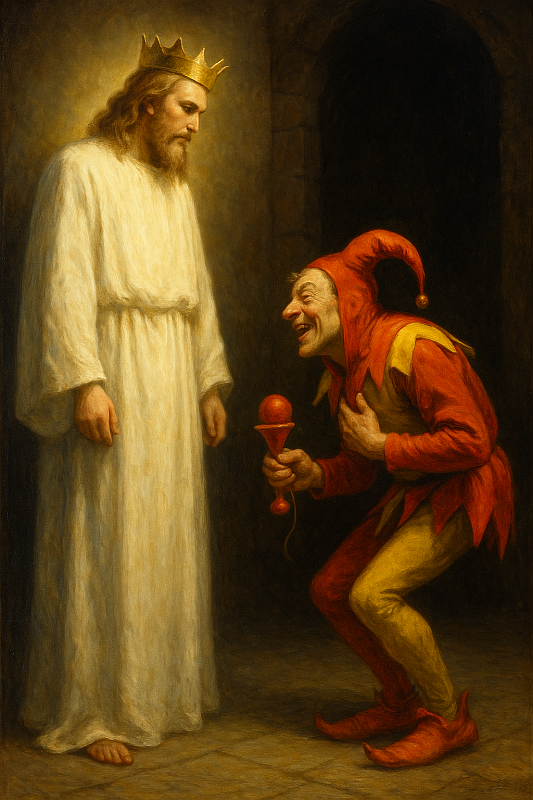
Barrett’s story is often told as a cautionary tale about drugs or fame, but it is more than that. He was a spiritual casualty — a pilgrim who tried to force the gates of consciousness and was struck down by the intensity of what he found. The line between the prophet and the fool is perilously thin; Barrett crossed it. Like the fool in Shakespeare’s court, he spoke truths that others could only glimpse, but his wisdom came at the price of madness.
In another age, he might have been recognised as a visionary and protected; in ours, he became an emblem of the psychedelic dream’s collapse. His early death, though not violent, was a kind of long martyrdom to excess — not of pleasure, but of perception.
There is a lesson here, and it reaches beyond one musician’s fate. Revelation cannot be seized. Awakening must arise through the limits of our humanity — through patience, love, and attention to ordinary life. The brain, like the soul, must be prepared for the light it receives. When we try to shortcut that process, we mistake illumination for exposure and burn our wings in the attempt.
Barrett’s genius was real. But genius alone is not salvation. His music remains like a half-finished prayer — luminous, broken, and unbearably human — a reminder that the road to the infinite must be walked, not swallowed.