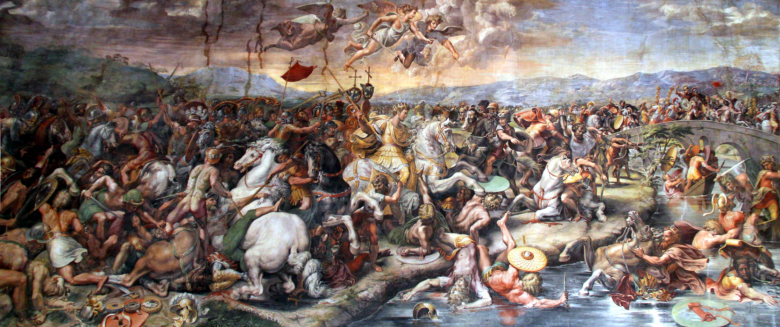
“The Battle of the Milvian Bridge (312 CE), where Constantine secured control of the Western Empire.”
The Politics of Empire, Power, and Historical Accident
We consistently underestimate the significance of one event in late antiquity: Constantine’s decision to adopt Christianity as an imperial religion. Without that single act of political calculation, Christianity might have remained a marginal sect among dozens, fading into the dust of the eastern Mediterranean. Its triumph was not inevitable. It depended on one emperor recognising its usefulness.
Constantine did not embrace Christianity because it was true; he embraced it because it worked. His empire was fracturing under military, economic, and cultural pressures. Pagan religion no longer commanded loyalty. Philosophical schools offered coherence but not mass adherence. Christianity, however, already possessed a network of disciplined communities — and a moral teaching that discouraged revolt.
A religion that urges its followers to turn the other cheek, submit to authority, love their enemies, and accept suffering with humility is extremely attractive to rulers seeking stability.
The early Christians themselves were not admired. The etymology of Christianus — from the same root that gave us cretin — reveals how they were viewed: naive, credulous, harmless. Precisely the sort of population an empire might cultivate if it wished a docile, governable public.
Constantine: Not a Believer, but a Strategist
Constantine was no theologian or mystic. He was a hardened soldier with an instinct for power. His “conversion” was shallow. He postponed baptism until his deathbed, continued as pontifex maximus of the pagan cults, funded temples, and intervened in Christian disputes from impatience, not devotion.
He saw Christianity as a unifying technology:
one God, one Empire, one Emperor — himself.
His disenchantment with Christian quarrels is well documented. But his sons — especially Constantius II — seized Christianity with zeal he never shared. They enforced orthodoxy, persecuted pagans, and embedded Christianity far deeper into imperial machinery than Constantine ever intended.
Thus:
Constantine weaponised Christianity; Constantius institutionalised it.
Why Christianity Survived (and Others Did Not)
This raises an unsettling question. Did Christianity triumph because it possessed inherent divine truth? Or because it happened to be available when an emperor needed a tool of cohesion?
Had Socrates lived in the fourth century; had a Stoic sage arisen at the right moment; had a charismatic mystic captured imperial attention — any such figure might have become the nucleus of a world religion.
Imperial endorsement is the decisive ingredient in creating a civilisation-shaping faith.
This does not diminish Jesus’ moral genius. It clarifies why his movement, and not another, became the backbone of the West. Christianity survived not because it was inevitable, but because it was adopted.
A Galilean teacher became the centre of global religion because an emperor saw in his followers something malleable, disciplined, and politically promising.
Europe as the Afterlife of Rome
Modern Europe is not the opposite of Rome. It is Rome in a new idiom.
We are taught that the empire collapsed, that history broke cleanly between antiquity and the Middle Ages. But this is a comforting fiction. The real story is continuity through transformation.
The Church inherited Rome’s bureaucracy.
Latin remained the administrative engine.
Canon law preserved Roman law.
Bishops replaced magistrates as moral governors.
Europe did not rise from Rome’s ashes. It is Rome — redirected, moralised, and extended.
Where Rome ruled by law and force, Christendom ruled by conscience, guilt, and inward discipline.
Since the fall of Rome, it is moral fear — not military power — that has governed the European mind.
Late Antiquity shifted the seat of authority from the external world into the interior life. Confession replaced the arena. Self-policing replaced legions. The frontier moved into the soul.
The Psychological Legacy: Why ‘Woke’ Culture Exists
This centuries-long internalisation of moral authority explains the rise of modern “woke” culture since the 1950s.
Christianity placed the individual at the centre of moral life — but always bound dignity to responsibility, to agapē, to care for the other.
The post-Christian world retained the centrality of the individual while discarding the balancing ethic. What remains is an acute sensitivity to injury, identity, and recognition — without the stabilising principle of reciprocal duty.
This is why the modern moral project often attacks the very institutions that shaped its vocabulary.
Take gay marriage. Two people forming a committed union is entirely within the range of human nature — neither monogamy nor non-monogamy is aberrant. But demanding that the Church must call such a union a sacrament is a symbolic act of aggression: an insistence that an ancient institution publicly repudiate its own identity.
The movement is right to expose historic moral burdens but wrong to imagine that attacking the Church removes them. Liberation does not arise from forcing institutions to change their rites. It arises from recognising — and finally ignoring — the machinery of guilt.
The Mind-Boggling Implication
When all these threads are gathered, a startling truth emerges:
The beliefs we regard as universal are the products of political contingency.
They survived because they aligned with imperial need, bureaucratic habit, theological ambition, and psychological hunger.
This does not empty Christianity of meaning. It releases it from the illusion of inevitability. It allows us to separate the man Jesus — whose ethical clarity remains astonishing — from the imperial religion constructed around him.
The final irony is profound:
• Jesus stood outside power.
• Constantine stood at its apex.
• Yet Constantine, not Jesus, determined Christianity’s historical fate.
Understanding this frees us from the belief that history’s winners are history’s truths. And it returns us to the essential task:
to recover, beneath the imperial edifice, the uncompromised moral insight of the man at its beginning.
Postscript: Rome’s Shadow in the Modern World
Modern Europe is not the opposite of Rome. It is Rome in a new idiom. We often imagine that the fall of the Western Empire created a clean rupture in civilisation, but the deeper truth is more troubling. What changed were the symbols; what persisted were the instincts. The same structures of central authority and institutional self-preservation that characterised the empire continued through the Church and into the modern state, even as the focus shifted from political order to moral discipline.
Since the fall of Rome, it is moral fear — far more than military power — that has governed the European mind. The empire’s collapse shifted the locus of authority from the sword to the conscience, and the Church quickly learned that nothing exercises control more effectively than the regulation of desire. Sexuality, universally vulnerable, became the perfect instrument. A civilisation once disciplined by legions was now disciplined from within. The legacy is still visible today: public figures are not ruined for incompetence or corruption nearly as swiftly as they are for sexual scandal.
The unsettling possibility is that this continuity is not accidental. Perhaps the same psychopathic dynamic — the human appetite for order, hierarchy, and the management of others — lies at the heart of every civilisation. Rome expressed it imperially; Christendom expressed it morally; Europe expresses it bureaucratically. These forms differ, but the impulse is recognisably the same.
This does not invalidate the search for meaning or moral renewal. But it reminds us that history’s transformations often conceal deeper inheritances. Every age believes itself free of Rome while continuing, in new language, Rome’s ancient project.