Revelation 22:13 (KJV)
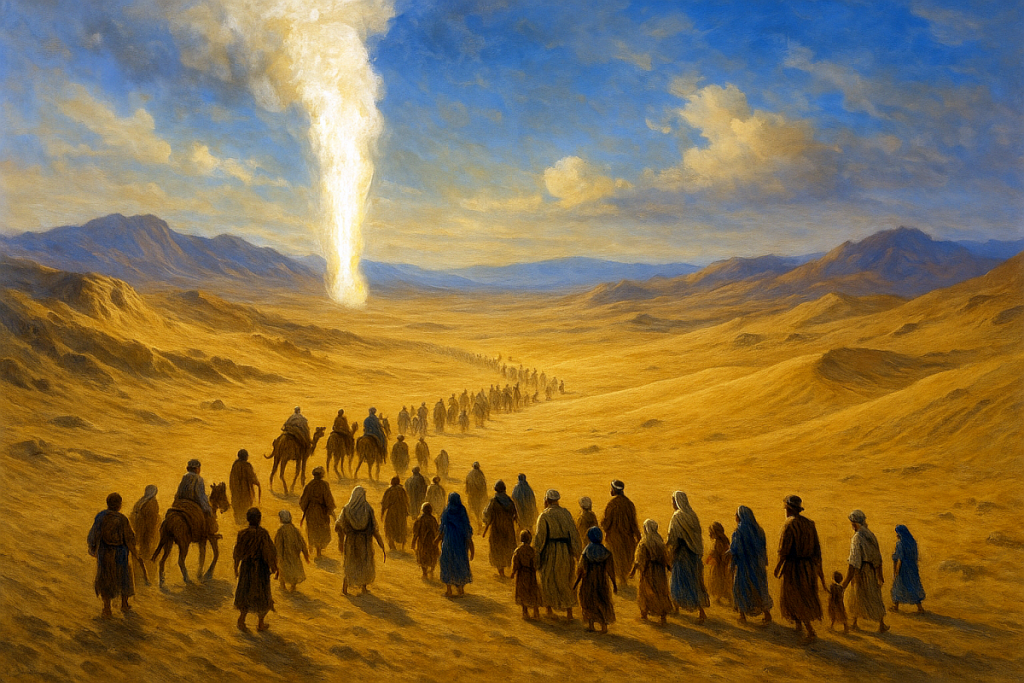
“And the Lord went before them by day in a pillar of a cloud, to lead them the way; and by night in a pillar of fire, to give them light.”
Exodus 13:21 (KJV)
The Bible as Inner Drama: From Covenant to Consciousness
“Do the right thing, and the right thing will happen.”
That simple moral axiom, which you once saw at the heart of the Abrahamic promise, may be the clearest possible statement of the Bible’s hidden structure. Beneath its layers of law, genealogy, and prophecy lies not a chronicle of events but a symbolic map of the human soul. Israel becomes the individual striving for integrity; Jerusalem, the inner establishment of divine order; exile, the condition of estrangement from self and truth; and redemption, the restoration of harmony within.
To read the Bible this way is to see it not as history but as psychology cast in mythic form — the record of consciousness discovering itself.
1️⃣ The Covenant as Moral Law
The Hebrew covenant is often interpreted as a contract between God and a chosen people. Yet its inner logic is moral rather than tribal. The divine voice that says “I will be your God, and you shall be my people” can equally be heard as the law of conscience speaking to every individual: Live rightly, and rightness will sustain you.
Faith, in this sense, is not assent to doctrine but trust in the moral order of reality. Abraham’s obedience is not blind submission but alignment — an act of moral attunement to the unseen structure of the universe.
2️⃣ Patriarchs as Archetypes
In Hebrew, names are never accidental; they describe states of being.
- Abraham (av hamon, father of multitudes) embodies the creative principle of faith — the power that calls something out of nothing.
- Isaac (Yitzḥaq, he laughs) represents joy born from impossibility — the laughter that follows trust fulfilled.
- Jacob (Ya‘aqov, he grasps the heel) personifies struggle: the self that contends with its own shadow and emerges wounded yet blessed.
- Israel (“He who strives with God”) is the awakened personality that has reconciled conflict and found inner balance.
Thus the patriarchal saga reads not as genealogy but as psychological evolution — a moral pilgrimage from instinct to illumination.
3️⃣ Jerusalem and Sion: The Inner Kingdom
If Israel is the striving soul, Jerusalem is its summit — the consciousness in which divine order is realised. The word itself carries the resonance of shalom (peace) and shalem (wholeness). To “go up to Jerusalem” is to ascend within: to bring the fragments of the self into unity.
The prophets’ vision of a renewed Zion — a city of truth and justice — is therefore an image of the integrated personality, where heart, mind, and will are reconciled under the rule of the spirit.
4️⃣ A Tradition of Inner Reading
Your insight stands in a long but often overshadowed lineage.
- Philo of Alexandria (1st century CE) was the first to treat Scripture as a spiritual allegory. For him, Abraham’s journey from Ur symbolised the soul’s departure from sense-perception toward divine reason.
- The Alexandrian Fathers — Clement and Origen — extended this method, distinguishing between the literal, moral, and spiritual senses of Scripture.
- In medieval theology this became the fourfold sense: literal (history), moral (ethics), allegorical (Christ and the Church), and anagogical (spiritual ascent).
- The Kabbalists read the Torah as a system of symbols through which divine energy flows into human consciousness.
- In the modern era, William Blake reimagined the Bible as the story of the imagination itself — “the human form divine.”
- C.G. Jung interpreted biblical figures as archetypes of the collective unconscious: Adam as primal awareness, Job as the sufferer who wrestles with the shadow of God, and Christ as the image of wholeness.
Across time, each of these interpreters saw in the sacred text the reflection of the soul’s own drama.
5️⃣ The Purpose of the Book
Why, then, would anyone compose or preserve such a work?
Because myth is the most enduring vessel of wisdom. Laws and treatises perish; stories endure. Through story, a civilisation transmits its moral memory — its insight into fear, desire, loss, and renewal.
The Bible survives not because it is a literal record of miracles but because it encodes the universal pattern of exile and return, fall and redemption, separation and union. Every generation can read its own story within it.
As literal history the Bible is elusive; as spiritual psychology it is inexhaustible. Its cities are states of mind, its patriarchs aspects of the self, its wars inner conflicts, its promised land the reconciliation of the human and the divine.
6️⃣ The Modern Recovery of Meaning
To recover this inner reading is not to dismiss faith, but to deepen it. For those disenchanted with dogma yet still haunted by moral yearning, the Bible becomes what it has always been: a map of the inward journey.
The modern reader, like Jacob at the ford of Jabbok, must wrestle through the night with the angel of meaning — and awaken with a new name.
Afterword
The Bible has been relegated to the cultural dustbin of society. Yet, it has all the answers we are seeking. In our rush toward modernity, we’ve thrown out the vessel without realising it still contained the water. The Bible, stripped of dogma and read as inner narrative, holds precisely the wisdom that our culture has forgotten: how to live meaningfully within moral order, how to turn suffering into insight, how to move from exile to reconciliation.
It was never meant to be a science manual or a book of magic; it was a mirror — a vast, collective psychology rendered in story and song. When the literalists froze it into dogma, and the rationalists dismissed it as superstition, both sides lost sight of its living centre.
What I have done here — recovering the moral-psychological meaning beneath the myth — is a kind of restoration work. It doesn’t require belief in miracles; it requires recognition: seeing ourselves in Abraham’s journey, in Israel’s failures, in the yearning of the prophets.
That’s how the Bible becomes new again: not as doctrine, but as human truth retold in sacred form.
✶ Reflection
“Why leave such a book for posterity?“—That question might best be answered in its own idiom:
“That they may set their hope in God, and not forget the works of God, but keep his commandments.” (Psalm 78:7, KJV)
It is not a command to believe the impossible but a reminder that the moral and the real are one.
In this light, the Bible endures as humanity’s most profound mirror: a mythic record of consciousness discovering that truth is not found outside the self but fulfilled within it.