
Prayer is often understood as asking for things, but in the Gospels it appears as something quite different. It is not a means of control, but a moment of release — a stepping back from the self and a return to what is real. In prayer, one lets go, sees more clearly, and, however briefly, is set in the right direction.

Meditation is not an escape from life, nor a technique for manufacturing insight, but a way of learning when consciousness can safely let go. Human beings live through rhythms of attention, rest, and drift, and change unfolds over time rather than through heroic effort. What sustains a life is not constant awareness, but the capacity to return—again and again—to meaning, structure, and relation as life moves on.
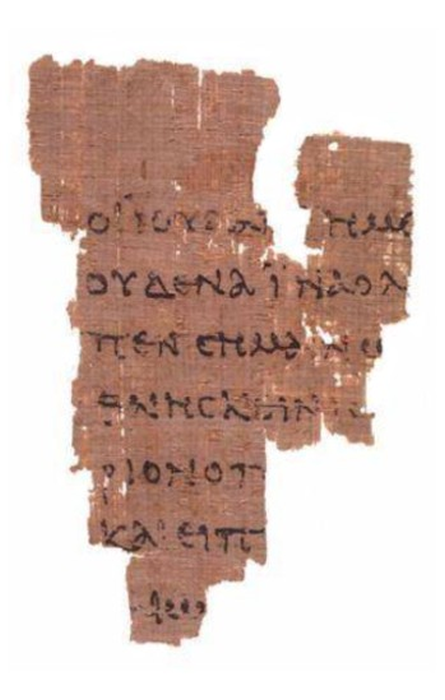
Behind the vast theological edifice of later Christianity lies a very different figure: a Galilean teacher whose sayings in the Synoptic Gospels preserve a startling moral clarity largely absent from the metaphysical Jesus of John and the cosmic Christ of Paul. Recovering the historical Jesus requires peeling away these later layers and listening again for the radical ethical voice that once challenged his hearers to transform the inner life rather than speculate on the nature of the universe.
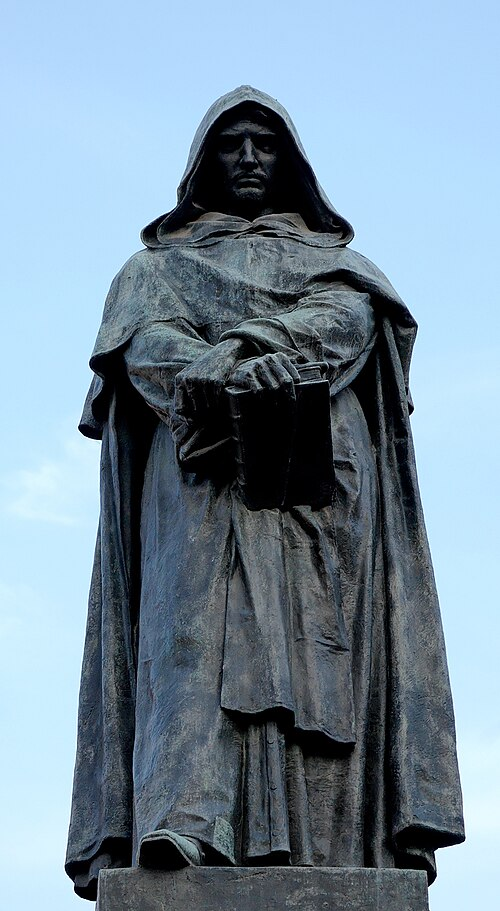
Giordano Bruno saw, more than 500 years ago, that human beings project their inner life onto the cosmos. His “infinite universe” was not astronomy but a vision of the human psyche speaking through myth — a truth that echoes across my own work. In an age that has lost its spiritual depth, Bruno’s voice returns with renewed urgency.
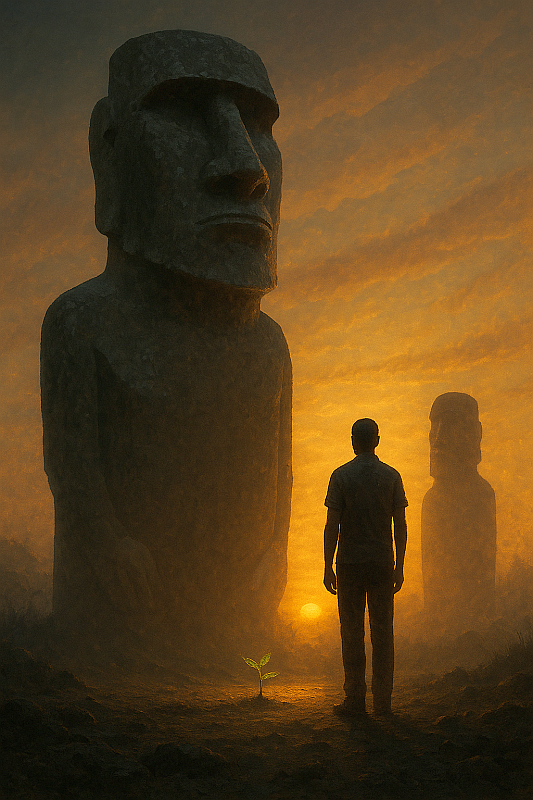
A sweeping reflection on humanity’s struggle to reconcile instinct and intellect, from the ancient gods of Mesopotamia to the teachings of Jesus. This essay argues that true transcendence lies not in power but in inner integration, and that mortality presses us toward completion. Through myth, psychology, memory, and personal experience, it shows that the only moment for wholeness is now.
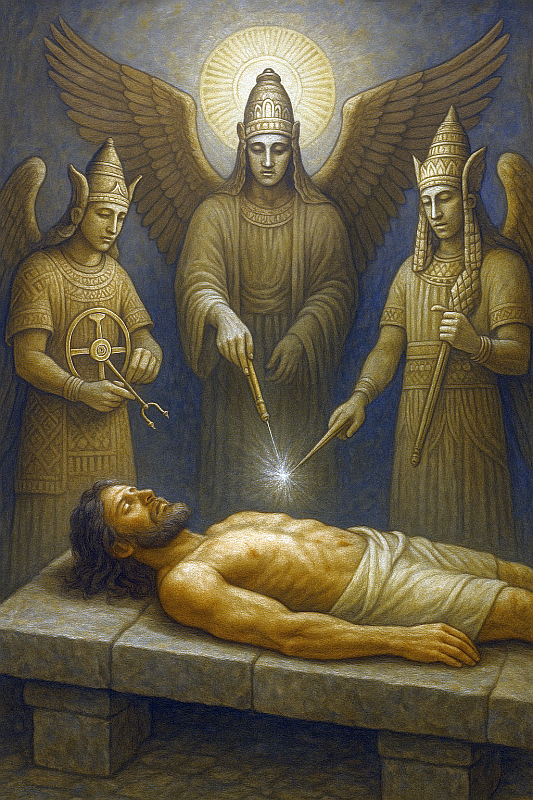
A demythologised reading of Genesis and the Gospels reveals a single thread running through human history: we are conflicted, powerful, unstable creatures trying to understand ourselves. Eden describes why we are dangerous; Jesus offers a path to inner transformation. Later doctrine turned this into metaphysics, but the original insight was psychological. This article explores Adam, Meister Eckhart, the Synoptics, and the Sumerian myths as early attempts to explain the divided human self — and what redemption really meant.
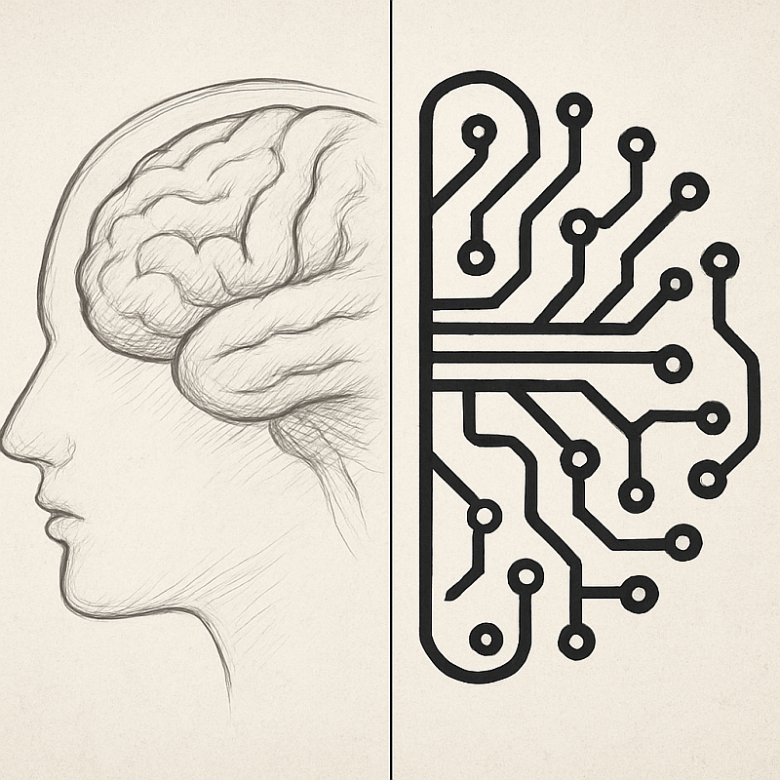
A visual reflection on the deepest difference between humans and AI: the human mind grows through experience and becomes itself over time, while AI arrives fully formed, pre-structured, and without a lived past. This split image captures the contrast between organic consciousness and engineered intelligence.

A reflection on the real meaning of enlightenment — not as mystical experience, but as the quiet reconciliation between our deeper vital dynamics and the surface structure of everyday life. The heart, the conscience, and the unconscious guide us long before reason recognises their pattern.
A reflective essay viewing the Bible as an allegory of consciousness — where Abraham, Israel, and Jerusalem represent stages of inner growth, and the ancient covenant reveals itself as a timeless moral psychology of the human soul.
A reflection on the inner stillness that frees us from self-rejection and restores our capacity to love. Drawing on Jesus’ teaching of the Shema and contrasting the Western vision of wholeness with the Zen ideal of self-effacement, this meditation explores awareness as a natural state — a flight of the spirit in peace and light.