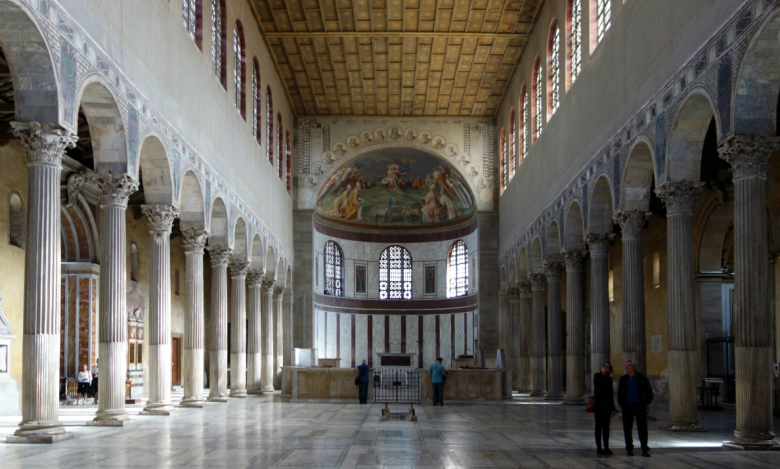
Santa Sabina, Rome — interior nave
Santa Sabina was built c. 422–432 AD, in the early 5th century.
Christianity did not emerge as a single, coherent faith that later fractured. It began as a field of competing interpretations, practices, and hopes, all struggling to define what Jesus meant and what following him required. People were drawn to Jesus because he offered dignity, moral seriousness, and belonging to those living under Roman power, debt, and social exclusion. His teaching promised reversal — that the last might be first, that power should take the form of service, and that inner transformation mattered more than status or ritual compliance. What later centuries would call “heresy” was not a deviation from an established norm; the existence of heresy showed that the movement was still undecided about what it represented. Orthodoxy was not the original state of Christianity; it was the eventual outcome of conflict, negotiation, and power.
In the first two centuries after Jesus’ death, there was no universally accepted canon, no binding creed, and no central authority capable of enforcing uniform belief. Communities were scattered, texts were fluid, and memory competed with interpretation. The movement was, in modern terms, a mess. The Jesus movement was not one road that forked into errors; at the beginning it was already a crossroads that diverged in many directions. The Christianity that survived was not inevitable. It was one version among many.
The Ebionites represent perhaps the most historically conservative of these early paths. They understood Jesus as a Jewish teacher and prophet, not a divine being who abolished the Law but one who embodied it. For them, adherence to Torah remained essential, and Jesus’ significance lay in his moral authority rather than metaphysical status. This form of Christianity kept Jesus firmly within Judaism and resisted the radical universalism that would later define the church, especially in Paul’s version. Its strength was continuity and ethical clarity; its weakness was that it did not travel well beyond its original cultural soil. In a Roman world hungry for universal systems to unite a fragmenting empire rather than particular covenants that honoured the demands of the Torah, Ebionite Christianity remained local, restrained, and ultimately marginal. (Ebionite Christianity did not survive as a continuous, self-identifying church, though elements of Jewish-Christian belief appear to have persisted indirectly in non-canonical texts and in later Christian traditions outside the main centres of Roman and Byzantine political and ecclesiastical control.)
At the opposite extreme stood Marcion, active in the mid-second century (c. 140 CE), whose vision of Christianity was startlingly radical. Marcion rejected the Hebrew Scriptures altogether, arguing that the God of Israel was not the Father proclaimed by Jesus — a claim often revisited in modern popular discussions, including some YouTube treatments. He offered a Christianity stripped of Jewish history, focused entirely on grace, mercy, and deliverance from a flawed world. Marcion’s churches were organised, disciplined, and textually focused, with clear moral expectations, defined leadership, and one of the earliest attempts at a Christian canon. His error, from the later orthodox perspective, was not disorder but excess clarity. By severing Christianity from its Jewish roots, Marcion created a faith that was too stark, too dualistic, and too theologically disruptive to serve as a bridge between past and present, since it could not plausibly claim continuity with Israel while also asserting universal authority. Orthodoxy would reject Marcion, but quietly adopt his organisational instincts while repudiating his theology. Organisation was the heart of the matter: the tighter the bureaucracy, the tighter the grip on believers and the more effective the communication with outside authorities.
Gnostic movements represent another road not taken, one that reinterpreted Christianity as a drama of awakening rather than obedience. In Gnostic texts, salvation is not achieved through belief in a creed or submission to an institution, but through insight — the recognition of a divine spark within the self. Many Gnostic writings, such as the Apocryphon of John, are highly speculative and metaphysical, raising the question of how such elaborate cosmologies attached themselves to the Jesus movement at all. Jesus becomes a revealer rather than a redeemer in some strands — most notably in texts such as the Gospel of Thomas — a guide to hidden knowledge rather than the centre of a sacrificial economy. This form of Christianity spoke powerfully to those alienated by empire, hierarchy, and material suffering. Yet its very inwardness proved politically disabling. A religion of personal awakening offers little leverage for building durable institutions or governing large populations. This point is crucial. Gnosticism threatened not merely orthodoxy’s doctrines but its capacity to function as a social system.
The Montanist movement reveals yet another possibility: a Christianity driven not by texts or bishops, but by ongoing prophecy. Montanus and his followers believed that the Spirit was still speaking, still correcting, still unsettling established authority. Women played prominent roles as prophets, and moral seriousness was intense. This Christianity was urgent, charismatic, and uncompromising. It challenged the church’s growing preference for stability over inspiration. Montanism was not rejected because it lacked fervour — indeed, its intensity invites comparison with some forms of modern evangelicism — but because it offered too much of it. A church governed by living prophecy cannot be safely administered. Orthodoxy chose stability and institutional continuity over a form of Christianity driven by spontaneous prophecy, because only the former could be administered, regulated, and sustained over time.
What unites these lost Christianities is not error per se but incompatibility with empire. At a time when both institutions were still fragile, church and state needed one another. The state required moral authority and social discipline from the church, while the church depended on the state for protection, enforcement, and, when necessary, coercive power. This relationship unfolded over several centuries: Rome did not finally fall in the West until the fifth century, meaning that for nearly five hundred years Christianity developed within an imperial framework. It is therefore hardly surprising that the church took much of its direction from the political institution in which it was embedded, especially after the fall of Jerusalem and the disappearance of alternative centres of authority.
Each of these alternative Christianities offered a form of faith that resisted standardisation, hierarchy, or political usefulness. As Christianity moved from marginal sect to imperial religion, particularly after Constantine and the subsequent church councils that brought leaders together from across Christendom, it required a form that could unify diverse populations, stabilise moral expectations, and coexist with Roman administrative habits. The Christianity that survived did so not because it answered every spiritual question best, but because it balanced theology, discipline, and governance with sufficient flexibility to endure.
Seen in this light, Christianity in its orthodox and enduring form was decisively shaped by Roman power. What survived was not simply a religion centred on Jesus, but a Roman-adapted system capable of legitimising authority, disciplining populations, and sustaining imperial continuity after Jerusalem’s fall.
Orthodoxy, then, should not be understood as the natural culmination of Christian truth, but as a negotiated settlement. It preserved enough Jewish inheritance to ground itself historically, and that was its genius: continuity with Israel allowed Christianity to claim antiquity, legitimacy, and moral depth while still presenting itself as universal in a Roman world. It retained enough universality to cross borders, enough mysticism to inspire devotion, and enough structure to govern belief. What it excluded were paths that threatened coherence, continuity, or control — in other words, its own survival.
The forgotten heresies remind us that Christianity’s survival was not inevitable. Without careful political manoeuvring and institutional adaptation, the movement itself might have died out altogether, whether or not rival interpretations existed. They also show that Christianity could have become something very different: a reform movement within Judaism, a radically anti-Jewish religion of grace, a mystical philosophy of awakening, or a prophetic movement perpetually open to disruption. That it became none of these exclusively is not a sign of divine inevitability but of historical selection, driven by pragmatic judgement as church leaders recognised where their strengths lay and acted upon them.
To recover these lost Christianities is not to resurrect them as alternatives, but to recognise the contingency — and perhaps the arbitrariness — of what we now call “the faith.” Christianity did not descend fully formed from heaven. It emerged from struggle, compromise, and power. Remembering the roads not taken frees us from the illusion that the present form of belief was the only possible one, and invites a more honest, more spacious understanding of what Christianity has been, and what it still might become, even if today’s institutional churches seem poorly equipped to guide that adjustment.