The irony is hard to miss. The very people who make the laws are also expected to live under them. How inconvenient that must be.
Nigel Farage, now spoken of by some as a future Prime Minister, is reported to have accepted a £5 million personal gift from a major Reform UK donor. He says the money was for personal security and that there was no obligation to declare it. Others clearly disagree, and the matter is now the subject of political and regulatory scrutiny.
But even before the rules have finished grinding through their procedures, the moral question remains. What does it say about public life when a politician can receive a personal gift on a scale utterly unimaginable to most of the people he claims to represent? In a country where families struggle with rent, food, heating, debt, and insecure work, £5 million is not merely a private matter. It is a symbol of distance: the distance between political performance and ordinary life.
The issue is not only legality. It is judgement. If a man accepts such a sum before attaining the highest office, what might he accept once closer to power? Public trust does not depend only on obeying technical rules. It depends on the visible refusal to blur private enrichment, donor influence, and political ambition.
This is an old constitutional problem in modern dress. The Bill of Rights (1689) sought to restrain arbitrary power by placing the monarch under law and making government answerable through Parliament. Absolutism had to be checked because no nation should be ruled by one unchecked will. Yet the problem has not disappeared; it has merely changed form. The old devil wore a crown and could therefore be seen. The new one moves through money, influence, party machines, donor networks, and personal ambition dressed up as public service.
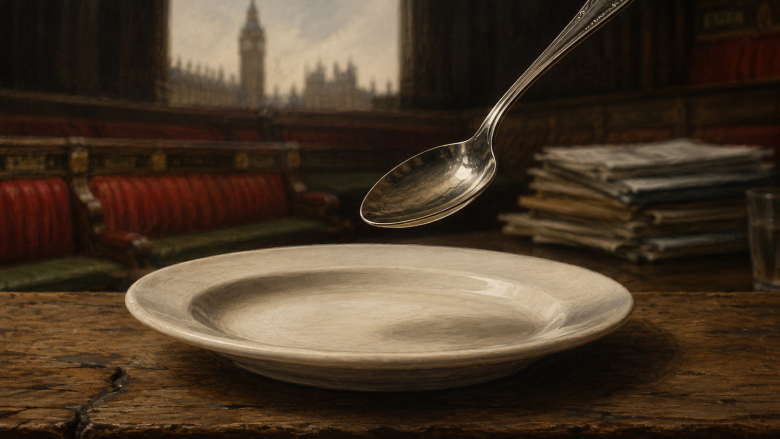
And so the old question returns in a sharper form. Which is worse: those born with a silver spoon in their mouths, or those born without one but endowed with the ruthless cunning to acquire it? In either case, the spoon ends up in the same place — far from the empty plates of those who are asked to believe that politics is being conducted in their name.


