
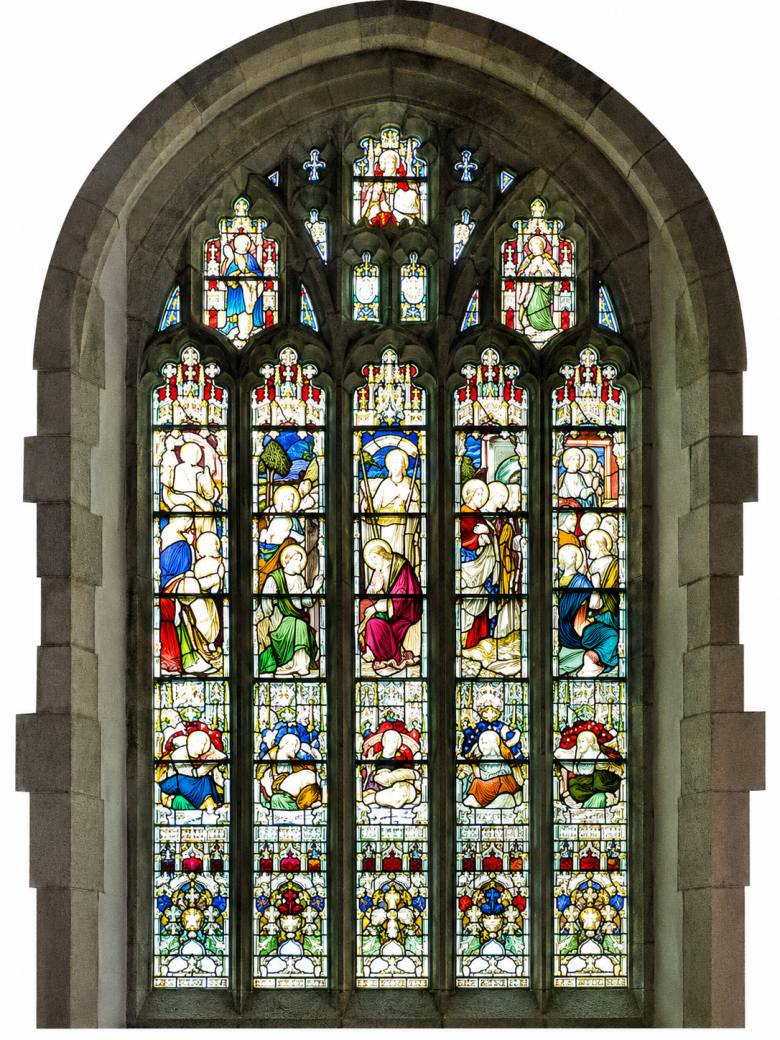
Featured image: The east window above the altar in St Mary’s Church, Kelly, Devon.
A starting point for local historical inquiry
The parish churches of Devon and Cornwall are among the richest historical documents in the landscape. They are not merely buildings for worship, nor simply picturesque survivals from an older Christian age. They are records in stone, glass, wood, brass, inscription, burial, restoration, and memory. To enter one of these churches is to step into a layered account of local life: faith, family, power, rank, benefaction, continuity, loss, and change.
At first sight, many of these churches appear to belong chiefly to the medieval world; the first question one often asks is how old the church is. Their towers, fonts, dedications, carved stones, fragments of early masonry, and ancient churchyards often point to a Christian history stretching back many centuries. In Cornwall especially, the dedication to a local saint or the presence of an early inscribed stone may hint at a world older than the present building. Yet the more churches I visit, the more I am struck by another fact: while evidence of an earlier past is certainly present, it is often the nineteenth century that has stamped itself most visibly on the ancient churches of Devon and Cornwall.
The medieval church may provide the bones of the building, but the nineteenth century frequently gives it its present face. It supplies many of the stained-glass windows, wall tablets, brass plaques, family memorials, restored chancels, pews, floors, roofs, lecterns, pulpits, and ordered churchyard inscriptions through which the church now speaks. The Victorian age did not merely inherit the ancient parish church; it interpreted it, repaired it, reordered it, and often remade it as a visible record of faith, respectability, family memory, and social order.
This is why a parish church is such a useful starting point for historical investigation. It allows us to begin not with abstract theory, but with names, dates, families, windows, tombs, and local benefactions. Who paid for the stained glass? Whose names appear on the tablets? Which families recur in the churchyard? Which rectors, squires, soldiers, widows, children, and benefactors are remembered? Who had the means to place a permanent marker inside the church, and who remains silent or invisible?
Stained glass as historical record
The stained-glass windows are not merely decorative. They are among the most important historical records inside a church. They may preserve names, dates, family connections, clerical relationships, artistic taste, biblical priorities, local grief, military service, and patterns of wealth. A window may commemorate a parent, spouse, child, rector, benefactor, or local notable. It may reveal which families possessed both the money and the confidence to write themselves into the sacred space of the parish.
In this sense, stained glass should be read almost as a document. Its imagery matters, but so do its inscriptions, donors, dedicatees, makers, dates, and position within the building. A window in the chancel, aisle, transept, or family chapel may say something about status and memory. The subject chosen for the glass may also tell us something about the religious imagination of the period: Christ the Good Shepherd, the Resurrection, the Nativity, saints, prophets, apostles, angels, or scenes of sacrifice and consolation.
To photograph and record these windows properly is therefore more than a visual exercise. It is part of preserving local history. The glass may contain some of the clearest surviving evidence of nineteenth-century parish life, especially where other records are scattered, inaccessible, or forgotten.
The nineteenth century and the solid state of memory
Looking at churchyards and the names recorded inside churches, one receives the impression that the nineteenth century was an age of considerable confidence. It was a society that presented itself as ordered, hierarchical, Christian, and continuous. The names in glass, stone, and brass suggest a world in which property, family, piety, and local obligation still held together.
Of course, the nineteenth century was not as calm or unified as it sometimes appears from its memorials. It contained poverty, Nonconformity, industrial unrest, agricultural depression, class conflict, religious argument, imperial anxiety, and social change. Yet inside many parish churches, the impression is of a highly ordered world. The church became the visible archive of that order. Older patterns of land, family, patronage, and worship did not disappear; they hardened into memorial form. It was as if the liquid past had congealed into the solid state.
Many nineteenth-century parish figures seem to have believed that they had both the right and the duty to leave a permanent mark inside the local church. Their names appear in stained glass, wall tablets, brass plaques, family tombs, restored furnishings, and churchyard monuments. Such memorials express privilege, certainly, but also a now-vanished assumption of responsibility and continuity. To endow a window, restore part of a church, or commemorate a family member inside the building was to place oneself within the continuing story of the parish.
What they perhaps did not foresee was that the world which gave such gestures meaning would not remain stable. They acted as though the church would always stand at the centre of local memory, and as though future generations would still understand the language of rank, benefaction, Christian duty, family continuity, and public respectability.
The twentieth century unsettled all of that.
The creation of the twentieth century
The phrase “the twentieth century” can easily sound like a mere date. Yet the twentieth century was not created simply when the calendar moved from 1900 to 1901. It was created by war, technology, taxation, social mobility, secularisation, mass democracy, American influence, changing manners, and the collapse of old assumptions.
Before 1914, many of the landed and professional classes still inhabited a world that seemed secure. Its symbols were visible everywhere: country houses, parish churches, family pews, stained-glass memorials, wall tablets, schools, charities, estate cottages, and the confidence of names repeated across generations. The social order had faults and injustices, but it also possessed continuity. Those who belonged to it assumed that it would endure.
What they did not foresee was the revolution in manners and fortune that the twentieth century would bring. The First World War did not simply kill men; it damaged the imagination of permanence. It weakened deference, accelerated taxation, unsettled estates, drew women further into public life, enlarged the claims of the state, and exposed the fragility of an order that had seemed almost natural.
The war debt was paid in young blood. Britain lost hundreds of thousands of young men; France lost more than a million. The survivors returned to societies physically present but inwardly weakened: bereaved, indebted, suspicious of old certainties, and vulnerable to new ideologies, machines, amusements, and appetites. France, in particular, never fully escaped the demographic and psychological shadow of the Great War. Its villages, memorials, and cemeteries still bear witness to a rupture no later prosperity could wholly repair.
The old guard did not vanish at once. The houses still stood; the churches still displayed the family names; the rituals continued. Yet something had altered in the moral atmosphere. The men who returned from the war had seen courage, but also waste, incompetence, class presumption, and the terrible impersonality of modern slaughter. They had learned that inherited authority was not necessarily wisdom, and that rank did not guarantee judgment.
In that sense, the old order paid later in diminished reverence. The memorials remained, but the spell had been broken.
Modern currents
It would be too simple, however, to read this transition merely as a moral revenge by the young against the old. Personal intention rarely dictates the course of events. Circumstance is the greater and often unforeseen motivator.
The old social order was weakened by forces beyond any one person’s control. The First World War took young lives on a scale that damaged not only families but the moral confidence of the society that had sent them. At the same time, America was rising in wealth, industry, cultural energy, and technological influence. Cars, cinema, advertising, jazz, mass production, consumer goods, radio, and a new idea of self-invention began to alter expectations.
Britain, standing between America and Europe, was especially receptive to these new currents. American modernity gave energy to a tired society, but it also introduced restlessness, appetite, consumer aspiration, and a new impatience with inherited restraint. The twentieth century was created not only by the trenches, but by what entered the bloodstream afterwards.
The old world had assumed continuity; the new world arrived as movement.
Churches as evidence of transition
This is why the transition between the nineteenth and twentieth centuries remains so fascinating, and why local churches provide such a good starting point for investigation. They preserve the confidence of one age while allowing us to see, from our later vantage point, how fragile that confidence was.
the east window above the altar in St Mary’s Church, Kelly, Devon.the east window above the altar in St Mary’s Church, Kelly, Devon.In Devon and Cornwall, a parish church may contain the medieval past, the Reformation, local gentry, Victorian restoration, imperial memory, war commemoration, and modern decline all in one place. The building becomes a historical cross-section. It allows us to ask:
- Who held power here?
- Which families shaped the parish?
- Who paid for the windows, bells, pews, monuments, and restorations?
- How did land, church, family, and memory interact?
- Which names recur across generations?
- How did the nineteenth century reinterpret the older church?
- What did the twentieth century do to the world those memorials assumed would continue?
A local church is therefore not merely a religious building. It is a document in stone, glass, wood, and inscription. It shows how a society remembered itself, who had the means to be remembered, what values were publicly honoured, and what happened when the world that created those memorials began to pass away.
To walk through a Devon or Cornish parish church is often to stand inside the nineteenth century’s idea of permanence, while knowing that the twentieth century has already undone it.