A reflection on Shakespeare’s vision of futility, Christianity’s imposed meaning, the Romantics’ fragile beauty, and existentialism’s void — and why the true flame of life is found within, constant and indestructible.
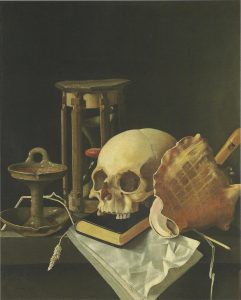
Shakespeare placed these words in the mouth of Macbeth at the point of collapse. They are not only the voice of a guilty man, but one of the starkest articulations of futility in all of literature. Life as shadow, noise, and brevity: a candle quickly snuffed out. Long before Camus or Sartre, Shakespeare had already grasped what we now call the absurd.
It is Macbeth who voices the futility most starkly, sensing life itself as sound and fury signifying nothing. Yet Shakespeare had already circled around the same theme in a very different key, putting into the mouth of Jaques in As You Like It a sardonic account of life’s decline — the “Seven Ages of Man,” reducing existence to a set of roles that end in helpless decay and oblivion:
Again and again, the same recognition: that ambition, power, even human grandeur collapse into silence.
For centuries, orthodox Christianity — built on Paul’s theology and embodied in the hierarchical power of the Roman Church — offered an answer. It wove a grand story over the void: creation, fall, redemption, heaven. It gave people a drama larger than themselves, and in doing so, shaped much of the world we live in. For many, this belief was nourishing: it gave life coherence, lent dignity to suffering, and bound communities together. Even if not literally true, it worked like a cultural placebo — sustaining people for as long as they believed in it.
But this orthodoxy was not the same as the teaching of Jesus in the three Synoptic Gospels. His message was simpler, more radical, and far less institutional: love your neighbour, forgive without limit, resist wealth and power, and trust that the kingdom of God is already among us. It was a call to inner strength and human dignity, to stand upright rather than cling in dependence. By contrast, the Church encouraged obedience — like children holding to a parent — and in time this structure became a tool of control.
Today, that scaffolding has collapsed. Orthodoxy is largely passé, and what remains is a world still under threat — from climate change, the depletion of animal and plant species, and renewed military aggression — yet robbed of any larger story to steady it. What endures is what Jesus pointed to: our inner resources, the strength that remains when every imposed meaning has failed.
For a few Romantics — Shelley above all, but also Byron and Keats — rejecting orthodoxy meant not only rejecting Paul’s theology but also turning away, uneasily, from Jesus himself. Disturbed by their own disbelief, they sought a comforting substitute. For them, Beauty became the bearer of transcendence, a surrogate for religion. In effect, they were re-inventing Jesus’ method in Platonic terms, but missing the point: where he grounded meaning in love of neighbour, in the dignity of every human being, and in the inner strength to stand firm against fear and power, they sought it in Beauty as an eternal ideal glimpsed only through fleeting earthly forms — a vision always beyond reach, leaving them dissatisfied with the impermanence and transience of joy and beauty as they experienced them in their short lives.
For Shelley, Beauty was the “radiance of eternity.” He believed in its permanence — but he located it outside himself, as a power that visited and departed. In moments of exaltation he felt its presence; in moments of despair he lost sight of it. Because it was never grounded within, he remained at the mercy of its absence.
Keats, too, tied Beauty to transience:
Both poets sensed the same fragility — the very things that seemed to give meaning slipped through the fingers. And we, too, are still tempted to rest our hope in fleeting visions: consumer beauty, political spectacle, celebrity culture. The old Romantic yearning repeats itself in new forms.
Existentialism pushed the point further: there is no meaning one can give to life other than the one we ourselves impose. For Sartre this meant radical freedom; for Camus, revolt in the face of the absurd. Yet both left people with a burden that felt more like despair than release. Camus called life absurd — a longing for meaning in a world that remains silent. Sartre portrayed existence as nausea, alienation, emptiness. Their responses were revolt or radical freedom, but for many it was a bleak liberation. And here again the parallel is clear: much of our contemporary mood — anxiety, despair, distraction — is just this sense of the void, but without the philosophical clarity.
The Inner Flame
What remains, at least for me, is a hypothesis: that there is an inner flame — life itself, conscience, dignity — which endures even when outward meanings collapse. Others may reject it. But in a world that often feels senseless, the only thing I can be sure of is my own will to survive, and the strength I find in recognising that flame within.
I think of a candle flame enclosed in a red shade above the altar. In the Christian church it signifies presence — the sanctuary lamp that never goes out. But beyond its ritual meaning, it has a personal symbolism. The flame is the inner truth, the conscience, the quiet dignity that belongs to us by birthright. The altar is the self, holding whatever life lays upon it: fear, longing, grief, hope, love. The flame burns over them all, not to give them worth, but to symbolise life itself — fragile yet enduring, temporal yet hinting at eternity.
This inner flame is not like Shelley’s passing spirit of Beauty. It does not come and go. It can be obscured, but not destroyed.
Shelley wrote of the “white radiance of eternity” in a Neoplatonic vision: life as a broken projection of a divine reality, the whole restored only in death. But I would say that radiance is not withheld until then. It shines within life itself — often scattered, often obscured, yet never absent. Whether it survives death I cannot say with certainty; but here and now it feels indestructible, and in that recognition there is strength.
Conclusion
Shakespeare saw the futility. Christianity imposed a story. Shelley longed for a fleeting vision. The existentialists stared into the void. And today, many live adrift in its shadow.
My answer is simpler: the flame has never gone out — not a visiting spirit or a fragile candle, but the inner flame of life itself: conscience, dignity, and the quiet strength that abides when every outward meaning falls away.