
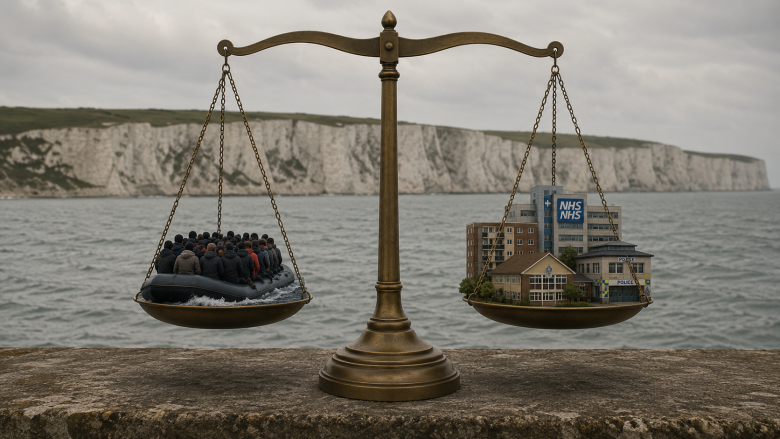
Immigration, Public Cost and the Limits of Altruism
Immigration is usually discussed through the language of morality, race, compassion and national identity. These questions matter, but they often obscure the practical issue underneath them: how many additional people can a country house, employ, educate, treat and integrate without reducing the security and standard of living of those already living there?
This question does not require a racial answer. It can be considered in terms of public capacity, financial cost and equal treatment.
1. The problem of two-tier treatment
The expression “two-tier policing” has gained force because many people believe that the police apply different standards according to race, religion or political opinion. Comparisons are often made between the policing of left-wing or pro-Palestinian demonstrations and the treatment of nationalist or anti-immigration protests. Similar suspicions arise when offensive statements by one group appear to be pursued more readily than threatening statements by another.
The evidence is mixed. Black people are disproportionately stopped, searched and subjected to police force. Official investigations have found racial bias and institutional failure in some police forces. At the same time, there is credible evidence that police and public authorities have sometimes hesitated to act against offenders from minority communities through fear of accusations of racism. The failures surrounding organised sexual exploitation in Rotherham, Rochdale and elsewhere remain the clearest examples.
It is therefore difficult to prove a coherent national policy of favouring one ethnic group. British policing appears inconsistent. It can disadvantage minority groups in some circumstances while exercising excessive caution towards them in others. The resulting uncertainty damages public confidence because equal justice depends upon the belief that the same conduct will receive the same response.
2. Ethnicity, crime and public information
Knife crime illustrates the difficulty of reaching firm conclusions. White offenders probably form the largest group numerically across England and Wales because the White population is much larger. Young Black men, especially in London and certain other cities, are nevertheless greatly over-represented relative to their share of the population.
Complete national information on the ethnicity of knife-crime offenders is not available. Many crimes do not result in an identified offender, while official statistics often concentrate on offences, arrests or victims rather than producing a single reliable ethnic breakdown.
Media reluctance to identify ethnicity contributes to suspicion. Editors generally omit race unless they consider it directly relevant. Police may withhold it during an investigation, and reporters may be unable to establish it reliably. These precautions are understandable, yet inconsistent disclosure creates an information vacuum. Rumour then replaces fact.
A more defensible rule would require equal and purposeful disclosure. Ethnicity or nationality should be stated when it helps identify a suspect, corrects serious misinformation or explains a racial or communal element of an offence. Complete aggregate statistics should also be published. Individual crime reports cannot provide a sound picture of national patterns.
3. Housing, benefits and promotion
Claims of racial favouritism also require careful separation.
There is little evidence of a national rule giving non-White people priority for ordinary benefits or social housing simply because of ethnicity. Housing is allocated mainly according to homelessness, overcrowding, disability, family need and local connection. Benefits depend upon income, age, disability, caring responsibilities and immigration status.
Different ethnic groups nevertheless receive housing and benefits at different rates. Some groups experience more poverty, overcrowding and insecure housing and therefore qualify more frequently under need-based rules. The outcome may look like ethnic preference even where ethnicity does not formally appear in the decision.
Employment and promotion present a clearer case. Positive-action programmes may target ethnic minorities for mentoring, training, internships and recruitment. Representation targets are common in the public sector. In limited circumstances, ethnicity may be used as a deciding factor between equally qualified candidates.
These policies are intended to correct disadvantage. They can still create unfairness when race is used as a substitute for actual need. A poor White applicant excluded from an ethnicity-specific opportunity may reasonably feel discriminated against. Ethnic categories contain prosperous and deprived people alike. Economic and educational disadvantage would often provide a more accurate basis for assistance.
4. Is Britain a soft touch?
Britain may reasonably be described as a soft touch where enforcement is slow, fragmented and uncertain. People may enter illegally, claim asylum, remain for lengthy periods and avoid removal even after refusal. Rules exist, but their consequences are often delayed.
The arrangement under which Britain is paying France £662 million over three years to reduce Channel crossings reveals the weakness. Preventing a boat from launching in France is probably cheaper than rescuing, accommodating and processing its occupants in Britain. Yet payment is largely made for French activity rather than a guaranteed reduction in successful crossings.
France has less incentive than Britain to prevent every departure. Once migrants leave French territory, France’s immediate administrative burden is reduced. Britain pays for patrols and surveillance while France retains operational control.
The arrangement could represent value if it prevents many thousands of arrivals. It cannot be justified merely by counting attempted crossings disrupted, since the same people may try again later. The proper measure is the number permanently prevented from reaching Britain and the resulting saving to the British taxpayer.
5. Immigration and the financial limit of morality
Asylum hotels have recently cost Britain billions of pounds each year. In some periods, the cost per resident has approached £60,000 annually. Supporters of immigration may answer that refugees who later work will pay tax and contribute to the economy.
That is possible, but taxes paid are only one side of the account. The calculation must also include housing, healthcare, education, welfare, administration, pensions and infrastructure. High-earning workers without dependants may make a substantial positive contribution. Low-paid workers, dependants and refugees who experience prolonged unemployment may produce a negative fiscal balance.
This does not reduce human worth to money. Governments nevertheless make moral decisions within financial limits. A hospital treatment, disability service, school place or refugee programme can operate only if the expense can be met. Every pound spent in one area is unavailable elsewhere.
West Germany’s response to East Germans after the fall of the Berlin Wall illustrates the limit of collective altruism. The initial welcome was warm and emotional. Reunification then required enormous transfers, taxation and long-term economic support. Enthusiasm weakened once solidarity became visible in the individual pocket. East and West Germans shared language, history and nationality, yet resentment still developed.
Immigration involving greater differences of language, religion and culture places further demands upon integration. Public consent depends upon the scale of the sacrifice, the fairness of its distribution and whether existing citizens feel that their own needs remain recognised.
6. A rational immigration rule
A race-neutral immigration policy would begin with national capacity.
Britain should admit no more people than it can house, employ, educate, treat and integrate without imposing an excessive burden on those already present. Annual limits could take account of housing availability, public-service capacity, expected earnings, dependants, labour needs and long-term fiscal contribution.
Humanitarian admissions would remain possible. Compassion does not require the absence of limits. A government may accept some immediate financial cost in order to protect people in genuine danger. It must still decide how many can be supported without weakening the society expected to support them.
British employers and public services have often sought overseas workers, especially in healthcare, social care, agriculture and specialist occupations. Their need for labour should not automatically determine national policy. Employers gain the workers, while the wider public bears many of the housing and infrastructure costs. Overseas recruitment can also reduce the pressure to improve wages, conditions, training and productivity.
The central question is therefore neither racial nor sentimental. It is whether immigration is being maintained at a level the country can afford materially, institutionally and socially. Once that limit is exceeded, altruism gives way to resentment and public trust begins to fail.