
Excerpt:
Roger Waters’ The Wall is more than a rock album — it is the requiem of a civilisation that rebuilt its cities and lost its soul. This essay traces the work’s roots in post-war disillusionment, its existential honesty, and its moral warning to the modern West. Blending personal memory with cultural analysis, it reflects on the hollow triumphs of the 1960s and the enduring need for inner renewal beyond the walls we build around ourselves.
I. The Sound of a Collapsing Faith
When The Wall appeared in 1979, it sounded less like a rock album than a requiem for Western civilisation. It was the long echo of a collapsing faith — not merely in God, but in humanity itself. The story was told through a fragmented first-person voice: a man withdrawing into isolation, brick by brick. His name, “Pink,” was not explicitly given until the later film (1982), when the abstract sufferer of the album became the rock star Pink Floyd — Everyman of the modern West, imprisoned by his own defences.
Waters’ creation belongs to the same existential lineage as Camus and Sartre — men who faced the void with brutal honesty once transcendence had been stripped away. The album’s soundscape of despair, anger, and withdrawal is the music of a civilisation that has outlived its gods but cannot live without them.
II. Biography and Breakdown
Roger Waters’ own life is the hidden script behind The Wall. The character of “Pink” — later embodied in the 1982 film — is less an invention than a projection: Waters’ alter ego, stripped of disguise and laid bare in sound. The parallels are unmistakable. Waters’ father was killed in the Second World War; he grew up in post-war England, marked by the shadow of loss and the discipline of the grammar-school system. Those early experiences of absence, conformity, and repression became the emotional architecture of his music.
By the late 1970s, fame had brought neither peace nor connection. The band that had once symbolised creative freedom had become a corporate spectacle, and Waters felt alienated both from his audience and from himself. Each episode of his life became a brick in the wall: the absent father, the authoritarian teacher, the numbing routines of success, the corrosion of love, and finally the collapse into psychological isolation.
In The Wall, biography becomes myth. Waters transforms private disillusionment into a parable of modern existence — the story of a civilisation that built its own prison, one brick at a time.
IIa. The Collapse into Psychological Isolation
By the end of the 1970s, Waters’ emotional world had imploded. Success, which should have offered liberation, brought only estrangement. The vastness of the crowds, the roar of the amplifiers, the ritual of fame — all served to intensify his sense of distance from reality. The moment when he spat at a fan during the 1977 Montreal concert became emblematic: the artist who once sought communion with his audience had come to despise their worship. The wall was already being built.
In The Wall, this experience becomes both confession and prophecy. Pink, like Waters, begins by seeking protection from hurt — from the death of his father, the cruelty of teachers, the failures of intimacy. Yet every defensive act adds another brick to his enclosure. What begins as self-preservation becomes imprisonment. By the time the great wall is complete, he can no longer reach or be reached.
This is not ordinary loneliness. It is the collapse of relationship itself — the extinction of empathy. Pink’s wall symbolises what happens when the self becomes its own universe, when the need for safety outweighs the capacity for love. It is a psychological truth and a spiritual one: that isolation is the natural end of a culture that has lost the sense of belonging to anything beyond itself.
III. The Wall as Western Allegory
As the album unfolds, The Wall grows from personal confession into cultural allegory. Pink’s wall is not merely psychological; it is civilisational. Each brick represents a wider symptom of Western decay — bureaucracy, consumerism, celebrity, surveillance, and the machinery of authority without purpose. What begins as one man’s breakdown becomes the portrait of a society that has lost its soul.
The closing scenes, where Pink’s fortress collapses, might suggest catharsis, yet nothing is rebuilt. The pessimism is complete. Waters offers exposure, not redemption. The implication is chilling: even if the walls fall, the emptiness remains. The modern West, stripped of faith yet still haunted by the need for meaning, finds itself unable to build again.
IV. Existentialism and the Need for Meaning
Pink’s torment is existential in the strict sense. He faces the void without illusion, discovering that his defences — the wall of self-sufficiency — have become a prison. Every attempt to protect himself from pain leads only to deeper alienation. It is the same truth voiced by Camus and Sartre: that modern man, once cut off from transcendence, becomes trapped within himself.
Waters captures this condition with devastating honesty. There is no divine consolation, no metaphysical hope, only the unbearable awareness of one’s own construction. In this, The Wall stands as a kind of secular Passion — the suffering of the human spirit deprived of grace. It is not unbelief that torments Pink, but the silence that follows the death of meaning.
V. The Lost Thread of Christianity
Here the deeper spiritual question emerges. The West once possessed a moral grammar capable of transforming despair into compassion: the teaching of Jesus as a way of awakening and reconnection. But the Church, losing touch with this ethical core, turned faith into metaphysics and hope into dogma. It offered salvation as a promise beyond life rather than transformation within it.
In Waters’ world, that thread has snapped. Pink’s anguish is not only personal but cultural — the cry of a civilisation that has forgotten its language of inner renewal. The moral call to love and awareness, which once stood at the heart of Christianity, has been drowned beneath the noise of progress and production. The result is the very emptiness that The Wall so painfully depicts: a society brilliant in its engineering and barren in its soul.
VI. From Diagnosis to Healing
Seen in this light, The Wall is both mirror and warning. It names with unflinching precision the disease of the modern West: isolation, cynicism, and spiritual exhaustion. Its enduring power lies in its accuracy — and in its silence about the cure.
To move beyond the wall, a new kind of faith must be found — not in dogma, but in awareness. The historical Jesus, recovered not as redeemer but as teacher, offers that missing counterpart. His message of inner awakening and moral courage is precisely what Pink lacks and what the modern world still needs. The wall, after all, is not dismantled by rebellion or ideology but by consciousness — the courage to see, to feel, and to forgive.
When the final bricks fall, the silence that follows is not annihilation but possibility. The same truth that Waters uncovered in despair can be reinterpreted in hope: that behind every wall lies the same forgotten unity — the simple, radiant fact of belonging to one another and to the living whole.
After the Wall: Generations and Forgetting
The end of the Second World War was not simply the dawn of peace but the turning of a page. A new world had begun, though few yet understood its cost. It was not only buildings that were shattered in the Blitz but customs, beliefs, and the moral scaffolding that had held Britain together for centuries. The old order had gone; the new one had no soul.
By the 1960s we were playing with the new morality like children with matches. A mood of liberation swept through the cities, but beneath the glitter ran a deep exhaustion. It was no surprise that so many of my generation were stricken by an existential unease that no amount of freedom or fashion could cure.
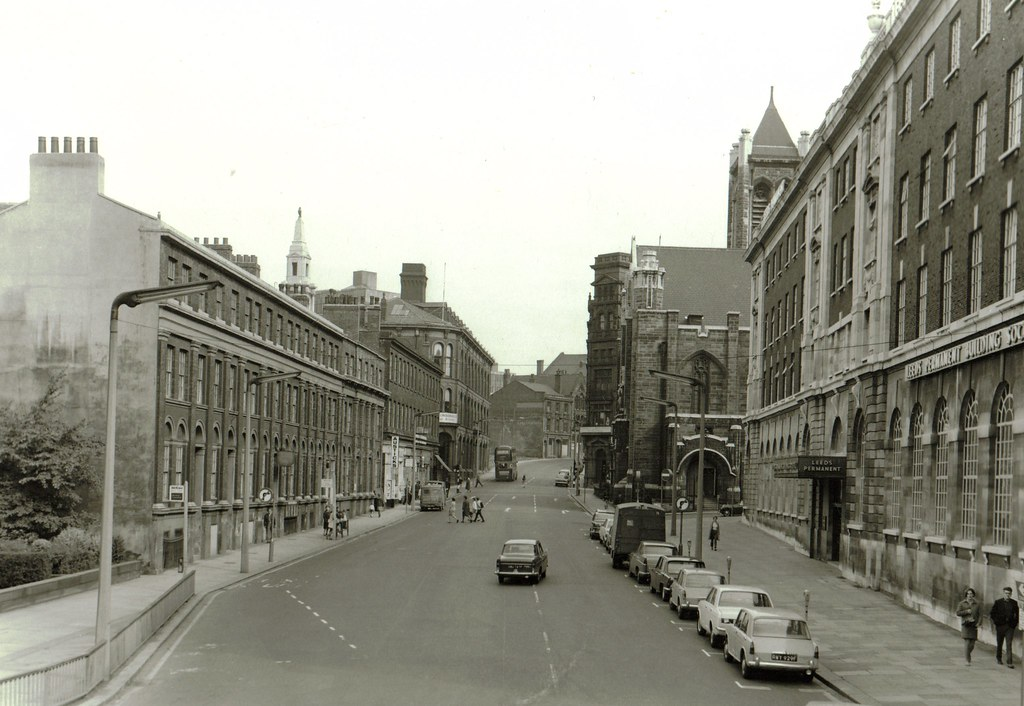
I remember the winter of 1963 — bitter, endless, the cold seeping through cracked windows and damp walls. In my Leeds bedsit a paraffin heater spread its sweet, oily smell while mildew bloomed on the panes. My solitude was broken only by the rasping cough of the man next door, dying slowly of bronchitis. There was nothing bright and beautiful about the “swinging” sixties. Behind the glitter of rock ’n’ roll and the melancholy dirges of the Beatles lay a dull ache of poverty and disorientation. “She’s Leaving Home,” scored for harp and strings rather than the usual guitars and drums, replaces energy with sentimentality. The arrangement sighs and wheezes like an accordion lament; it invites tears, not change. It is the sound of a generation turning sorrow into style — more likely to wallow in self-pity than to seek a way out of the slough of despondency.
The Beatles thought they had found innocence again, and for a time the world believed them. But it was a hollow triumph — the illusion that purity could be recovered through youth, pleasure, and sound. Behind the bright harmonies lay denial: the refusal to face the depth of post-war exhaustion. By the end of the decade the illusion had faded, and the joy curdled into introspection. The dream had soured long before Roger Waters gave it voice.
That was the soil in which The Wall would later take root — the long aftermath of war and the collapse of moral certainty. Roger Waters, a child of the same age and soil, grew up under the same grey skies, the same grammar-school discipline, the same quiet grief for a father killed in the war. By the time he wrote The Wall, that private wound had widened into a cultural one. What I experienced in a damp Leeds bedsit he translated into sound: the sense of a civilisation rebuilding its houses but losing its heart.
We were, in a sense, fellow travellers — products of a generation that had inherited neither faith nor direction. The mod and the rocker, the poet and the pop star, the teacher and the student — all were fumbling toward meaning amid the ruins of inherited belief. Waters’ wall was my wall too: the slow construction of defences against pain, against disillusionment, against the fear that life had become a machine without purpose.
The generations that followed looked upon this darkness with a mixture of pity and impatience. To them, Pink Floyd sounded ponderous, self-indulgent — the music of fathers brooding over ghosts they no longer believed in. And yet, beneath the laughter and speed, the same emptiness lingered. The wall had merely changed its texture: where ours was built of loss and memory, theirs was built of distraction and noise.
Waters’ despair, like that of so many of us, was not the sickness of a single man but the symptom of a wider disinheritance. We were the children of victory, yet we lived among ruins — moral, emotional, spiritual. The war had killed millions, but it had also killed the faith that gave suffering meaning.
That is why The Wall still speaks across generations: not as nostalgia, but as warning. It tells of a civilisation that rebuilt its cities and lost its soul, that made noise to drown its silence, and that mistook freedom for purpose. Waters faced it with bitterness; I faced it with loneliness; but the cry was the same — that without inner renewal, no outer victory can save us.
If there is an answer, it lies not in rebellion or retreat but in awareness: the courage to face what was lost and begin again, brick by brick, in love and consciousness. The wall is our inheritance; the task of tearing it down remains our own.
*“Hey you, don’t tell me there’s no hope at all.
Together we stand, divided we fall.”*
— Pink Floyd, “Hey You” (1979)