Excerpt:
The outcry over Canterbury Cathedral’s graffiti-style installation reveals more than a clash of taste. It points to a deeper anxiety about how ancient sacred spaces can speak to the modern world. The real issue is not art but meaning — whether the Church still trusts the Gospel itself to renew hearts without resorting to novelty.
The Canterbury Controversy
A recent art installation at Canterbury Cathedral — graffiti-style phrases affixed to the pillars — has sparked widespread criticism. Former Anglican bishop Dr Gavin Ashendon described it as “artistic defecation” and “civilisational vandalism,” arguing that graffiti, even in sticker form, signals lawlessness and moral decay. For him, the mere suggestion of such imagery in a cathedral betrays a collapse of order and reverence.
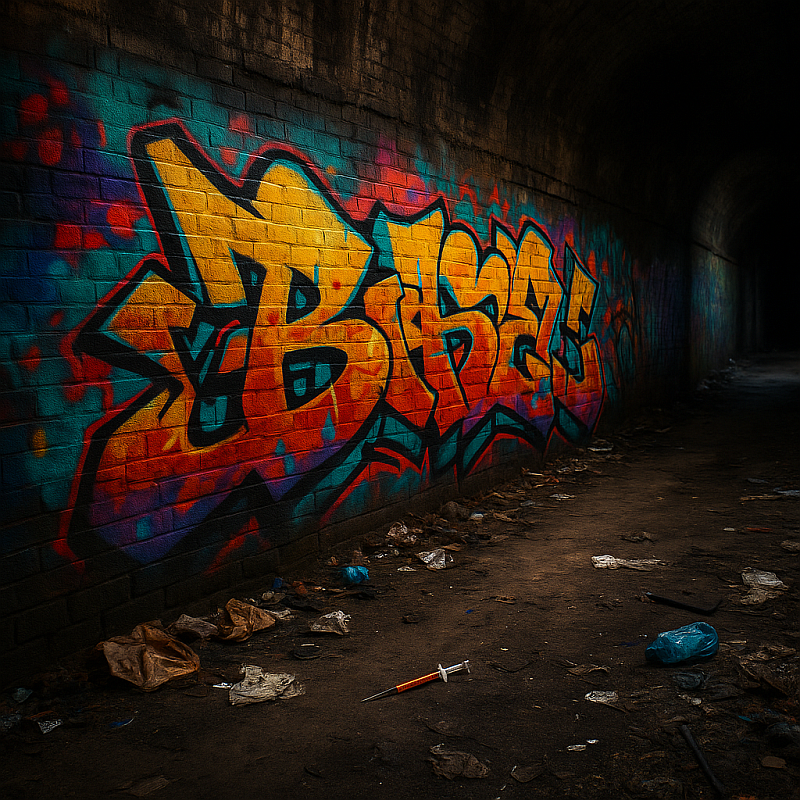
Ashendon’s language is heated, but his concern touches something real: the fear that the Church, in trying to appear relevant, risks cheapening the sacred. Canterbury Cathedral is not just a building; it is a symbol of continuity, beauty, and spiritual gravity. To turn its interior into a stage for cultural experiment feels, to many, like confusing worship with commentary.
Form and Substance
Yet the question runs deeper than decoration. How should ancient sacred spaces speak to contemporary publics without losing what makes them holy? The impulse behind such experiments — to reach the unchurched, to make faith visible in the idiom of the street — is understandable. But when form displaces substance, the gesture rings hollow.
The Church has often substituted form for meaning. It presents the Gospel in fragments — as it has done since the Book of Common Prayer first divided Scripture into brief readings for each Sunday of the year. The same is true in the Catholic Church, where the Lectionary follows a three-year cycle of short passages, designed for liturgical rhythm rather than continuous understanding.
Read in this way, the Bible does not emerge as a coherent document capable of leading believers on to deeper study. Instead, it appears as a mosaic of moral episodes and poetic sayings — beautiful in parts, but disconnected from the radical social and spiritual message that gives it unity.
If the Church seeks renewal, it should not look to visual provocation but to the text itself — to the full, unbroken story.
The Word as Living Presence
The ancient command in Deuteronomy that the Law should be bound “upon the hand” and “between the eyes” (Deuteronomy 6:8; 11:18) was never merely ritual. It symbolised the eternal companionship of the divine — the sense that God’s Word should move with us in every action and remain before us in every thought.
Orthodox Jews still honour this command literally by wearing tefillin, small boxes containing the sacred texts, during morning prayer. Yet the deeper meaning is universal: that the Word of God — or, in broader terms, divine awareness — is not confined to temples or ceremonies but is present always, at all times and in all places.
Rediscovering the Whole Gospel
Groups such as the Jehovah’s Witnesses, for all their discipline, read Scripture continuously and collectively — an admirable practice in itself. Yet their reading is closely bound to the interpretations of their Governing Body, leaving little room for personal reflection or insight. The result is a form of study that is rigorous but rarely transformative. True spiritual growth requires both structure and freedom — the courage to read deeply, and the freedom to think for oneself.
Central to Christian communion is not the preservation of form but the act of remembrance. Jesus’ command at the Last Supper — “Do this in remembrance of me” (Luke 22:19; 1 Corinthians 11:24–25) — was not an instruction to stage-manage ritual but to sustain living memory. The meal he shared was the Passover, a time when Jewish families recalled their deliverance from Egypt. According to tradition, the meal was accompanied by the reading and reflection commanded in Exodus:
“And thou shalt show thy son in that day, saying, This is done because of that which the Lord did unto me when I came forth out of Egypt.” (Exodus 13:8)
Read symbolically, this moment marks not only Israel’s deliverance but the awakening of consciousness itself — the passage from unawareness to understanding, from bondage to insight. In spiritual terms, Egypt represents the state of captivity to our own compulsions — the “desires of our hearts” (Psalm 37:4; James 1:14) that, as the Gnostics saw, feed the demiurge and keep the soul asleep. To come forth out of Egypt is to cease being nourishment for that system: to awaken, to recognise illusion, and to reclaim awareness as an act of freedom.
That act of shared remembrance — retelling the story, reflecting on its meaning, and handing it on — is what Jesus adapted and sanctified at the Last Supper. It is this rhythm of story and reflection, not decorative experiment, that can still renew the life of faith today.
A Call to Renewal
Christianity is in dire need of renovation — not cosmetic, like the addition of graffiti to ancient walls, but spiritual. Its centre must once again be the act of remembrance: “Do this in remembrance of me” (Luke 22:19). The Last Supper was not a ritual of conformity but a moment of awakening — a shared meal that joined remembrance with reflection, symbol with understanding.
Jesus asked us to remember that his blood was shed and his body torn because he preached the Kingdom of God as our birthright — not as something external, administered through secular states and laws, but as something inherent and spiritual. His message placed the divine within the reach of every person, affirming a kingdom not of dominion but of consciousness.
That remembrance should be reinforced by a renewed engagement with Scripture: the Bible read whole, not in fragments; read swiftly enough to grasp its unity, then studied in depth to uncover its layers of meaning. The Gospel was never meant to be heard in isolated verses but as a single, unfolding revelation of freedom.
Jesus was crucified not for preaching piety but for proclaiming that human beings are not subservient to the state — that “the kingdom of God is within you” (Luke 17:21). His teaching placed divine understanding in the conscience of each individual, above the laws of emperors and priests alike. To recover that insight is to recover Christianity’s moral power.
The goal of religion is not submission but awakening: a change of awareness that transforms both the inner life and the world it perceives. As Paul wrote, believers must “put on the whole armour of God” (Ephesians 6:11) — not as soldiers of dogma, but as conscious beings equipped with truth, integrity, and love.
Only by returning to this foundation — remembrance joined with understanding — can the Church hope to speak again with authority and grace.