Excerpt:
While the public argues about chatbots and digital art, artificial intelligence has quietly crossed a threshold: it no longer merely assists research — it now makes discoveries of its own. From protein folding to mathematics, weather, and medicine, the pace of knowledge has shifted from human time to machine time. The question is no longer whether AI will transform science, but whether humanity can still keep pace with the knowledge it creates.
A Quiet Revolution
While public debate has raged about ChatGPT, Midjourney, and the future of creative work, something far more consequential has been taking place. Artificial intelligence has begun solving problems that defied human ingenuity for decades.
In biology, DeepMind’s AlphaFold predicted the shapes of over 200 million proteins — a task that would have taken centuries by traditional methods. The discovery reshaped molecular biology and opened new routes to drug design. In neuroscience, AI-driven brain–computer interfaces now allow paralyzed patients to communicate and control prosthetic limbs through thought alone.
Mathematics has seen its own upheaval: AlphaGeometry solves Olympiad-level proofs with transparent reasoning, while meteorology was transformed by GraphCast, an AI model that predicts cyclones and weather systems faster and more accurately than the world’s best physics-based models.
In materials science, GNoME has predicted hundreds of thousands of new stable compounds — potential breakthroughs for batteries, solar panels, and superconductors. In computer science, AlphaDev has created faster algorithms, some already adopted into the C++ standard library. And in laboratories across the world, autonomous robot scientists now run experiments continuously, refining hypotheses without human direction.
A New Kind of Intelligence
The article that describes these developments calls AI a “discovery engine,” and it is difficult to disagree. Scientific progress that once required lifetimes now unfolds in months. But such language hides a deeper issue. These systems are not discovering in the human sense: they process data and model relationships faster than we can, yet they do not understand what they find. Interpretation still belongs to us.
There is, however, a shift in agency. For centuries, human intellect was the final arbiter of knowledge; now, discovery can occur in forms we cannot fully explain. Machines generate proofs too complex for mathematicians to verify, and design materials whose inner logic is understood only statistically. Science, once the expression of human curiosity, is becoming an ecosystem of interacting intelligences — human and artificial — each extending the other’s reach.
The Question Beneath the Triumph
The achievements are extraordinary, yet they raise an ancient question in a modern form: What is knowledge without understanding? If a machine solves a problem that we cannot follow, has humanity advanced or merely shifted the boundary of its ignorance?
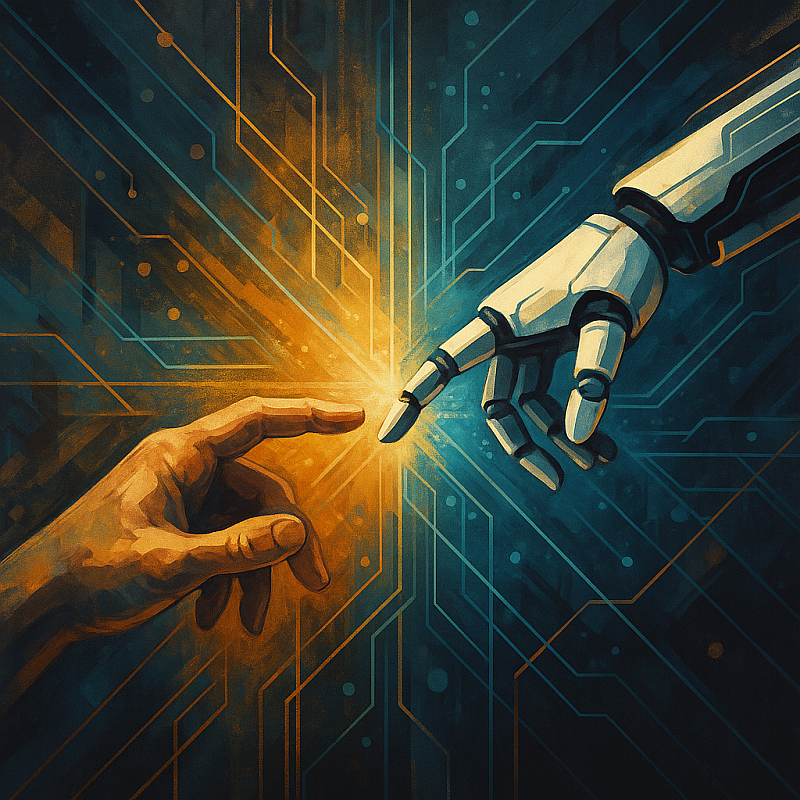
The relationship between human and machine is beginning to resemble that between student and savant: one feels wonder, the other delivers results without explanation. The real danger is not that AI will replace scientists, but that it may outpace the reflective capacity that gives discovery meaning.
Awareness — the slow, conscious comprehension of what is known — remains our domain. Without it, knowledge becomes accumulation without insight, data without wisdom.
Awareness Versus Automation
The new frontier is not technical but philosophical. As AI accelerates discovery, we must guard the contemplative dimension of science — the ability to ask why, not merely how. Machines can generate solutions; only minds can generate understanding.
If there is a lesson in this transformation, it is that human awareness must evolve alongside artificial intelligence. The measure of progress will not be how much we know, but whether we remain awake to the meaning of what is known.