Excerpt:
Jean-Paul Sartre (1905–1980) turned the collapse of religious certainty into a demand for moral self-authorship. This essay sketches his life, clarifies his philosophy (“existence precedes essence”), traces the steps by which he reached his insights—from bleak fiction to public ethics—and considers possible misunderstandings that remain. It concludes with a sober appraisal: we need not act from anxiety or ideology; real action springs from the will to live.
Introduction
Jean-Paul Sartre (1905–1980) turned the collapse of religious certainty into a demand for moral self-authorship. This was not merely a personal rebellion but the product of a wider historical change. In France, religion had lost its public authority far earlier than in England. The Third Republic’s commitment to laïcité — formalised in the 1905 Law of Separation between Church and State — removed the Church from education and political life, leaving reason, science, and civic virtue as the new moral foundations.
By the time Sartre was born, Catholicism in France was no longer the framework of national meaning; it was a private faith in a secular society. For the educated classes, the question was no longer whether God existed, but how to live once He no longer mattered. In England, by contrast, Christianity retained its cultural hold well into the twentieth century — through monarchy, schools, and moral convention. French secularism thus preceded English secularisation by several decades, and Sartre’s generation inherited the full consequences: a world without metaphysical anchor.
It was from within that vacuum that Sartre sought to construct an ethics — not by returning to faith, but by asking how freedom itself might become the source of moral order.
1) A Short Biography
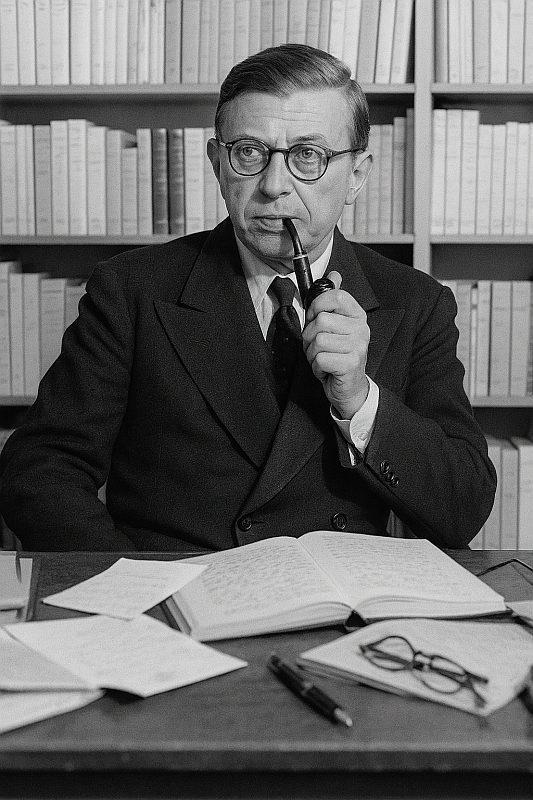
Jean-Paul Sartre was born in Paris in 1905. He studied philosophy at the École Normale Supérieure (ENS) — the most prestigious of France’s grandes écoles, created after the Revolution to train the nation’s intellectual elite. Admission was (and remains) fiercely competitive, open only to the most gifted students of philosophy, literature, and science. Its graduates — known as normaliens — traditionally filled the highest ranks of French education, government, and thought.
At the ENS Sartre met Simone de Beauvoir, who became his lifelong companion and intellectual partner. In 1929, both passed the agrégation in philosophy — the national examination qualifying candidates to teach in the upper levels of secondary and university-preparatory education. The agrégé title carried enormous prestige, marking one as a member of the French intellectual aristocracy.
After teaching for a decade in provincial lycées (notably Le Havre and Laon), Sartre left formal education to write full-time. His early fiction (La Nausée, 1938; Le Mur, 1939) established his reputation. The war years — captivity in 1940, return to occupied Paris, and the moral reckoning of the Resistance — shaped his later insistence on freedom and responsibility. He helped launch the journal Les Temps modernes (1945) and became the post-war public intellectual — novelist, dramatist, critic, and polemicist. He never held a university chair, preferring independence. He died in 1980, having refused the Nobel Prize (1964) to preserve that independence in principle as well as practice.
2) Core Idea in One Line
Existence precedes essence. We are not born with a preset nature or divine purpose; our existence has no pre-existent meaning or end. Whatever we become arises from choice and action within the world, not from design. Freedom, therefore, is not a privilege but a responsibility — the continual task of shaping value in a purposeless universe.
3) The Path to the Insight: From Bleak Fiction to Public Ethics
Early fiction (1930s): Sartre’s early stories and novels were not expressions of existentialism as a finished philosophy but explorations of a problem — how to find meaning in a meaningless universe. Works such as La Nausée (1938) and Le Mur (1939) are internal dialogues set against an interwar Europe adrift in cynicism and rising authoritarianism. In them, Sartre depicts the raw experience of consciousness confronted by absurdity: freedom without direction, awareness without purpose.
In “Érostrate” (1939), Sartre was already probing the limits of the sovereign subject. The protagonist’s plan to commit a random murder is a grotesque attempt to prove his independence — to act freely, without motive or morality. Yet the act, conceived as pure self-assertion, exposes the futility of such freedom. It reveals that absolute autonomy, stripped of responsibility, leads not to empowerment but to nausea and self-disgust. The story is therefore less a celebration of freedom than an early diagnosis of its pathology — a dark prelude to the philosophy Sartre would later formalise in Being and Nothingness.
It was only later, through reflection on those same themes, that he came to see meaning as something created through responsibility rather than unchecked licence. Freedom for its own sake leads only to despair; freedom joined to responsibility becomes the basis of morality.
Phenomenology and Being and Nothingness (1943)
In Being and Nothingness Sartre reworked the ideas of phenomenology — the study of conscious experience — around the human subject. For him, consciousness is not a fixed “thing” inside us but an open relation to the world. It is aware, questioning, and always capable of stepping back from what is given.
Sartre describes consciousness as free, negating, and projective:
- Free, because nothing within it is predetermined. We are not bound by an inner essence or divine plan; we must decide what to make of ourselves.
- Negating, because consciousness can recognise what is not — it can imagine alternatives, notice absences, and deny what is. This power of negation gives rise to both freedom and anxiety.
- Projective, because human beings always look forward, shaping themselves through choices and intentions. We live in possibilities, not in fixed states.
Put simply, Being and Nothingness describes the structure of awareness that makes freedom possible. It shows that we are never merely what we are, but always what we are becoming.
Public ethic (1945): In Existentialism Is a Humanism Sartre moves from analysis to proposal. Having shown that consciousness is free and undetermined, he now asks what such freedom requires of us. If there is no given essence, we must become the authors of our own values. This is not permission to do as we please, but a call to responsibility: every choice affirms what we believe a human being should be. Freedom and responsibility, therefore, are inseparable — the moral burden of a world without divine order.
4) Freedom, Situation, and the Habitus
Sartre’s slogan is often read as metaphysical absolutism. A more faithful reading is this: he rejected pre-given essence, not social formation. The child is not born with an essence; but as soon as we enter language, family, class, and culture, we are shaped by them — what Bourdieu later calls the habitus. Yet freedom persists as situated freedom: we cannot choose where we begin, but we can choose how we respond.
5) Critics and the Turn to Structure
Claude Lévi-Strauss and Michel Foucault objected that Sartre overestimated the sovereign subject. They argued that human beings are not independent authors of meaning but products of deep cultural and historical structures. Language, myth, and power shape the possibilities of thought long before the individual becomes aware of them.
Sartre later acknowledged that freedom operates within limits. In Critique of Dialectical Reason (1960) he spoke of “praxis within structure”: individuals act under constraint but remain responsible for their choices. Where Sartre says “choice creates meaning,” structuralists reply “meaning structures choice.”
6) Engagement, Ideology, and a Persistent Risk
Sartre’s insistence on engagement made him a witness to his time, but it also tempted him toward ideological surrogates for meaning (periods of sympathy with Marxism). Camus shared the impulse — to oppose injustice — yet both risked turning action into a compensatory metaphysics: activism as salvation story. Action pursued to silence anxiety becomes hollow — mere “sound and fury, signifying nothing,” as Shakespeare wrote — movement in place of compassion or creation.
7) Possible Misunderstandings (Offered as Interpretation)
Over time, Sartre’s ideas have often been simplified or misrepresented, both in popular discussion and in secondary commentary. The following points summarise some of the more common distortions — offered here as interpretation rather than authority:
- Misreading freedom as licence: Sartre’s freedom is responsibility without excuse, not indulgence. (Crowley’s “Do what thou wilt” is easily misread as permission; Sartre’s claim is a burden.)
- Taking “existence precedes essence” as denying society: He denies a pre-given essence, not the formative power of language, class, and habitus.
- Confusing engagement with meaning: Political noise can become a new theology. Real meaning is not guaranteed by volume.
- Assuming despair is the endpoint: The early fiction dramatizes pathology; the mature ethic seeks clarity and dignity without illusion.
8) The Final Paradox
When Sartre speaks of the nothingness of existence, he does not mean literal non-being but the absence of inherent meaning in the universe. Existence operates in a different magisterium from human thought and perception: the world simply is, while the human mind insists on asking what it is for. We meet no answer, because purpose is not built into reality.
In this sense, nothingness is not an external void but a mirror of our own questioning nature. Human consciousness cannot rest in mere being; it demands comprehension and possession. As Erich Fromm later observed, we live between the modes of being and having — between allowing things to exist in their own right and trying to seize them through ownership, concept, or belief. We turn existence into property so that it feels secure and intelligible.
Sartre’s philosophy exposes this tendency. The task is not to conquer meaning but to live honestly in its absence — to acknowledge that the universe does not speak our language, and yet to go on creating, acting, and caring within it.
We cannot accept the nothingness of existence without feeling compelled to respond, yet that compulsion easily becomes restless activity. Sartre thought freedom demanded engagement, but action pursued from unease or moral compulsion becomes performance — another attempt to quiet the mind. Real action springs from the will to live, not from desperation or missionary zeal. It is the impulse of the hiker setting out for a day’s walk, or the artist lifting a brush: acts done not to escape the void, but because life itself asks to be expressed.
9) Coda
Many of the things we do are small and seemingly insignificant, but when done with love and motivation, they become mountains — not in the social sense of achievement, but in the inward sense of life fully lived. Meaning does not descend from heaven or arise from ideology; it is made, moment by moment, in how we live. We cannot measure our actions by social standards, nor live by bread alone. The power within experience is the force of life itself — the quiet abundance that turns existence into living.
And that is the point: when we act from fullness rather than lack, the fer dans l’âme — the cold iron of anxiety — begins to melt away. We experience not torment but fulfilment, not the weight of freedom but its joy. The angst dissolves, and life, accepted as it is, becomes enough.