Orientation in an Age of Acceleration
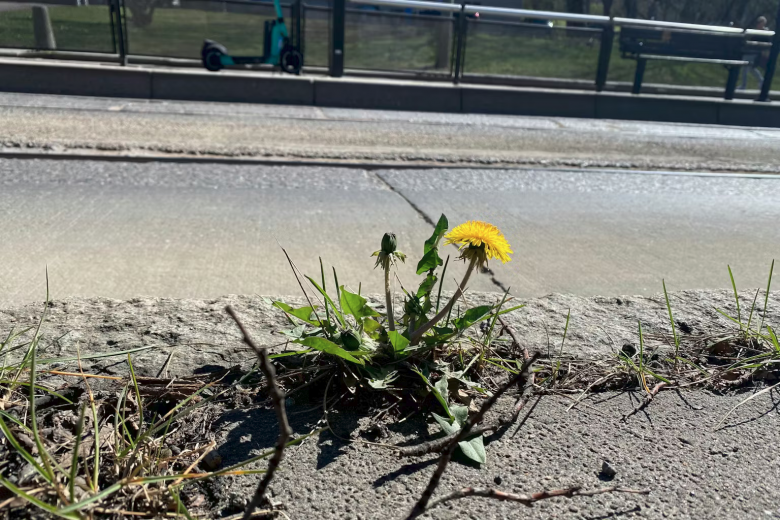
A single dandelion growing beside an autobahn is not a sentimental image. The motorway roars past, carrying traffic at relentless speed, while the flower stands in the verge, dusted with grime yet stubbornly alive. The contrast captures something of our age: power and movement on one side, fragility and endurance on the other.
Many people today carry a quiet sense that something is out of balance. We speak of civilisational decline, of fragile systems, of an economy that seems unable to imagine life without constant growth. Supply chains stretch across continents, cities expand into green space, energy flows invisibly through grids we barely understand, and consumption is treated as normal. The world feels less bounded than it once did, and therefore less secure. This unease is not irrational. Modern societies are complex and tightly connected; efficiency has increased, but resilience is harder to see. When everything depends on everything else, stability feels conditional.
It is tempting to search for a historical turning point. The early modern period marked a decisive shift. Figures such as Henry VIII or Machiavelli can stand symbolically for a change in political thinking: from a world embedded in inherited limits to one shaped by sovereign ambition and calculated power. The Industrial Revolution intensified this shift. Fossil fuel provided energy on a scale no previous society had known. Production expanded rapidly, distance seemed to shrink, and growth became both possible and expected. Constraint, once imposed by geography and scarcity, became something that could be postponed or ignored.
The pre-industrial world should not be romanticised. It was harsh, unequal and frequently violent. Forests were cleared, land was overworked and power was concentrated in the hands of the few. Yet it was limited by the energy available to it. Our own age is not limited in the same way. We possess immense capacity, and therefore face a different moral challenge. If there are to be limits now, they must be chosen rather than enforced by poverty or isolation. That is a more demanding task.
The scale of modern problems easily overwhelms. When we consider billions of people, global trade, ageing populations, climate change and environmental strain, it is easy to feel that individual action counts for little. Despondency follows from imagining that one must solve problems at the same scale at which they appear. Yet human life is not lived at planetary scale. It is lived locally.
I have often arrived at a picnic spot to find it littered and neglected. On occasion I have gathered the rubbish and left the place cleaner than I found it. That act did not reform economic systems or slow urban expansion. It was not a protest against modernity. It was simply an expression of reverence. The place was already imperfect; I did not preserve an untouched landscape. I made a small repair. In a modest way, that was enough.
The Psalms describe a similar movement of mind. They often begin in anxiety or complaint: the world seems unjust, the wicked appear to prosper, the faithful grow weary. Then comes a change of direction. The writer remembers, turns, and offers praise. The outward circumstances may not have altered, but the inner orientation has. The Psalms do not present a life free of lapses. They show how easily one can forget, and how necessary it is to return.
We are always pulled in more than one direction. Appetite and restraint, ambition and humility, expansion and care all compete within us. We are never perfectly aligned. The important thing is not flawless consistency but the willingness to correct course. In that sense, modern civilisation’s power does not remove moral responsibility; it increases it. We understand ecological limits in a way earlier ages did not. We have the language of sustainability, biodiversity and climate science. Whether we act adequately is uncertain, but awareness exists. That awareness makes the question of alignment unavoidable.
If every person made even one deliberate choice in favour of care rather than excess, the cumulative effect would not be trivial. Yet even if others do not, one may still act. Responsibility begins with oneself. To act rightly because it is right, to leave a place better than one found it, to show moderation in consumption and gratitude for what is given—these are not dramatic gestures, but they are not empty either.
Civilisation is shaped not only by institutions and policies but by countless private decisions. When indifference becomes common, decline follows. When restraint and reverence are practised, however quietly, they exert their own influence. The dandelion beside the motorway may seem insignificant, yet its persistence is real. It reminds us that endurance and repair can exist alongside acceleration.
We cannot return to an earlier age, nor should we pretend that it was better in every respect. The task before us is to live responsibly within the power we now possess. While we are alive, we can give thanks, make amends where possible, and maintain our bearing. The future may remain uncertain, and systems may remain strained, but orientation is still within our control. In that sense, even small acts of care become part of a larger fidelity.