
- The Problem of Religious Language
There are certain words in religious speech which are used so often that their meaning is easily assumed rather than examined: God, Spirit, light, grace, glory, kingdom, eternal life. They carry great emotional weight, but they are not always used with precision.
This is not a small matter. If such words are used loosely, they may conceal rather than reveal. They may comfort without clarifying. They may preserve an inherited atmosphere of reverence while leaving the actual experience unnamed.
Yet these words should not be dismissed too quickly. They may be attempts to speak about realities for which ordinary language remains inadequate. Awe, ecstasy, inward reconciliation, moral awakening, the experience of being judged by truth, the sudden recovery of courage — these are not easy things to describe formally. Science can speak about neural correlates, hormones, attention, cognition, and behaviour; but it has not yet provided a complete vocabulary for what these experiences feel like from within.
Religious language may therefore belong to an earlier stage of human self-understanding. It may be metaphor before theory; symbolic language before formal language.
The question is not whether these words sound holy. The question is whether they point to something real.
- Jesus and Metaphor
Jesus did not speak like a systematic theologian. He did not offer a metaphysical definition of God. He did not explain the mechanics of salvation, incarnation, Trinity, atonement, or life after death in the later doctrinal sense.
He spoke in images.
God is Father.
The kingdom is like seed, yeast, treasure, a pearl, a feast.
Human beings may be blind or seeing.
The heart may be pure or divided.
The person may be lost or found.
The house may be built on rock or sand.
The tree may bear good fruit or bad fruit.
The burden may be heavy or light.
These are not abstract propositions. They are psychological pictures.
That does not make them inferior. Metaphor may be the only adequate language for certain kinds of truth. A phrase such as “Blessed are the pure in heart, for they shall see God” cannot easily be improved by reducing it to modern terminology. One might say that those whose inward life is cleansed of duplicity and resentment become capable of perceiving reality differently. That may be useful as explanation, but something has been lost. “They shall see God” carries the depth of the experience.
This is the power of metaphor. It speaks to the whole person.
- Jesus’ Humanity
The metaphorical character of Jesus’ teaching also points to his humanity.
Had Jesus been speaking as a divine visitor with direct access to higher realms of knowledge, one might expect him to speak with conceptual precision. He might have explained exactly what God is, what the soul is, what happens after death, and how salvation works.
But that is not what we find.
We find a Jewish teacher speaking in the religious and symbolic language of his time. He uses the idiom available to him: Father, kingdom, judgement, repentance, forgiveness, Gehenna, seed, harvest, light, darkness, treasure, debt, bread, wine, shepherd, vineyard.
This does not diminish him. It may make him more intelligible.
Jesus appears not as a supernatural lecturer delivering heavenly metaphysics, but as a man of extraordinary spiritual and psychological insight. He saw deeply into the human condition and used the symbolic resources of his tradition to describe alienation, awakening, forgiveness, and return.
- God as a Product of Consciousness
The word “God” may point to something real, but not to something “out there” in the way an object is out there.
God is not a thing in the universe.
God is not an invisible person located beyond the sky.
God is not a supernatural mechanism used to explain what science has not yet explained.
Rather, “God” may be the name consciousness gives to its deepest encounter with truth, value, dependence, awe, judgement, love, and reconciliation.
This does not mean that God is simply invented. Nor does it mean that God exists independently as a being outside consciousness. It means that the experience named by “God” arises within consciousness as consciousness encounters the world.
That encounter is never pure. It is always shaped by circumstance.
A person’s experience of God may be influenced by childhood, fear, love, suffering, education, beauty, trauma, authority, poverty, culture, language, and moral formation. One person hears “Father” and experiences trust. Another hears the same word and feels domination. One hears “judgement” and becomes morally serious. Another is paralysed by shame. One hears “light” and awakens to truth. Another uses “light” as a word for self-flattery.
This is why Jesus’ Parable of the Sower is so important.
The seed is the same, but the soil differs. Some seed falls on the path. Some falls on stony ground. Some is choked by thorns. Some falls into good soil and bears fruit.
This is not merely a sermon about listening properly. It is a profound image of consciousness under conditions. Truth does not enter an empty space. It enters a formed, damaged, defended, receptive, or distracted self.
God, therefore, is not simply invented; but neither is God encountered apart from the conditions of human consciousness.
- The Inner Light
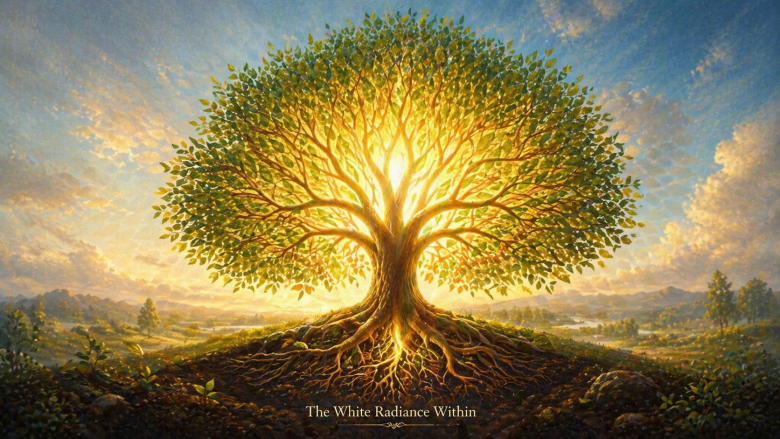
A useful image for this understanding of consciousness is that of a tree filled with light.
Each leaf represents a life. Each life is distinct, but all belong to a larger living structure. Some leaves are more pervious to the light than others. Some are turned towards it. Some are shadowed. Some are damaged. Some receive and transmit it more fully.
But the light should not be understood as something descending from outside. It is not an external supernatural beam. It is an inner radiance: the potential within consciousness itself.
This potential may be tended or ignored, cherished or neglected. It may grow stronger through discipline, love, suffering, reflection, education, beauty, courage, and truthfulness. It may also be stifled by fear, resentment, brutality, distraction, falsehood, or despair.
This gives us a more precise way of speaking about what religion has called “Spirit” or “light”. These words may refer to the awakening of latent inner strength: the capacity of consciousness to become more truthful, more courageous, more receptive, more whole.
At last, perhaps, we reach a scientific word: potential.
- From Religious Metaphor to Formal Language
The history of knowledge often begins with metaphor.
Before modern chemistry, people had phlogiston. The theory was wrong, but it was not worthless. It was an early attempt to explain combustion before the concepts of oxygen and oxidation had been properly formed. People had noticed a real phenomenon, but they did not yet possess the right explanatory language.
Something similar may be true of consciousness.
People still speak of consciousness as light, field, stream, presence, witness, resonance, or spirit. Some of this language may eventually prove confused. Some of it may disappear. But it may also indicate that people are trying to describe something real for which our vocabulary remains incomplete.
The same may apply to religious language.
“Grace” may describe the experience of unearned release: the lifting of guilt, shame, fear, or estrangement.
“Glory” may describe the overwhelming perception of value or radiance in the world.
“Holy” may describe the sense that something is set apart from ordinary use, not reducible to appetite or utility.
“Kingdom” may describe an inward and social order in which the good governs life.
“Light” may describe changed perception: the clearing of self-deception or moral blindness.
“Eternal life” may describe not endless duration after death, but a mode of being in which life is experienced as participating in something deeper than mere survival.
These are not final definitions. They are attempts at translation.
The task is not to preserve religious language at any cost. Nor is it to discard it with contempt. The task is to ask what, if anything, it truthfully names.
- Truth and Freedom
Jesus is remembered as saying, “The truth will set you free.”
That sentence must apply to religious language itself. If truth frees, then words such as God, Spirit, grace, light, and eternal life must not be protected from examination. They must be tested. What do they mean? What experience do they describe? What illusion do they conceal? What truth do they preserve?
It may be that “God” is, in one sense, an illusion: not a being outside us, not a heavenly father watching from beyond the world, not a supernatural guarantor of safety or survival.
But if so, that need not lead to nihilism.
It may mean that what human beings have called God is partly an externalised image of their own deepest capacities: conscience, courage, imagination, love, endurance, forgiveness, and the ability to begin again.
“May the Force be with you” is, in this sense, not merely a popular phrase. It expresses mythically the knowledge of inner strength: the capacity to act, endure, perceive, and align oneself with what is true.
But this too must be handled honestly. Not all obstacles are overcome. Not all wounds heal. Not all losses are redeemed. Not every burden becomes light. A mature understanding of inner strength must include limitation.
Truth does not free us by flattering us. It frees us by making reality bearable.
- Jesus’ Metaphors Reconsidered
Seen in this light, the major metaphors of Jesus become psychologically exact.
The Father is not a literal male deity, but the image of inward authority, trust, origin, and acceptance.
The kingdom is not merely a future supernatural realm, but a reordered condition of life in which the good becomes governing.
Light is not an external substance, but awakened perception.
Darkness is not merely ignorance, but resistance to truth.
The heart is the centre of the person: the place from which action flows.
Fruit is the visible result of inward formation.
The lost sheep, lost coin, and lost son are images of estrangement and return.
Debt is the felt burden of guilt and injury.
Forgiveness is release from the tyranny of the irreparable.
The yoke is discipline; the light yoke is discipline aligned with one’s true nature.
The house on rock is a life built on enacted truth.
The house on sand is a life built on illusion.
The seed and soil describe consciousness receiving truth under different conditions.
These images form a coherent account of human transformation. They describe alienation, awakening, repentance, forgiveness, integration, and return.
- A Rational Theory of God
This suggests a rational theory of God derived from the teachings of Jesus.
God is not an object to be proved.
God is not a supernatural being whose existence can be demonstrated like a fact in the world.
God is the name given to the deepest dimension of consciousness when it encounters truth, value, awe, judgement, love, and the possibility of reconciliation.
This theory preserves the seriousness of religious experience without requiring supernatural machinery. It allows us to understand why religious language has endured, why it can transform lives, and why it can also damage them.
For if God is mediated through consciousness, then the quality of that consciousness matters. A damaged or fearful consciousness may produce a terrifying God. A controlling consciousness may produce an authoritarian God. A loving and truthful consciousness may discover a God of mercy, courage, and freedom.
Again, the Parable of the Sower is central. The word does not act mechanically. It falls into soil.
- Conclusion: The White Radiance Within
The old religious words should not be used carelessly. They need definition, discipline, and honesty. But neither should they be thrown away before we have understood what human experiences they were trying to name.
The word “God” may not point to something outside us. It may point to something within consciousness: a depth, a summons, a radiance, a capacity for truth and strength.
The light is not elsewhere. It is not a supernatural substance descending from beyond the world. It is a potential within conscious life itself.
Each life is more or less open to it.
Each life may tend it or neglect it.
Each life may become more truthful or more defended.
Each life may bear fruit or fail to grow.
Jesus’ genius was to speak of these things in images simple enough to be remembered and deep enough never to be exhausted. His metaphors are not decorative additions to doctrine. They are the teaching itself.
God, then, may be understood not as an external ruler, but as the name human consciousness gives to its own deepest encounter with truth. If that is so, the task is not to believe blindly, nor to dismiss crudely, but to see clearly.
For if the truth sets us free, then even the word “God” must answer to truth.