From Life, Through Doctrine, Through Doubt, and Back to Life Again
There is a long line of men and women in the Christian and near-Christian tradition who seem to have discovered something similar, even though they lived in different centuries, wrote in different styles, and belonged to very different worlds. St Augustine, Pseudo-Dionysius, Symeon the New Theologian, Bernard of Clairvaux, Hildegard of Bingen, Bonaventure, Meister Eckhart, Tauler, Suso, the unknown author of The Cloud of Unknowing, Catherine of Siena, Teresa of Ávila, John of the Cross, Jakob Böhme, George Fox, William Law, Pascal, Swedenborg, Blake, Coleridge, Emerson, Tolstoy, Dostoevsky, Evelyn Underhill, Simone Weil, Martin Buber, Teilhard de Chardin, Thomas Merton, Thomas Keating, Bernadette Roberts, Richard Rohr, and Cynthia Bourgeault all belong, in one way or another, to the same great trajectory. Their dates stretch from late antiquity to the present day. Their backgrounds differ, their language differs, and their theology differs. Yet one cannot help feeling that they are circling the same centre.
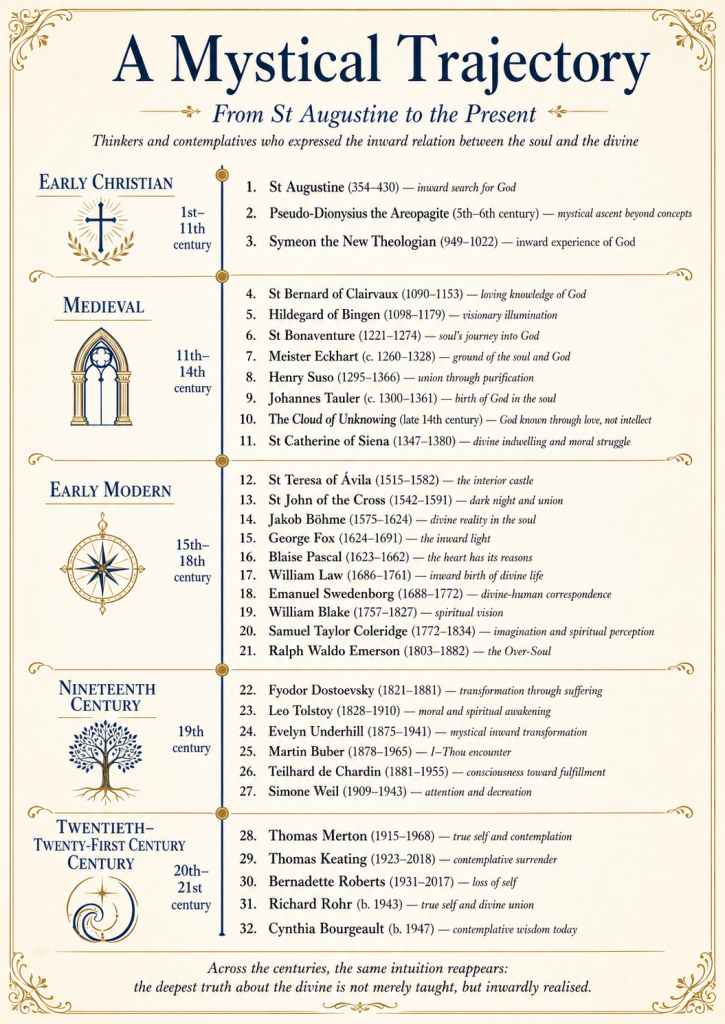
What unites them is not the repetition of one formula, but the repeated discovery that the deepest truth cannot simply be taught from outside. It must be realised inwardly. A book may prepare the mind. A tradition may supply language. A teacher may point the way. But the decisive thing seems always to come through some mixture of suffering, prayer, silence, conscience, crisis, inward recollection, and awakening. Tradition can supply the map; realization comes only when the country itself is walked.
This helps explain why many of these figures knew earlier writers and yet did not merely copy them. Augustine was formed by Paul and by Platonism, but his Confessions are not a borrowed system: they are the record of a man turning inward until truth became real. Bernard knew Augustine; Bonaventure knew the patristic and monastic inheritance; Eckhart stood within a long Christian and scholastic tradition even while saying startling things of his own; Teresa and John of the Cross read within an already rich contemplative world; Merton read widely in the whole mystical tradition. In such cases, earlier works clearly mattered. They gave language to what might otherwise have remained half-felt. They showed that others had gone this way before. They corrected confusion. They encouraged practice.
But there is another pattern too. Some men seem to arrive at similar ground through crisis rather than through direct literary dependence. Tolstoy was not produced by reading Eckhart. He came to his understanding through moral collapse, existential desperation, and confrontation with the Gospels. George Fox’s language of the inward light arose through intense personal struggle, even though of course he lived in a Christian culture already shaped by Scripture and devotion. The same truth, then, appears both as a tradition and as a rediscovery. It is handed on, but it also has to be reborn in each person.
The individual soul often follows a recognisable path. It begins not in doctrine but in life itself. One might call the first stage “Glad that I live am I,” after Lizette Woodworth Reese’s hymn: “Glad that I live am I; / That the sky is blue.” Learned in early childhood, it expresses simple gratitude for being alive, before dogma, sin, or metaphysics. The child is unformed and pre-moral, open and receptive, simply living in sensory, direct experience.
Next comes formation. Parents, school, church, and custom introduce language and authority: There is a God. The child receives this shape before testing its truth. Inevitably, confusion follows. Who is God? Father, judge, power, projection, myth? Old words no longer satisfy, yet nothing inwardly settled has appeared. The soul is in-between: formed, questioning, uncertain.
For some, a fourth stage arises: mystical understanding. God is no longer only an external idea but encountered inwardly, as the ground of life, conscience, and being. Divine reality is known, not just believed. If one is lucky, one may then return to that first gladness, now deepened by struggle, doubt, and inward discovery. But many do not. Most people live their lives largely within the world-picture handed to them by society, rarely questioning it deeply or seeking an inward encounter with the divine or ultimate truth.
This whole discussion raises a further question. Must one pass through formal religion at all before coming to such understanding? I do not think so. The human sense of the numinous seems older than doctrine. Awe, reverence, fear, gratitude, dependence, and the feeling that the world is alive with meaning do not require theology in the strict sense. They arise naturally under certain conditions: solitude, danger, beauty, silence, birth, death, suffering, love, and contact with the natural world. That is why so many so-called primitive peoples are animists. They do not begin with metaphysics. They begin with experience. The forest, the river, the mountain, the storm, the animal: these are encountered as charged with presence. In this respect animism may stand closer to the root than many later religious systems, for it has not yet split the world cleanly into dead matter here and spirit elsewhere.
But such reverence need not be dismissed as pre-moral. Primitive peoples often possess a natural morality embedded in their relation to the world around them. Their morality is woven into kinship, land, custom, taboo, obligation, reciprocity, danger, and survival. It may not first appear as an explicit theory of universal duties, but it is still a moral order: organic, shared, lived, and rooted in reality. In simple societies, chief and tribesman often sing from the same hymn sheet because both remain visibly subject to the same land, the same weather, the same animals, the same scarcity, the same fertility, the same danger, the same common dependence. There is less room for one stratum of society to float free and curate moral fashions for another.
By contrast, in large and complex civilisations morality easily becomes institutional, codified, managerial, and performative. It can be preached from above, adjusted to serve power, and turned into a language of approval and disapproval which masks interests rather than expressing a lived relation to reality. Primitive morality is often existential and embedded; civilised morality is often reflective, institutional, and therefore more easily manipulated. That does not make primitive societies morally pure. They may still be harsh, tribal, and violent. But their moral order remains more visibly rooted in the conditions of life itself.
This is where Jesus becomes such an interesting and decisive figure. He seems to have reduced morality to something inward, immediate, and living. Not a long code. Not a priestly system. Not a social performance. But a condition of the heart. Love God. Love your neighbour. Forgive. Show mercy. Be pure in heart. In this sense morality is no longer mainly external rule-keeping; it flows from inward alignment with what is highest. It arises naturally from reverence and from a right relation to the divine.
That makes Jesus at once more primitive and more universal than later civilisation often realises. In a tribal or animist world, morality is often first a matter of right relation: to kin, land, ancestors, powers, and the order that sustains life. Jesus takes that sense of right relation and intensifies it inwardly and universally. He does not abolish law so much as draw it back to its source. What makes him so remarkable is that he joins together three things that had often been separate: inwardness, reverence, and moral universality. Animism sees spirit in the world. Mysticism discovers depth in the soul. Jesus binds that depth to love.
This is why his message had such force, and also why it lent itself so easily to appropriation. Anything that speaks with that degree of spiritual authority is bound to be useful to institutions. The Church could turn inward transformation into doctrine, hierarchy, sacrament, and empire. Secular powers could turn Christian moral prestige into social discipline, legitimacy, and obedience. The living spring could be channelled into systems. The result is one of the great tragedies of history: the man who called people back to the kingdom within became the banner under which vast external structures were erected.
And yet that is not the end of the story. Every so often, people strip away the layers and rediscover him. The institutional Christ may serve empire; the living Jesus still speaks to conscience. Churches may use him; mystics, reformers, and solitary seekers keep finding him again. That is why his words still sound so fresh when read without the accumulated machinery of theology and power. He reduced morality to an inward law arising from reverence and alignment with the divine. That made him at once deeply primitive, deeply universal, and infinitely adaptable — which is why history both needed him and betrayed him.
That is why the great mystical trajectory remains so compelling. From Augustine to Eckhart, from Teresa to Fox, from Tolstoy to Merton and beyond, the same lesson keeps returning. The soul cannot live second-hand forever. It must pass through doctrine, confusion, and struggle into something inwardly known. The map can be inherited. The road must be walked.
Blaise Pascal is an interesting case. He seems to have come to a deeper awareness not chiefly through outward trauma, but through the boldness to question the conventional notion of God. Yet his famous Wager also shows the danger of reducing spiritual reality to calculation. By treating belief as a prudent bet, Pascal risked trivialising the very depth he otherwise sensed. The divine becomes something to be chosen for safety rather than encountered inwardly as truth. In that sense, the Wager is ingenious but spiritually thin: it may persuade the mind to hedge its bets, but it does not awaken the soul.
Whatever else may be true, religious, mystical, or numinous experience — our experience of God — appears to have neurological correlates. That is no great scandal. Love, grief, music, moral conviction, and mathematical insight all have neurological correlates. These things are bound up with the life of the mind and body. The same may be said of our experience of God. This proves neither that God is real nor that God is unreal. It proves only that such experience belongs to life itself. The Psalmist expressed the matter with stark simplicity: “In death there is no remembrance of thee” (Psalm 6:5). God, like love, grief, and the rest, is a manifestation of life — something known, if at all, in and only through the living consciousness of man.
So where does all this leave us? Perhaps with a modest but important conclusion. The deepest truth is handed on through tradition, but it cannot remain tradition alone. It must be realised. Books matter. Teachers matter. Earlier witnesses matter. But they do not remove the need for inward discovery. A man may read a hundred mystical books and remain unchanged. Another may read one sentence at the right moment, and because life has prepared him, it becomes incandescent.
And when that road is walked, one may at last return to the beginning — not with childish innocence, but with mature gratitude — and say once again, with more depth than before: Glad of life am I.