We have lived for two thousand years inside a consoling dream—a vision of divine purpose, moral order, and ultimate redemption. For much of that time, this vision gave shape to existence. It offered meaning amid suffering, comfort amid uncertainty, and a moral compass that guided whole civilisations through war, plague, and hardship. But beneath that dream lay something harder and more human: the enduring will to own, to rule, to preserve power. Religion, though often born from a longing for truth and justice, became entangled with the mechanisms of authority.
What we have inherited as “faith” or “truth” is, in large part, a narrative woven from myth, politics, longing, and control. Christianity—especially in its institutional and imperial forms—gave Western civilisation a moral and metaphysical framework that softened the brutality of life. It taught compassion, forgiveness, humility, and service. Yet at the same time it stabilised hierarchy and justified submission. It taught people to see obedience as virtue, to interpret suffering as providence, and to locate justice in the next world rather than in this one.
For centuries, this tension between moral idealism and social control defined the Christian West. The same cross that inspired acts of mercy also flew above crusades and inquisitions. The same Church that preserved learning and culture often silenced dissent and punished free inquiry. Religion, for most of European history, functioned not only as a spiritual guide but also as a powerful instrument of governance—a moral infrastructure that kept subjects loyal and consciences subdued.
The promise of salvation, the vision of heaven, the assurance that all would be made right in the end—these offered genuine psychological relief. They gave suffering a meaning and death a purpose. Yet they also served, again and again, to defer accountability and postpone justice. From Constantine’s union of the Cross and the sword, through the wealth and absolutism of medieval popes and princes, to the “civilising missions” of empire, sacred symbols were repeatedly used to sanctify worldly power. In the name of divine order, nations were conquered, slaves converted, and hierarchies preserved. The dream of heaven became a useful device to keep people from rebelling against the injustices of earth.
Still, it would be unfair to treat the whole tradition as mere manipulation. Within Christianity ran other, quieter streams: the voices of Francis of Assisi, Julian of Norwich, Erasmus, Bartolomé de las Casas, and countless unnamed reformers and mystics—men and women who took the moral essence of the gospel seriously enough to challenge its corrupt custodians. They saw that the real message of Jesus lay not in metaphysical speculation or submission to authority, but in compassion, truth-telling, and inner freedom. Their example reminds us that religion’s deepest impulse was never control but conscience. The dream was never only illusion; it was also a vessel for deep human yearning.
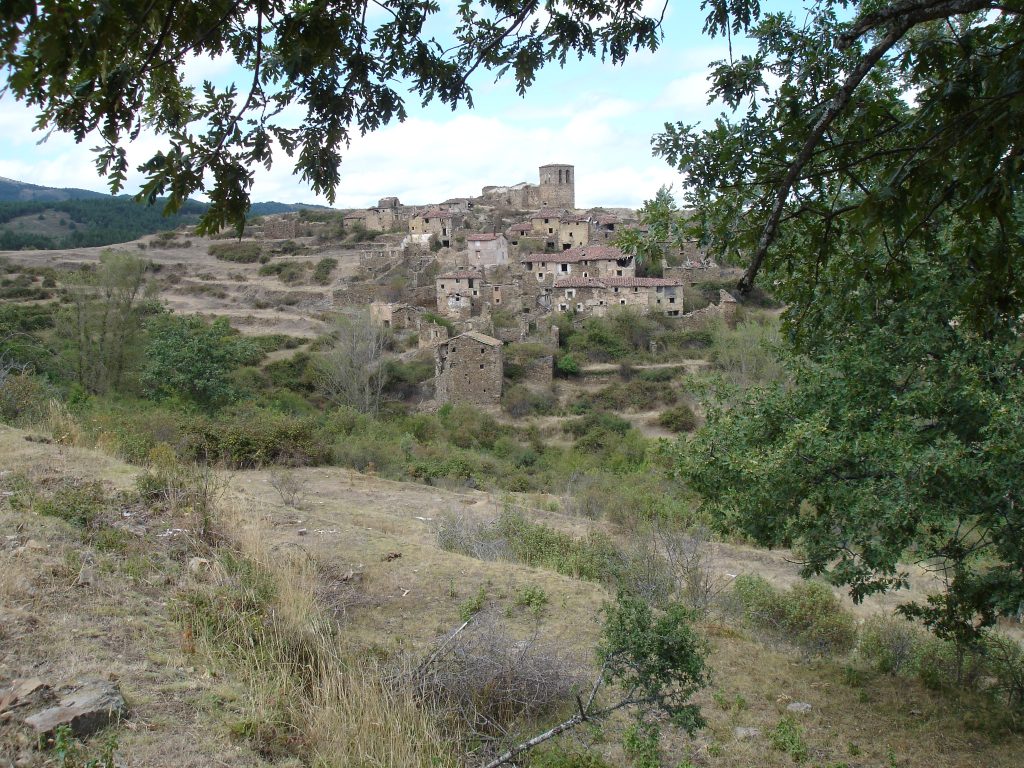
I was reminded of this in 2000, standing at Santa María en Cameros in La Rioja. The village lies in ruin now, but the church—set high on a hill above the houses—still commands the site. I imagined the priest who once heard every confession and knew each life more intimately than its owner; the moral vantage point was not only spiritual but geographic. From that height he governed not by decree but through knowledge—the knowledge of each soul’s weakness, guilt, and need for forgiveness. Faint frescos were still discernible then, though the building was already collapsing—a visible parable of how an authority that once shaped conscience can linger as memory while its structures decay. The stones endure long after belief has faded.
To awaken from that dream is not to sneer at it. It is to see it in full: the consolation and the compromise, the light and the shadow. Awakening means recognising that the myths which once consoled us also confined us—that the faith which promised liberation often demanded submission. Yet it also means acknowledging what the dream preserved: a moral imagination, a language of love and mercy, a hope for justice that transcends mere survival.
The great task now is to reclaim that longing—the hunger for meaning, justice, love, and transcendence—without the myths that once bound it to power. We must learn to separate the human need for connection and purpose from the institutional systems that exploited it. The ancient stories may no longer persuade us as literal truth, but their moral intuition—that compassion redeems, that conscience must stand above force—remains vital.
If the old faiths have lost credibility, the need they expressed remains. What we require is not a return to superstition, nor a surrender to cynicism, but a more honest spirituality: one grounded not in obedience or reward, but in awareness, integrity, and shared humanity. Religion may have lulled us for centuries into dreams of divine order; yet from its fragments we can still awaken to something enduring—a truth that is not imposed from above but discovered within.
The dream may be over, but the awakening has only begun.