
“And then the whining school-boy, with his satchel
And shining morning face, creeping like snail
Unwillingly to school.”
— Shakespeare, As You Like It, Act II, Scene VII
In a recent interview, Tom Rogers, history teacher and CEO of Teachers Talk Radio, described what many teachers now experience in Britain’s schools: classrooms where behaviour has worsened, authority has eroded, and senior management offers little real support. He spoke of constant surveillance, Ofsted anxiety, and a profession exhausted by accountability rather than renewed by purpose. Teachers, he said, are no longer trusted to teach. They spend more time defending their decisions than inspiring young minds.
It’s a telling symptom of a deeper malaise. The erosion of authority is not simply an administrative problem; it reflects a cultural loss of faith in the teacher as a moral guide. When every action is second-guessed—by parents, pupils, inspectors, or senior managers—the classroom ceases to be a community of learning and becomes an arena of compliance. No wonder so many are leaving.
Yet if teachers are constrained by external control, pupils are starved of inner life. Modern schooling does little to help children discover what moves them or what they might live for. The timetable is full, the spirit empty. Passion, curiosity, and imagination—those inner resources that make learning joyful—are treated as optional extras.
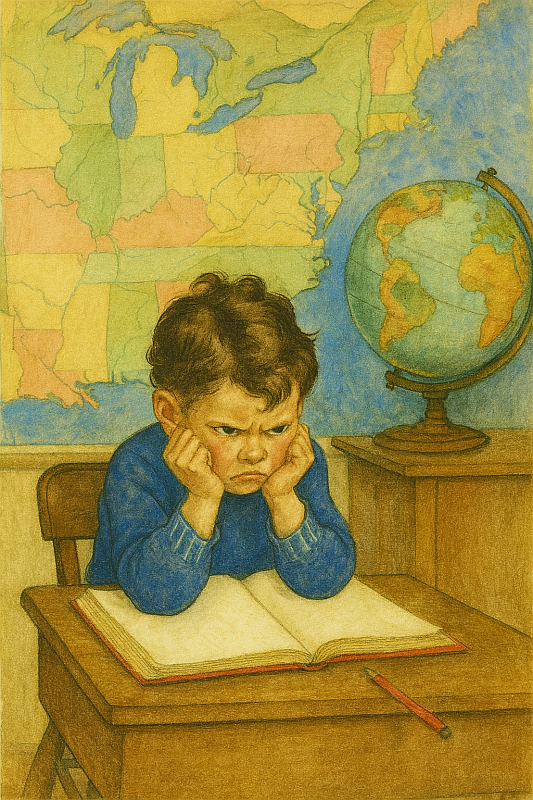
But boredom, though painful, serves a purpose: it is the psyche’s demand for meaning, a signal that life must be richer than routine. Young people are restless and full of energy; when that vitality finds no outlet in purposeful work or creative discovery, it curdles into frustration and aggression. The problem is not that they are disobedient but that they are underfed—emotionally and imaginatively.
Since the early 1990s, legislation and safeguarding protocols—well-intentioned though they may be—have also militated against meaningful relationships between pupils and staff. The natural warmth, humour, and mentorship that once defined good teaching have been replaced by distance and self-protection. A kind of institutional soullessness has become the new professional virtue: teachers must appear neutral, detached, beyond affection or moral influence.
Independent schools may appear to offer an escape, but often they simply train their pupils to compete more effectively—to manage rather than to understand, to lead without compassion. Abroad, the pattern is much the same: a global culture of performative education driven by data, markets, and managerialism.
Yet there are still magical teachers—rare but unforgettable—who inspire despite the system, whose humanity shines through the fear and formality imposed upon them. I can think of perhaps three in all my decades of teaching: men and women whose classrooms were alive with trust and laughter, where pupils felt known and valued. Such people remind us that the spark of education has not died; it merely survives in spite of the conditions meant to suppress it.
Until that spirit is again recognised and protected, most classrooms will remain what Pink Floyd called the wall—orderly, clever, and lifeless. But wherever a teacher dares to break through that wall, something human still happens.
Coda: Beyond the Wall
The alienation we see in schools today is part of a wider cultural malaise—the same one Roger Waters captured in The Wall. The album’s despair lies in its clarity: it exposes our condition but cannot heal it. Like existentialism, it sees the wound but not the remedy. The walls that separate teacher from pupil, and each of us from one another, are the same walls that now define Western life.
If there is an answer, it lies not in systems or reforms but in reconnection—in rediscovering what Jesus taught long before theology hardened into doctrine: that love, awareness, and moral imagination are the only forces strong enough to break through the wall.