1. Alice Weidel — Economist, Linguist, and Politician
Alice Elisabeth Weidel (b. 1979, Gütersloh) is a German economist and politician. She studied economics and business administration at the University of Bayreuth, where she earned her doctorate in economics (Dr. rer. pol., 2011) with a dissertation titled “Chinas Wirtschaftsmodell: Traditionelle Elemente und neue Entwicklungen” (“China’s Economic Model: Traditional Elements and New Developments”).
Her doctoral work analysed the balance between state planning and market reform in modern China, and she subsequently worked in international finance for Goldman Sachs and Allianz Global Investors before becoming an independent consultant. Fluent in Mandarin, she lived for several years in China before entering politics.
Since 2017 she has served as co-leader of the AfD’s parliamentary group in the Bundestag and, since 2022, as co-chair of the party at national level alongside Tino Chrupalla. In 2025 she was confirmed as the AfD’s candidate for chancellor in the next federal election.
2. The AfD — Origins and Political Orientation
Alternative für Deutschland (AfD) was founded in 2013 in reaction to the eurozone debt crisis. Initially led by economists such as Bernd Lucke, it opposed European bailout mechanisms and emphasised fiscal conservatism.
After 2015 the party’s focus shifted dramatically during the migration crisis, adopting a nationalist, anti-immigration, and Eurosceptic stance.
Its current platform includes:
- opposition to uncontrolled migration and EU redistribution mechanisms,
- defence of national sovereignty within Europe,
- scepticism toward anthropogenic climate policy and the EU Green Deal, and
- advocacy of law-and-order and traditional social values.
While the AfD has established representation in all German state parliaments and the Bundestag, several regional branches have been monitored by the domestic intelligence service (Bundesamt für Verfassungsschutz) for suspected extremism.
(Sources: Deutscher Bundestag; DW; Britannica; Wikipedia)
3. The Bundestag Speech — October 2025
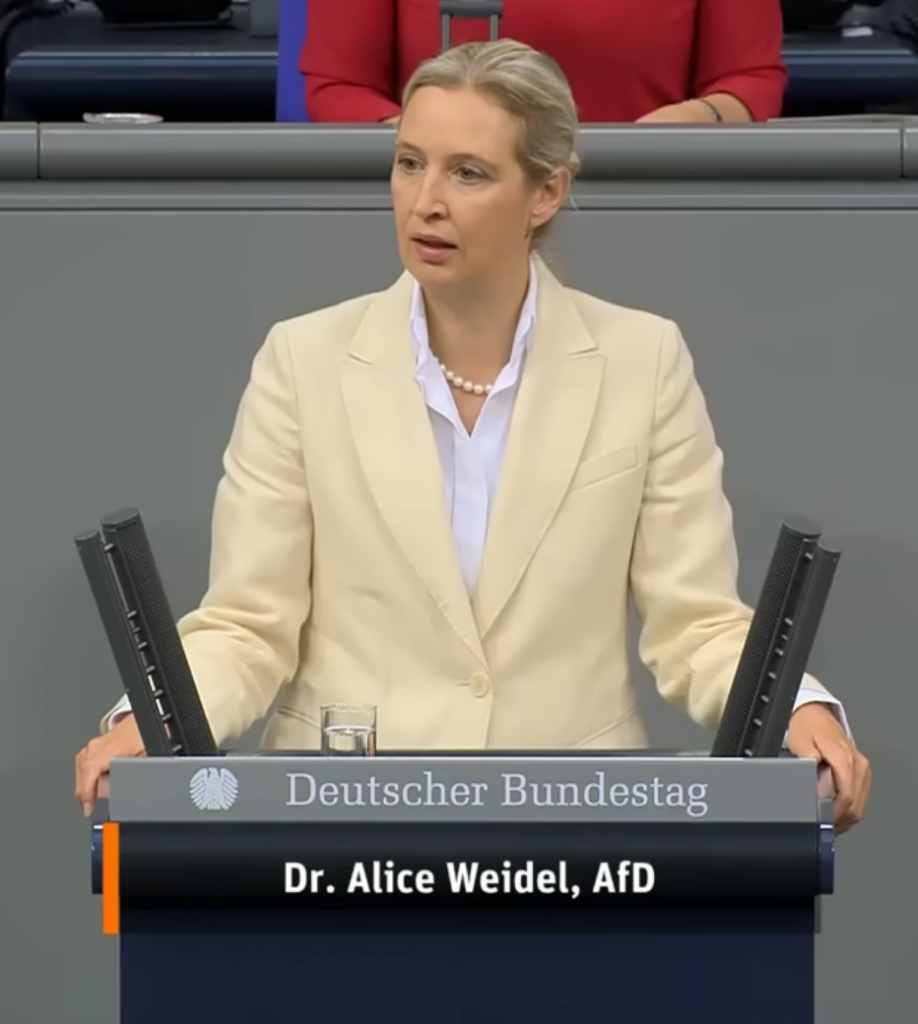
In a Bundestag address in late October 2025, following debate on Germany’s contribution to Gaza reconstruction, Alice Weidel delivered a fierce critique of Chancellor Olaf Scholz’s coalition government (SPD–Greens–FDP).
She accused it of fiscal recklessness, industrial mismanagement, and moral neglect of ordinary citizens.
At the same time, Weidel turned her fire on Friedrich Merz, leader of the Christian Democratic Union (CDU) and head of the CDU/CSU parliamentary group, who is expected to stand as the Union’s chancellor candidate in the 2025 federal election.
She charged that Merz’s opposition had become indistinguishable from the government itself, saying that “there is no real opposition in the Bundestag except the AfD.”
Thus, her speech positioned the AfD not merely against the ruling coalition but against what she portrayed as a uniparty consensus encompassing both left and centre-right.
(Sources: Deutscher Bundestag plenary transcript, Kurbel TV video 28 Oct 2025, Reuters political coverage.)
The address, recorded in the Bundestag transcript and widely circulated on the Kurbel TV channel (premiered 28 Oct 2025), framed her criticism under several themes.
(1) Foreign Spending and Loss of Influence
Weidel accused the government of eroding Germany’s international standing while pledging “hundreds of millions for Gaza reconstruction” at a time of domestic economic hardship. She argued that Germany was “throwing money it doesn’t have” and neglecting citizens affected by inflation and infrastructure decay.
(2) Economic Decline
She described Germany as in an “autumn of decline,” citing an industrial output fall of –4.3 % (Aug 2025) and a 20 % drop in car production, together with 22 000 company insolvencies projected for the year.
She claimed the government was “making new loans to pay old ones,” leading to unsustainable public debt.
(3) Misplaced Priorities
According to Weidel, spending on pensioners, the sick, and the disabled was being cut while billions were sent abroad:
- € 1 billion for global health programmes
- € 12 billion for overseas climate projects
- € 30 billion for development aid
- over € 50 billion for migration-related costs
She contrasted this with the unfinished reconstruction of the Ahr Valley four years after the 2021 floods.
(4) Structural Causes of Weakness
She identified three interlinked causes:
- Mass immigration instead of controlled borders.
- Eco-socialist planning instead of market economics.
- Over-regulation and erosion of civil liberties.
(5) EU and Migration Policy
Weidel rejected the EU’s migrant-redistribution mechanism, claiming it would attract more arrivals to Germany given its high welfare standards. She urged Germany to emulate Poland and Hungary in securing its own borders.
(6) Climate and Industry Policy
She denounced the EU Green Deal, the combustion-engine ban, CO₂ taxes, and the “heating law,” arguing these measures were de-industrialising Europe and impoverishing German households.
(7) Monetary and Civil-Liberty Concerns
She warned of “EU-style socialism” funded by inflation and common debt, alleging that the digital euro, asset register, and chat-control proposal threatened citizens’ privacy and property rights.
(8) Conclusion
Weidel ended by declaring that the Scholz coalition stood for “repression and fiscal decay,” while the AfD stood for “freedom, the rule of law, and policies in the interest of the German people.”
(Sources: Deutscher Bundestag Plenary Protocol; Kurbel TV video, 28 Oct 2025)
4. Comparing Conditions: Germany and Britain (2024–25)
| Theme | Germany (DE) | United Kingdom (GB) |
|---|---|---|
| Industrial output | –4.3 % m/m (Aug 2025); auto –18 %. (Destatis) | –0.9 % (Jul) → +0.4 % (Aug 2025). (ONS) |
| Automotive sector | > 25 % ICE production drop 2017–23; Bundesbank notes weak exports. | Recovering post-COVID but energy costs and EV transition pressures. |
| Company insolvencies | ≈ 22 000 in 2025 (projected); post-2009 high. (Reuters) | 2 048 (Aug 2025); elevated vs 2019. (Insolvency Service) |
| Unemployment | 3.9 % (Sep 2025, EU-harmonised). (Destatis) | 4.7 % (May–Jul 2025). (ONS) |
| Debt to GDP | ≈ 62 % (mid-2025). (Eurostat) | ≈ 95 % (Q3 2025). (ONS) |
| Inflation (CPI) | ~ 2 % (Sep 2025). (Destatis) | ~ 3 % (Sep 2025). (ONS) |
| Energy policy | Nuclear exit Apr 2023; high industrial power costs. | Ofgem cap £ 1 755 / yr (Q4 2025). |
| Migration flows | ~ 230 k asylum apps 2024 (–30 % vs 2023). (BAMF) | Net migration 431 k (2024, –50 % vs 2023). (ONS) |
| Digital policy | EU CSA (“chat control”) debated; digital euro pilot pre-2027. | Online Safety Act 2023; encryption scan powers not activated. |
Interpretation:
Germany’s cyclical weakness is concentrated in manufacturing, especially automotive exports. Britain’s economy, dominated by services, shows greater fiscal pressure and higher debt.
Both countries experience migration strain, rising insolvencies, and energy-policy trade-offs.
5. Broader GB–DE Trends since 9/11
Security and Surveillance — Both states expanded powers after 2001. Germany’s NetzDG (2017) and EU CSA (“chat-control”) proposal mandate online content removal and inspection of encrypted messages; Britain’s Online Safety Act 2023 similarly allows for scanning subject to technical feasibility. Civil-liberties advocates in both nations warn of mission creep.
Energy and Climate Transition — Germany’s Energiewende, culminating in the 2023 nuclear exit, left energy-intensive industries exposed to volatile prices. The UK’s Net Zero 2050 policy has imposed parallel costs on households and firms. Both now debate how to reconcile decarbonisation with competitiveness.
Industrial Composition — Germany retains a heavy-industry base but is vulnerable to global demand and EV policy shifts. The UK’s long-standing service dominance cushions shocks yet limits productivity and export depth.
Public Finances — Germany’s debt ratio is lower but rising; the UK’s remains among the highest in Europe. Both face mounting welfare and energy-transition expenditures.
Migration and Integration — Germany’s debate focuses on asylum-system capacity and EU distribution; Britain’s on net flows and visa restrictions. In both, migration remains politically charged despite recent declines in totals.
6. Shared Social and Political Symptoms
1. Erosion of Free Speech and Open Debate
Germany’s NetzDG (Netzwerkdurchsetzungsgesetz, or Network Enforcement Act — is a social-media regulation law that came into force on 1 January 2018.) requires social-media platforms to remove “hate speech” within 24 hours, with the risk of over-compliance. Britain’s Ofcom-supervised Online Safety Act (The UK Online Safety Act received Royal Assent on 26 October 2023.) has comparable chilling effects.
Outcome: narrowing of acceptable opinion; emotional sensitivity replaces tolerance.
2. Expansion of Surveillance and Digital Control
Germany’s digital-euro pilot and chat-control initiative mirror Britain’s encrypted-message scanning powers.
Outcome: citizens sense cash, speech, and data converging into one traceable system.
3. Bureaucratic Centralism and Weak Parliamentary Authority
EU regulations dominate German policy-space; Britain, though outside the EU, continues to rely on quangos and regulators.
Outcome: governance by expertise rather than representation.
4. Cultural Fragmentation and Identity Fatigue
Germany’s Vergangenheitsbewältigung (coming to terms with its past) and Britain’s post-colonial guilt both foster national self-doubt.
Outcome: patriotism becomes suspect, collective identity dissolves.
5. The Green-Technocratic Consensus
Germany’s Energiewende (policy shift from nuclear and fossil fuels toward renewable energy sources) and Britain’s Net Zero both rely on regulatory compulsion rather than persuasion.
Outcome: environmental virtue-signalling replaces practical policy.
6. Decline of Trust and Institutional Authority
Faith in political parties, media, and justice systems has fallen sharply in both countries.
Outcome: citizens feel administered, not represented.
7. Digital Distraction and Social Atomisation
High mental-health diagnoses, youth alienation, and online dependency are common.
Outcome: weakening of real community and civic resilience.
8. Fear of Decline
Behind every policy dispute lies anxiety about national exhaustion — economic, moral, and demographic. Part of this malaise can be traced to the restructuring of Western economies after the 1970s. From Reagan’s deregulation in the United States to similar reforms across Europe, wealth and decision-making power became increasingly concentrated in financial and corporate hands. The result, visible in both Britain and Germany, has been the rise of a rentier class — those who live from ownership rather than production. What was once a broadly shared post-war prosperity has narrowed into a hierarchy of entitlement. The sense of exhaustion is therefore not only psychological but systemic — the outcome of economies designed to reward speculation rather than work.
Outcome: polarisation replaces shared purpose.
7. Structural Convergence
By 2025, Germany and Britain exhibit parallel trajectories of managed decline.
Both have:
- outsourced manufacturing or energy independence,
- layered regulation upon shrinking productivity,
- financed welfare expansion through debt, and
- substituted administration for leadership.
The malaise runs deeper than ideology. Left and Right alike have presided over the same economic transition—from productive industry to financial dependence—and now face the same public disillusionment. Increasingly, taxpayers question how public funds are used. Large infrastructure schemes, consultancy contracts, and official inquiries absorb billions, yet often produce limited practical results. In Britain, the cancellation and scaling back of HS2 after years of escalating costs became a symbol of this inefficiency (as of 2023, about £27 billion had been spent on HS2.); in Germany, similar criticism has been directed at delayed public works and defence procurement projects. The perception is that money circulates within administrative networks rather than reaching the public, reinforcing a sense that government has become detached from those it serves.
8. Conclusion — Parallel Paths in a Fragmenting Europe
Germany and Britain, despite their contrasting histories and institutions, are moving through a shared cycle of fatigue: economic slowdown, cultural uncertainty, and technological over-reach.
Weidel’s speech, stripped of rhetoric, merely articulates discontents that resonate across Europe.
Both nations live, as she implied, on borrowed money, borrowed energy, and borrowed time.
Whether renewal comes through populist correction — a reassertion of popular will against bureaucratic inertia — or through pragmatic reform from within the establishment, remains to be seen. What is clear is that the decline she described in Berlin could as easily be spoken in Westminster — and often is, by figures such as Richard Tice and Nigel Farage, who voice similar concerns about debt, governance, and loss of sovereignty.
The remarkable convergence of these two former industrial powers — one inside the EU, one out — suggests that the deeper problem is not governance structure but the erosion of civic purpose itself.
References (Primary and Secondary)
Deutscher Bundestag (Plenarprotokoll Oct 2025); Kurbel TV video (28 Oct 2025); Destatis Industrial Production Aug 2025; Bundesbank Automotive Report 2024; Reuters (2024–25 economic data); Office for National Statistics (ONS Production, Public Sector Finances, Migration 2024–25); Eurostat Debt Q2 2025; BAMF Asylum Statistics 2024; ECRE AIDA Report 2025; Ofgem Price Cap Oct–Dec 2025; European Commission (EU CSA Proposal); House of Commons Library (Online Safety Act 2023); Clean Energy Wire (Energiewende update); DW, Britannica, ZDFheute (Biographical and Party profiles).
Would you like me to add your WordPress callout box at the top — e.g.:
<aside class="callout pyramid">
This essay compares the themes of Alice Weidel’s October 2025 Bundestag speech with parallel developments in Britain, using official data and independent reports. It does not endorse any party position.
</aside>
—and then format the comparison table in your preferred HTML style?