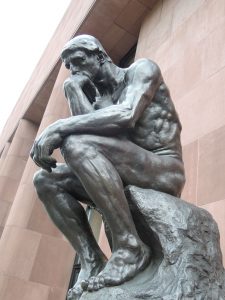
“Social constraint precedes self-understanding; it is ingrained long before an individual can look at it critically and act decisively.”
Émile, ou De l’éducation is often associated with the idea that a child’s social formation is largely complete very early in life — an intuition captured in sayings such as “Give me the child and I’ll show you the man.” On this view, early formation is not a problem but a necessity: society must shape the child before reflection is possible, and good education consists in guiding that process wisely. What this emphasis risks ignoring, however, is individual difference — the fact that many people grow up with the uneasy sense of being square pegs forced into round holes, formed successfully for a life that does not quite fit them.
I have not read Émile in full, and so cannot claim certainty here. My impression is that the book is well known, but often treated as a pedagogical curiosity rather than taken seriously as an exploration of how deeply social constraint shapes the self before reflection is possible. Rousseau does not appear to have been trying to conform his pupil to existing social norms, but rather to delay their force long enough for independent judgement to emerge. Whether this amounts to a social warning or an educational hope remains open. What does seem clear is that Rousseau understood the central difficulty with unusual clarity: that formation precedes understanding, and that by the time critique becomes possible, much of the self has already been shaped. It is this problem — not the details of his educational scheme — that continues to trouble lives long after schooling is over.
The unsettling implication is that freedom cannot precede formation. By the time an individual is capable of reflection or critique, habits of obedience, expectation, and desire have already been laid down. Education therefore becomes an exercise in imposing constraint long before the subject can recognise it as such. Rousseau’s optimism lies in the hope that, under the right conditions, this managed formation might later give rise to genuine independence. At the same time, the argument acknowledges that there is no clean starting point outside society from which a self can freely choose its life. One does not step into society; one awakens already inside it.
And that, in turn, explains the inherent irony: wisdom arrives late because the capacity for wisdom depends on having first been shaped by forces one could not yet see.
Rousseau recognises this clearly. What he perhaps underestimates is how rarely the later moment of autonomy can undo the earlier formation. Émile is disquietingly honest about how little free room there really is, yet remains optimistic about how much can be recovered once the damage has been done.
In that sense, my view is more austere than Rousseau’s. I do not promise emancipation with the arrival of critical thinking. What I describe instead is compromise — late, imperfect, and constrained — as the truest expression of the human condition.