Christianity did not begin with texts. It began with stories — fluid, flexible, shaped by memory and performance rather than by the rigidity of ink. For decades after Jesus’ death, the movement existed as a network of gatherings that relied on oral tradition, shared meals, improvised teaching, and local interpretation. Nothing about this early phase resembled a legal system. There was no canon, no creed, no central authority. The Gospels were not yet written, let alone enforced.
Yet within a few centuries, these same stories had become instruments of social control. Councils determined what was acceptable belief, bishops defined orthodoxy, and emperors invoked Scripture to stabilise society. The transformation was not accidental. It followed the slow but decisive shift from oral tradition — inherently fluid and participatory — to written documents that could be quoted, codified, and ultimately weaponised.
Writing changes everything. A spoken story can bend and adapt; a written one can be pointed to. Once a saying of Jesus existed in fixed form, it became available for argument, for authority, and eventually for governance. A fluid tradition invites interpretation; a text demands compliance. The creation of the Gospels — a process about which we know remarkably little — did not lead to a simple world in which Christians could confidently say, “This is what Jesus said.” In fact, almost the reverse occurred. As the oral traditions hardened into written texts, and as those texts were later shaped by copying, translation, and selection, the centre of authority shifted increasingly from Jesus’ own voice to the interpretations issued by theological councils and emerging church hierarchies.
The long gap between Jesus’ death (c. 30 CE) and the appearance of a complete Christian Bible — not stabilised until the late fourth century — is crucial here. We are not dealing with a few years of gradual development but with decades and then centuries, in an era when writing was difficult, expensive, and controlled by scribal elites, ecclesiastical centres, and later imperial authorities such as those of Constantine (306–337 CE) and Theodosius I (379–395 CE), who determined which texts could be copied, circulated, or preserved. The result is that we simply cannot know how much of what the Gospels record reflects the historical Jesus, how much represents the memories and preaching of early communities, and how much expresses later doctrinal concerns. Rather than giving us direct access to Jesus’ words, the scriptural tradition presents us with a layered and mediated record shaped by the selective processes of transmission, copying, and canon formation.
The Transformation of Roland
A useful comparison comes from medieval Europe. The historical Roland was a minor officer who died in a Basque ambush at Roncevaux in 778; yet by around 1100 — some three centuries later — his death had become the epic Chanson de Roland, a vast fable of giants, miracles, and holy war. The shift from a brief annal entry to a mythic saga shows how easily a community can reshape memory to meet its cultural and theological needs. This does not prove that the Gospel tradition is false, but it reminds us that long gaps, oral transmission, and selective preservation can profoundly transform the way an original event is remembered.
Something similar unfolded in early Christianity, though on a vastly larger and more consequential scale.
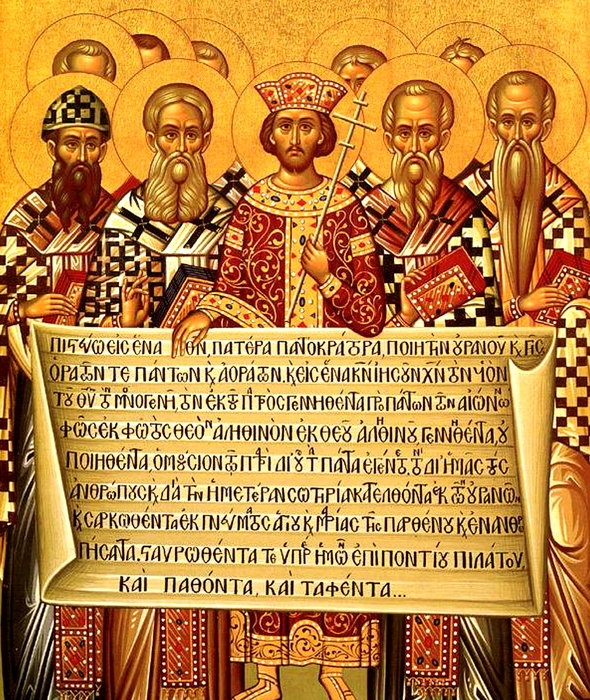
The process accelerated as the Church expanded and disagreements multiplied. Councils emerged not to preserve diversity but to manage it. When the Council of Nicaea (325 CE) declared the Son ‘of one substance with the Father,’ it was not clarifying a theological subtlety so much as defining what counted as orthodox Christian belief — and who fell outside it. The creed was a legal document before it was a devotional one. It told the empire who stood inside the Christian framework and who stood outside it. It told bishops what they must teach, and it told the faithful what they must accept. Its purpose was to establish a single, authoritative interpretation of what the Church represented — a monolithic standard of belief against which all other teachings could be judged. A basic level of group cohesion is essential to the survival of any community; without shared beliefs, shared purpose, or shared identity, groups inevitably fragment and institutions lose their stability.
Canon formation served the same purpose as the creeds: it created an authoritative boundary of teaching, fixing which texts defined Christian identity and excluding the many alternative writings circulating in the early Church. Out of the dozens of gospels, letters, and apocalypses circulating in the early centuries, only a small subset was selected. The guiding criteria were not limited to historical accuracy but included usefulness: which texts supported emerging doctrine, which could be harmonised, which reinforced episcopal authority, and which could serve a public religion in a vast and unstable empire. Once the canon was closed, it became a legal archive — a body of documents against which belief and behaviour could be measured.
How the Christian Canon Was Formed
The biblical canon did not descend ready-made from heaven. It emerged gradually as the Church sought to decide which writings carried authority and which did not. Early Christian communities used a wide range of texts — gospels, letters, apocalypses, and Jewish Scriptures — without a fixed list. The first attempt at a canon came not from the Church but from the heretic Marcion (c. 140 CE), whose severe selection forced bishops to clarify their own standards. Irenaeus of Lyons (c. 180) argued for the authority of four Gospels, no more and no fewer; the Muratorian Fragment (late 2nd century) shows an early, partial canon at Rome.
Origen (early 3rd century) distinguished between recognised, disputed, and rejected books, while Athanasius of Alexandria, in 367 CE, produced the first surviving list of the 27 New Testament books exactly as we have them today. Regional councils at Hippo (393) and Carthage (397, 419) later ratified this emerging consensus. The canon thus arose not from a single decision but from centuries of negotiation, controversy, and the practical needs of a growing institution.
What had once been an open conversation hardened into a system of rules. Scripture, now fixed and sanctioned, could be invoked to discipline clergy, silence dissent, and shape public policy. The Gospels became government in the sense that Christian texts underwrote the moral logic of authority. They gave theological backing to law, hierarchy, and obedience; they offered divine weight to human institutions; and they allowed those institutions to claim continuity with Jesus while enforcing norms he never articulated.
Papal Power and the Making of Christian Europe
Two popes in particular were decisive in transforming Christianity from a spiritual movement into the organising framework of European civilisation. Leo I (440–461), known as Leo the Great, asserted the primacy of the Roman bishop with a boldness not seen before. His Tome of Leo shaped Christological doctrine at the Council of Chalcedon (451), effectively defining orthodoxy for the Western Church. Politically, his famous meeting with Attila the Hun in 452 established the pope as a protector of the Roman people — a moral authority capable of negotiating where emperors could not. Leo I thus laid the foundations for a papal role that stretched beyond theology into governance and diplomacy.
Three centuries later, Leo III (795–816) completed this transformation by placing a crown on Charlemagne’s head on Christmas Day, 800 CE. In doing so, he fused Christian authority with imperial power, creating the ideal of a Christian empire that would dominate the medieval imagination. His act suggested that legitimacy flowed not only from military strength or ancient lineage but from the blessing of the Church. From Leo III onward, Europe’s political order was shaped by the principle that rulers governed best when they governed under God — and under the gaze of Rome.
None of this is to deny the beauty or power of the texts themselves; it is simply to recognise that, once incorporated into a legal and institutional framework, they could function very differently from the living words of the teacher who inspired them. The Gospels can still unsettle the conscience in ways no canon or creed ever could. The result was that the Gospel message, originally experienced as a call to inner transformation and moral awakening, was increasingly framed as obedience to a God understood from without — a God whose representatives were bishops, councils, and, in time, secular rulers who governed in the name of the Church.
Christianity inherited a wide range of writings from its early communities, but only a selection was approved as authoritative. The Church largely left these texts as it found them, yet it interpreted them in ways that differed significantly from the spirit of Jesus’ own teaching — turning them into tools for defining doctrine, regulating behaviour, and consolidating authority. In practice, attention shifted from Jesus’ moral and existential vision in the early chapters of the Gospels toward the Last Supper and the Crucifixion, scenes that enabled Church leaders to emphasise human sinfulness and the need for confession, forgiveness, and sacramental mediation. The Sermon on the Mount and the parables were preserved, but increasingly as illustrative stories rather than as the disruptive centre of Christian practice. Meanwhile, the letters of Paul provided fertile ground for theological and metaphysical elaboration, encouraging interpretations that moved Christianity further from Jesus’ call to inner transformation and closer to a system of doctrinal propositions. In this way, the tradition did not suppress Jesus’ teaching so much as reframe and overshadow it, redirecting its most unsettling insights into forms that institutions could manage and sustain.