Most people imagine the Bible as a unified book with single, named authors and consistent historical intention. In reality, the Bible is a library, compiled over centuries, reflecting layers of oral tradition, cultural exchange, theological innovation, redaction, and ideological struggle.
Genesis has multiple authors and incorporates motifs from older Near Eastern myths such as the Enuma Elish and the Epic of Gilgamesh.
The Synoptic Gospels (Matthew, Mark, and Luke) rely on earlier shared sources, including a lost sayings collection known as Q.
Only seven of the letters in the New Testament are unquestionably by Paul.
The Gospel of John, the letters of John, and Revelation are all written by different authors.
Acts is likely by the author of Luke and presents a harmonised view of early Christianity that glosses over real internal conflict.
Thousands of manuscript fragments exist with significant variations, including accidental errors and deliberate theological alterations.
Archaeology confirms that the Bible cannot be treated as modern history. Many figures and events cannot be verified. Yet the Bible remains the foundational text of Western civilisation—shaping Judaism, Christianity, ethics, imagination, and politics.
2. What the Bible Is About: Covenant, Failure, Expectation
Apart from the Creation stories—themselves theological retellings of older myths—the Old Testament is dominated by a single theme:
The Covenant.
Abraham enters into an agreement with a divine voice: His descendants will flourish if they obey.
The rest of the Old Testament recounts:
The struggle to remain faithful
The rise and fall of kings
Prophetic warnings
Moral failure
The Babylonian exile
The rebuilding under Persian sponsorship
The destruction of the Second Temple in 70 CE
The dispersal of the Jewish people
Across these centuries, the hope for a coming Messiah arises: a figure who will rescue Israel and fulfil the Covenant. Historically, this has not occurred.
Across these centuries, the hope for a Messiah develops only in fragments. Scattered references—such as the promises in 2 Samuel 7, Isaiah 9 and 11, Jeremiah 23, Ezekiel 34, and the vision in Daniel 7—point to a future king or deliverer, but they never form a coherent doctrine. The unified “messianic expectation” familiar today is a later construction, shaped by Second Temple Judaism and sharpened by early Christianity. Historically, messianic hopes within Judaism have remained unfulfilled—powerful as symbols, compelling in moments of crisis, but never realised in the concrete, national sense that many of these texts seemed to promise.
The New Testament reframes this expectation. Jesus of Nazareth was one of many charismatic Jewish teachers living under Roman occupation. After his death, a messianic movement rapidly formed around him, interpreting his life and teachings through the lens of Israel’s scattered hopes for deliverance. This first community was centred in Jerusalem and led by James, the brother of Jesus—an extraordinary fact, given James’s virtual absence from the Gospels despite his later centrality in the earliest Christian movement.
Meanwhile, a second thread emerges: Paul of Tarsus, who transformed the Jewish messianic movement into a universal religion.
Paul argued that Gentiles need not follow Jewish law. When Jerusalem fell in 70 CE and the original movement collapsed, Paul’s interpretation—turning Jesus into a metaphysical Christ—became dominant. This development laid the groundwork for what later became atonement theology.
3. From Persecution to Empire: How Christianity Survived
Early Christianity grew slowly among Greek-speaking, philosophically minded populations. It appealed to those seeking spiritual meaning beyond ritual law—and to those who were uncircumcised.
Christians were sometimes persecuted, as in the famous case of Polycarp, but the movement remained small and diverse until Constantine.
Constantine’s so-called conversion in 312 CE was politically shrewd. The Roman Empire was fracturing; he saw Christianity as a potential unifying force. With imperial support, Christianity transformed from a scattered minority sect into the ideological bloodstream of Europe.
By the 4th century, bishops wielded political influence, judicial authority, and sometimes even military power. I have always found it curious that the twelve disciples—Galilean fishermen, craftsmen, and ordinary followers of a charismatic teacher—should have transformed into “bishops”, effectively political administrators within an imperial structure. The contrast could not be sharper: from wandering disciples learning the way of inner transformation to officeholders negotiating with emperors, controlling cities, and shaping state policy. This evolution reveals how dramatically the Christian movement changed once it became entwined with Roman authority.
By the 5th, figures like Leo I articulated the primacy of the Bishop of Rome.
By the Middle Ages, the Church dominated intellectual, cultural, and civic life.
4. What Use Is the Bible Today? Literal Collapse and Metaphorical Renewal
For centuries, the Bible legitimised kingship, hierarchy, and social order. With no empirical proof of God’s existence, the Church relied on ritual, doctrine, fear, and—at times—force. Bible translation into the vernacular was once punishable by burning. Enlightenment thinkers such as Voltaire subjected Scripture to ridicule and criticism.
After the Second World War and the rise of secular individualism—the belief that meaning, identity, and purpose arise primarily from the autonomous self rather than from tradition, community, or transcendence—religion entered a steep decline in the Western world. Many now sense what might be called a spiritual vacuum: not an absence of meaning altogether, but a thinning of the deeper frameworks that once shaped life. Material comfort, entertainment, and family provide real sources of value, yet for many they no longer fully satisfy the older human longing for purpose, belonging, and transcendence.
Yet the Bible remains potent—if read symbolically. In many ways it is the oldest and most sustained critique of human behaviour that the West possesses: a mirror held up to pride, violence, hypocrisy, self-deception, tribalism, and the perennial temptation to turn power into a god. Long before the Enlightenment, long before modern cultural critics, the biblical writers traced the recurring patterns of human folly and moral collapse. Its stories endure not because they are literal history, but because they expose the dynamics of the human heart—the same forces that shape empires, institutions, movements, and even the distortions of meaning that emerge in our own age. Read symbolically, the Bible becomes not an archaic text but a psychological map: a way of seeing ourselves clearly when the world around us has lost the courage to speak uncomfortable truths.
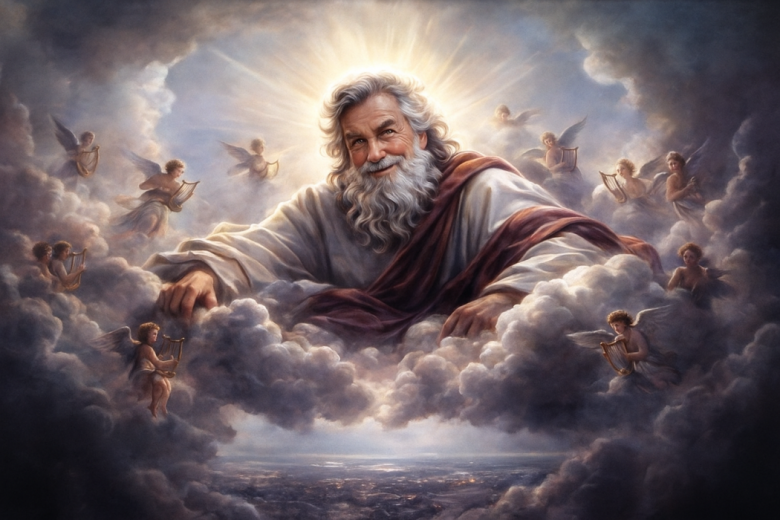
The literal reading envisions God as a being located in heaven, issuing commands and judgements. Increasingly, this seems untenable. (George Carlin mocked the absurdity of imagining a cosmic deity perched on a cloud.)
But a metaphorical reading transforms the Bible into a profound psychological text:
Israel becomes the inner struggle.
Jerusalem becomes the centre of consciousness.
The temple becomes inner order.
Exile becomes alienation.
God becomes the inner moral compass.
Psalm 1 illustrates this beautifully:
Blessed is the one who does not walk in the counsel of the wicked…
Read literally, it speaks of obedience, sin, righteousness, and judgement. Read inwardly, it describes alignment with one’s inner life—the “law of the Lord” as the voice of integrity, the tree by streams of water as the stable, centred self.
This interpretation echoes Jesus’ teaching: “The kingdom of heaven is within.”
Ultimately, the Bible’s value today is not in unprovable metaphysics but in its deep symbolic insight into human experience. It survives because it mirrors the inner landscape: struggle, failure, longing, fear, hope, and renewal.
The Bible, in this sense, is not a relic but a resource—a psychological map for those seeking meaning in a secular age.
In a fractured age, the Bible endures not as dogma but as witness — a record of humanity wrestling with its own depths. Its images, when read symbolically, illuminate the inner life that modernity so often obscures. The foolishness of denying God, in the psalmist’s sense, is not metaphysical scepticism but the refusal to see the moral dimension of our own existence. The Bible survives because it shows us ourselves — and invites us to become more than we are.