An in-depth exploration of how Jesus’ original teaching of inner transformation was turned into the theology of Christ, and how understanding the difference can renew both faith and reason today.
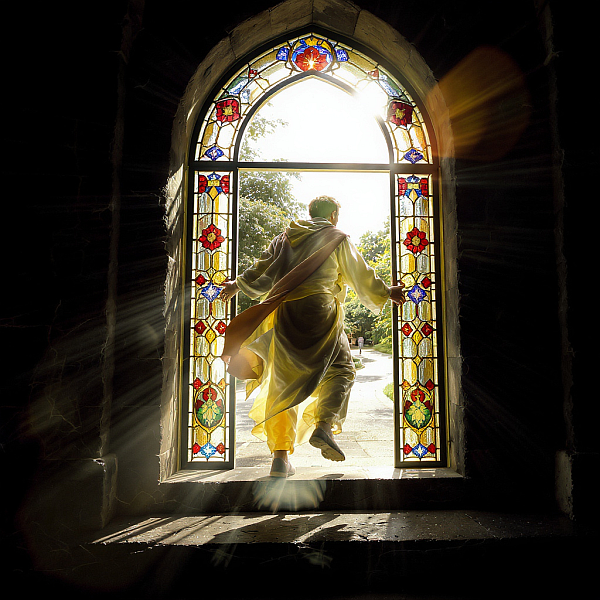
1. The Story That Formed the West
For nearly two thousand years, Western civilisation has lived within a single, shaping story: the Christian myth of the world’s fall and redemption.
This story taught that life has purpose, that moral law is divine, and that history itself is a journey toward ultimate justice. It placed at the centre of existence a personal God, a cosmic redeemer called the Christ, and an eternal life beyond the grave.
From it flowed the rhythm of our calendar, the architecture of our cities, the imagery of our art, and much of our sense of right and wrong. Even those who no longer believe in it still live in its shadow.
Yet beneath this grand structure lies a question rarely asked: was the original message the same as the later story?
2. Jesus and the Birth of a Movement
Jesus of Nazareth was a Jewish moral teacher who lived under Roman occupation in the first century. His sayings, preserved in the Synoptic Gospels, were not theological speculations but short, urgent calls to live differently.
He spoke of the kingdom of God — not a paradise in the sky, but a just and merciful order that begins in the human heart. His teaching was practical and psychological: forgive, release resentment, care for the poor, and love your neighbour.
Such teaching challenged both the religious establishment of his day and the political power of Rome. When he was executed by crucifixion — a punishment for rebels — it was an act of imperial suppression, not divine sacrifice. His death was political, not metaphysical.
3. The Making of “the Christ”
In the generations that followed, Jesus’ followers tried to make sense of his death and the hope they still felt. Out of this need arose the figure of the Christ: a divine being whose suffering and resurrection redeemed the world.
The Gospel of John, the letters of Paul, and later Church theology transformed the teacher into a cosmic saviour. The execution of a man became the fulfilment of a divine plan.
What had begun as a movement of ethical renewal among the poor evolved into a theology of sin, sacrifice, and salvation. The title Christ (from the Greek Christos, “the anointed one”) ceased to be a symbol of inner awakening and became a name of worship.
A political protest was thus recast as divine necessity. The crucifixion — originally the empire’s warning to dissenters — was reinterpreted as a God-ordained payment for human sin.
4. From Awakening to Authority
When Christianity spread through the Roman world, it absorbed much of Rome’s structure and psychology. After Emperor Constantine’s conversion in the fourth century, it became a state religion.
Bishops took on civic power; creeds defined who was orthodox and who was heretical. The empire gained a theology that sanctified obedience, and the Church gained protection and wealth.
The moral language of humility and patience, once revolutionary, began to serve the social order. “Render unto Caesar” and “turn the other cheek” could now be used to keep the poor quiet. The kingdom within was replaced by hierarchy without.
Through the Middle Ages this alliance of altar and throne produced both splendour and cruelty: soaring cathedrals, profound art, and compassionate charity on one side — crusades, inquisitions, and colonial conquest on the other.
The dream of divine order worked — but it worked by persuading the many to accept their lot as part of God’s plan.
5. The Knowledge We Now Possess
Modern scholarship has revealed how Christianity evolved. Historical study shows that most doctrines took shape centuries after Jesus’ death.
- The divinity of Christ was defined at the Council of Nicaea (AD 325).
- The Trinity — Father, Son, and Holy Spirit — was a later attempt to reconcile monotheism with that divinity.
- The atonement theory, that Christ’s death paid for human sin, emerged chiefly from the writings of Anselm (11th century).
- The vivid imagery of heaven and hell drew on Greek and Persian sources more than on Jesus’ words.
These were human attempts to explain mystery, not revelations handed down intact. They offered comfort and moral order, but they also hardened into systems of control. The faith of conscience became a faith of conformity.
6. The Dream and Its Awakening
To awaken from this dream is not to sneer at it. The Christian story inspired charity, art, and enduring moral ideals. It gave Europe a conscience and a vocabulary for mercy. But it also concealed the simple message that lay at its origin: the call to inner transformation.
Faith, in its earliest form, was not about believing improbable things. It was about trusting life and living truthfully. Jesus’ parables — the Good Samaritan, the Prodigal Son, the Mustard Seed — were not theology but invitations to awareness.
The later Church, by claiming exclusive authority to interpret these stories, replaced insight with obedience. It told people what to think, rather than showing them how to see.
7. The Lost Current Within Religion
Yet within Christianity itself, the current of direct experience never died.
Mystics such as Meister Eckhart, Julian of Norwich, and John of the Cross spoke of union with God as an inner reality, not a distant reward. George Fox, founder of the Quakers, rejected clergy and sacraments in favour of the “inner light.” William Blake saw the true Christ as the divine imagination in every human being.
Even in the twentieth century, thinkers like Teilhard de Chardin and Bonhoeffer sought to reinterpret faith in the language of consciousness and moral action rather than metaphysical belief.
Parallel insights appear elsewhere: in Buddha’s mindfulness, Laozi’s Tao, Rumi’s longing, and the Sikh insistence on equality and truth. In every tradition, the pattern repeats — awakening becomes institution, and prophets arise to renew it from within.
8. Which Gospel?
It is important here to distinguish between the teaching of Jesus and the gospel later preached about him.
Jesus spoke directly to the conscience. His “good news” was that the kingdom of God begins within us—that justice, mercy, and love are already possible in this world if hearts are changed. He called for awareness and compassion, not belief in a metaphysical scheme.
The later Church, inheriting his story through grief and interpretation, proclaimed a different gospel: that Christ, the Son of God, had died for the sins of the world and risen to redeem it. This message offered comfort and cosmic meaning, but it also shifted the emphasis—from transformation of life to acceptance of doctrine, from awakening to obedience.
To recover Jesus’ own teaching is not to deny the faith that followed, but to see it clearly. The Christ of theology and the Jesus of history are not enemies; one grew from the other. Yet the rediscovery of the teacher behind the redeemer may still be the truest form of preaching the gospel.
9. What Comes After the Dream
If we no longer expect a saviour to intervene in history, responsibility returns to us. This does not diminish the sacred; it restores it to its rightful place — within the human heart.
We are not children waiting for cosmic permission. We are moral agents, capable of creating meaning through compassion, justice, and awareness.
To reinterpret religion in this light is not to destroy it, but to redeem it. The language of myth can still speak, if we learn to hear it as metaphor:
- Resurrection as awakening;
- Kingdom of God as moral awareness;
- Salvation as freedom from fear and ignorance.
When read this way, the gospel of Jesus — not the theology of Christ — becomes an enduring guide for a humane and conscious life.
🜂 Aside — The Two Gospels
The Gospel of Jesus The Gospel of Christ “The kingdom of God is within you.” — Luke 17:21 “Christ died for our sins.” — 1 Corinthians 15:3 Moral awakening, inner transformation Redemption through divine sacrifice Universal compassion and justice Faith in a single historical act Self-knowledge as the way to God Belief as the condition of salvation A call to live awake A promise to be saved