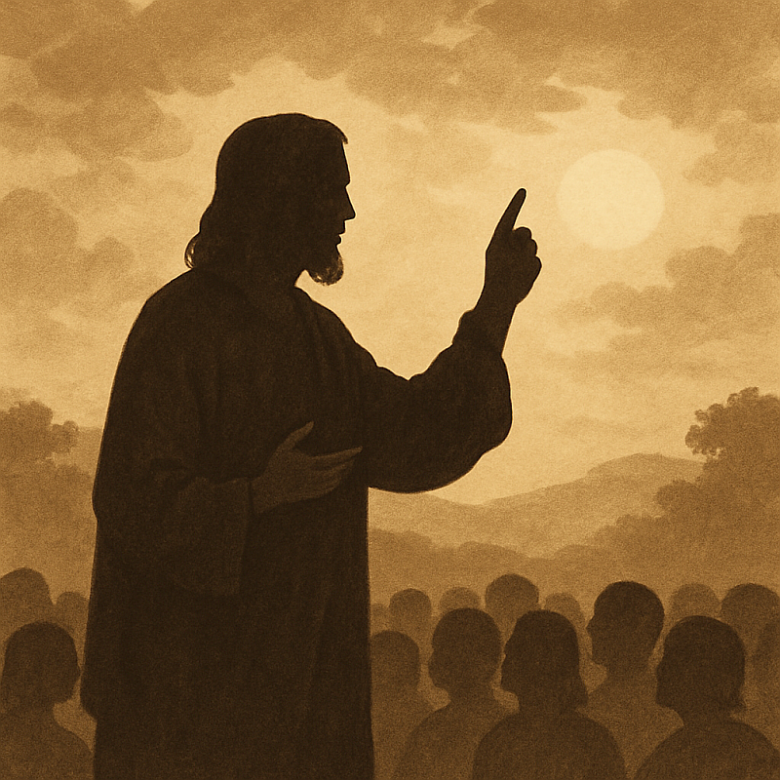
It is striking how modern Jesus sounds. When one reads the four Gospels without the later scaffolding of creeds and metaphysics, Jesus does not appear first as a cosmic redeemer or a heavenly abstraction, but as a penetrating moral critic whose insight into human society feels astonishingly contemporary. He speaks with a clarity that cuts across centuries. His concerns are our concerns. His world, for all its antiquity, feels uncomfortably like our own.
This raises a deeper question: does Jesus seem modern because he anticipated modern social ethics, or because the same social problems afflict every human society in every age? The answer, in truth, is the latter. The surface shifts; the underlying human condition remains constant. And it is to that condition that Jesus speaks.
1. The Social World of Jesus Looks Startlingly Familiar
The first-century Mediterranean world was marked by stark inequality, insecure labour, heavy taxation, corrupt officials, homelessness, unpayable debts, populist resentment, and the crushing presence of imperial power. Religious institutions often protected their own status while the majority struggled to survive. Remove the ancient clothing and the Roman insignia, and the basic social architecture remains recognisable.
It is in this environment that Jesus speaks with disarming modernity. His teachings on wealth (Matthew 6:19–21), anxiety (Matthew 6:25–34), justice, compassion (Matthew 25:31–46), fear, status (Mark 9:33–35), and power (Mark 10:42–45) resonate because the structural forces that distort human life have not vanished. They simply reappear under new names.
2. Jesus Focuses on the Inner Patterns Behind Social Injustice
Jesus’ response to the problems of his world is not primarily legal, economic, or institutional. It is psychological and moral. He identifies the perennial forces that warp human community:
- fear of scarcity (Matthew 6:25–27)
- obsession with status (Mark 9:35)
- the corrupting power of wealth (Mark 10:23–25)
- hostility towards outsiders (Luke 10:29–37)
- the desire to dominate (Mark 10:42–45)
- treating people as means rather than ends (Luke 14:12–14)
This focus on the inner life makes Jesus sound profoundly modern. He addresses the motives, anxieties, and moral distortions that reappear in all societies. His diagnosis matches what modern psychology and sociology recognise as universal human tendencies. In speaking to the heart, he speaks to the root.
3. Jesus as a Moral and Social Radical
Although Jesus is not a political theorist and proposes no administrative system, his teaching has unmistakably political consequences. He proclaims good news to the poor (Luke 4:18–19), warns the wealthy (Luke 6:24), reverses hierarchy (Mark 10:42–45), and envisions a community in which generosity replaces accumulation, service replaces domination, and compassion replaces competition.
His critique touches:
- the unequal distribution of wealth (Luke 6:20, 24)
- exploitation of the vulnerable (Matthew 23:14, 23)
- self-interest of elites (Mark 12:38–40)
- idolising of success (Luke 12:16–21)
- cruelty of rigid purity and status systems (Mark 2:15–17; Mark 7:1–15)
He stands outside every power structure: rejecting religious legalism (Matthew 23), state violence (Mark 15:1–15), crowd manipulation (Mark 15:11–14), and even his own family’s attempts to restrain him (Mark 3:20–21, 31–35).
This independence feels uncannily modern. And read this way, Jesus emerges not as a metaphysical figure but as a compassionate social philosopher in the ancient sense.
4. Jesus’ Kingdom Ethic and Democratic Socialism: The Fairest Comparison
If one wishes to compare Jesus with any modern outlook, the fairest comparison is not with a specific politician but with the moral foundations of democratic socialism.
Priority of the Poor
Jesus blesses the poor (Luke 6:20) and identifies with the least (Matthew 25:40).
Suspicion of Wealth
Wealth endangers compassion and moral clarity (Mark 10:23–25; Luke 6:24).
Shared Responsibility
The disciples share a common purse (John 12:6), travel without private provision (Mark 6:8–9), and lend without expecting return (Luke 6:34–35).
Universal Care
Jesus heals freely and universally (Matthew 4:23; Luke 4:40) and commands: “Freely you have received; freely give” (Matthew 10:8).
Critique of Domination
“The greatest must be the servant” (Mark 10:42–45).
These overlaps exist because Jesus addressed the same injustices democratic socialism attempts to mitigate.
5. Why Jesus Feels Modern
Jesus feels modern because he speaks to enduring human patterns:
- fear (Matthew 10:28–31)
- greed (Luke 12:15)
- anxiety (Matthew 6:25–27)
- status competition (Mark 9:34)
- exclusion (Luke 10:30–37)
- political hypocrisy (Mark 12:13–17)
- suffering (Luke 7:11–15)
- longing for justice (Matthew 5:6)
- hunger for meaning (John 6:35)
Technology changes; the human condition does not.
6. Stripping Away the Metaphysics
It is essential to strip Jesus of later metaphysical qualifications if we are to see him as the compassionate social philosopher he really was. The creeds and doctrines — divine essence, eternal generation, metaphysical sonship — obscure rather than illuminate the man in the Gospels.
The historical Jesus:
- confronts wealth (Mark 10:21–25),
- overturns status (Mark 9:35),
- heals freely (Matthew 4:23; Luke 4:40),
- welcomes outsiders (Luke 7:36–50; Luke 10:29–37),
- stands with the poor (Luke 6:20).
Removing later metaphysics restores Jesus the man: independent, fearless, compassionate — a voice of urgent moral clarity.
7. How Later Metaphysics Transformed Jesus
The earliest followers of Jesus described him using Jewish moral and vocational titles. These titles expressed function, not metaphysics:
- Messiah (Mark 8:29): the anointed leader who would restore justice.
- Son of God (Mark 1:11): a Hebrew idiom meaning God’s chosen representative, a “chip off the old block,” one who reflects God’s character.
- Lord (an honour title, not yet divine).
Nothing in these early titles implies that Jesus was a pre-existent divine being or a metaphysical entity. They indicate role, intimacy, calling, and authority — not essence.
The Shift Begins: John’s Gospel (c. 90–100 CE)
By the end of the first century, Christian reflection undergoes a decisive transformation.
In the Gospel of John, Jesus is no longer simply God’s chosen agent. He becomes:
- the pre-existent Logos (John 1:1–3),
- the divine Word made flesh (John 1:14),
- one who speaks of descending from heaven (John 6:38),
- one who shares the glory of God “before the world existed” (John 17:5).
This is a fundamental change of category.
The Jesus of the Synoptics is a man through whom God acts.
The Jesus of John is a heavenly being who becomes human.
Second-Century Developments: From Honour to Ontology
Early Christian thinkers then attempt to explain Jesus using the conceptual tools available — namely Greek philosophy.
This leads to new categories:
- Logos-theology (Justin Martyr): Jesus as a rational divine principle.
- Subordinationist metaphysics: Jesus as divine, but secondary to the Father.
- Emerging Trinitarian language: attempts to reconcile monotheism with the growing sense of Jesus’ divinity.
These developments are sincere, but they move far beyond the ethical prophet of Galilee.
The Crisis: How Divine Is Jesus?
By the third century, Christians were divided:
- Some viewed Jesus as a super-angelic being,
- Some as a divine intermediary,
- Some as fully God,
- Some as a man adopted by God.
This confusion is not evidence of early consensus, but the opposite:
the metaphysical question was not settled in the earliest period because it was not originally asked.
Nicaea (325 CE): The Metaphysical Jesus Is Defined
The Council of Nicaea finally imposes philosophical clarity:
- Jesus is homoousios (“of one substance” with the Father).
- Jesus is co-eternal, uncreated, fully divine.
- Jesus is not merely God’s agent, but God himself in metaphysical essence.
This is the birth of the dogmatic Christ, the Jesus of creeds and metaphysical theology.
The Key Point
None of this — Logos metaphysics, eternal sonship, divine essence — comes from Jesus’ own teaching.
None of it comes from the earliest Gospel tradition.
None of it forms part of the ethical, social, or moral message that gives Jesus his enduring relevance.
These layers are historical accretions:
- attempts to explain Jesus in Greek categories,
- attempts to unify doctrine across the empire,
- attempts to give Christianity philosophical respectability.
They may have value, but they belong to a different intellectual world from the Jesus who confronted injustice, healed the sick, welcomed the outcast, and overturned hierarchy.
Once these metaphysical layers are recognised as later additions, the figure of Jesus emerges with remarkable clarity:
- a Jewish prophet,
- a moral radical,
- a healer,
- a compassionate social philosopher,
- a man of profound independence and integrity,
- one who speaks to the human condition, not to cosmology.
The metaphysical Christ is a later theological construction. For centuries we have searched for truth not simply under the lamplight of theology, but under its gaslight — accepting a metaphysical portrait that obscures, and sometimes even reverses, the historical reality of Jesus, the moral radical of the Synoptics.
If we strip away the metaphysical haze, Jesus stands not as a supernatural problem-solver but as an example — a demanding, unsettling, deeply human example. His message is not a sop for the passive or a crutch for those unwilling to take responsibility. It is an invitation to moral courage: to confront injustice, to lift the fallen, to heal what we can heal, and to live with integrity. The historical Jesus challenges us not to wait for rescue but to become agents of compassion and justice ourselves.
If only people followed Jesus.
Not worshipped him.
Not speculated about him.
Not built empires in his name.
Not weaponised his teachings.
Not turned him into a metaphysical abstraction.
Not outsourced moral responsibility to him.
But followed him — in the plain, blunt sense the Synoptics insist upon:
- Do unto others as you would have them do unto you.
- Sell what you have and give to the poor.
- Blessed are the peacemakers.
- Forgive seventy times seven.
- Love your enemies.
- Do not store up treasures on earth.
- The last shall be first.
- Whatever you did for the least of these, you did for me.
Conclusion
Jesus appears modern not because he anticipated modern politics but because he exposes the permanent structure of human life: fear, greed, inequality, and the hunger for justice.
He is not a socialist in policy terms. Yet the Kingdom ethic — priority of the poor (Luke 6:20), suspicion of wealth (Mark 10:23–25), shared responsibility (John 12:6), universal care (Matthew 10:8), and reversed hierarchy (Mark 10:42–45) — resonates more strongly with democratic socialist ethics than with competitive individualism.
Above all, Jesus feels modern because he is free — free of convention, domination, and ideological capture. This independence is what the Gospels mean by “Son of God”: not divine chemistry, but moral likeness. In their idiom, Jesus is a chip off the old block, mirroring God’s compassion, justice, courage, and truthfulness.
It is this likeness — not later doctrine — that makes him eternally contemporary.